CBD vs. THC: What's the Difference and Which Is Right for You?
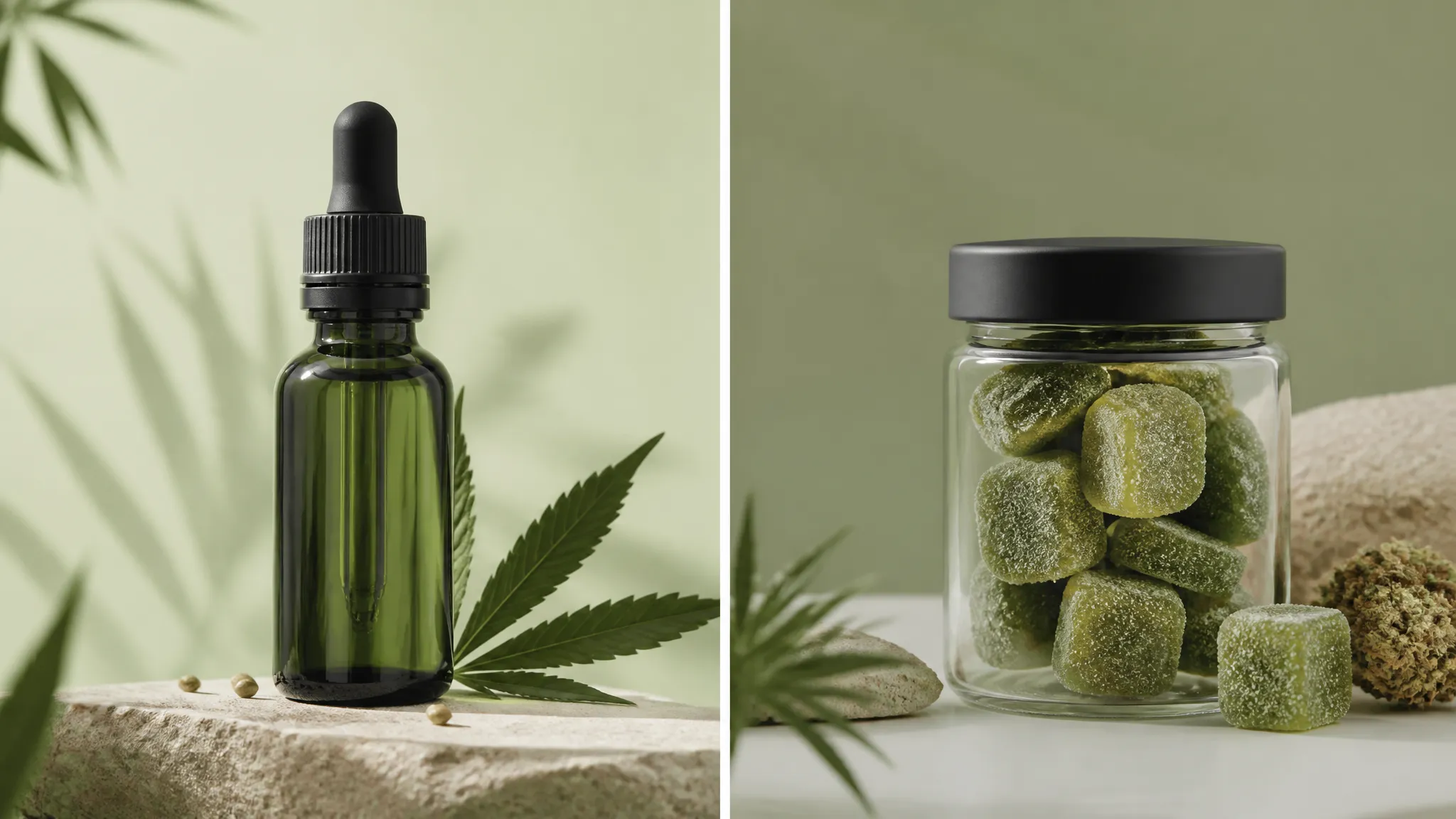
Picture this: you're standing in front of a wall of cannabis products, and two bottles could not look more similar. Both promise calm, both say "hemp-derived," both have those cheerful green labels. But one is a CBD tincture that most people describe as "a quiet, sober kind of relaxation," and the other is a delta-9 gummy that can leave you staring at your ceiling for three hours wondering if your couch is judging you.
The difference between these two compounds is the single most important thing to understand before you buy anything with a cannabis plant on the label. And in 2026, with more legal options than ever, the confusion is only growing. CBD and THC come from the same plant family, share nearly identical chemical skeletons, and yet they behave in completely opposite ways in your body. One is non-intoxicating and federally legal in low-THC forms. The other is the compound responsible for the "high" — and everything that comes with it.
This guide breaks down exactly what separates CBD from THC, what the latest 2024–2026 research actually says, and — most importantly — how to decide which one fits your goals without the marketing noise.
What Is CBD?
Cannabidiol, or CBD, is one of more than 100 cannabinoids found in cannabis plants. It is the second most abundant cannabinoid after THC, and in hemp varieties it often dominates the profile entirely. Crucially, CBD is non-intoxicating. It does not produce the euphoric "high" that THC is famous for.
In recent years CBD has moved from niche supplement to mainstream wellness staple. A broad-spectrum CBD product study published in Experimental and Clinical Psychopharmacology in 2025 noted that "a growing number of hemp-derived CBD products are available" as consumer interest has surged.
Because CBD does not bind strongly to the CB1 receptors in the brain that produce intoxication, its effects are generally described as subtle — a sense of calm, reduced tension, and better sleep for many users.
What Is THC?
Delta-9-tetrahydrocannabinol, or THC, is the primary psychoactive cannabinoid in cannabis. It's the molecule responsible for the euphoria, altered perception, and relaxation — or anxiety, depending on your dose and tolerance — that people associate with marijuana.
THC binds directly and strongly to CB1 receptors in the central nervous system, which is why its effects are so pronounced and why it's the compound targeted by most workplace drug tests. In the medical context, THC is also studied for pain, appetite stimulation, and spasticity — often in combination with CBD.
The Chemical Difference
Here's the part that surprises most people: CBD and THC have the exact same molecular formula — 21 carbon atoms, 30 hydrogen atoms, and 2 oxygen atoms. They are isomers, meaning their atoms are arranged slightly differently, like two words spelled with the same letters in a different order.
That small structural twist changes everything. THC's shape lets it dock neatly into CB1 receptors in the brain. CBD's shape does not, and in fact CBD can interfere with how THC interacts with those receptors. This is why one intoxicates and the other doesn't, despite sharing the same building blocks.
Psychoactivity, Explained
The difference comes down to receptor binding. THC is a partial agonist at CB1 receptors, which are densely packed in brain regions governing mood, memory, appetite, and coordination. The memory effects of THC versus CBD are explored in depth in our CBD and memory/cognition guide. When THC activates these receptors, you feel it — that's the high.
CBD, by contrast, has very low affinity for CB1. It works through a broader network of pathways, including serotonin and other receptor systems, which is one reason researchers are studying it for anxiety and inflammation rather than intoxication.
A 2026 systematic review in Frontiers in Neuroimaging examined CBD's effects on the brain in stress and anxiety, but the authors concluded there was "a lack of consistent evidence showing the acute effects of CBD on the brain," and rated the certainty of evidence as "low to very low." Translation: CBD is clearly non-intoxicating, but exactly how it calms the brain is still being mapped.
Medical and Therapeutic Uses
This is where the two compounds genuinely diverge in clinical research.
CBD is the focus of most of the modern wellness literature. A randomized, placebo-controlled crossover trial in Autism Research (2026) found that while CBD oil combined with terpenes did not improve the primary measure of social responsiveness in autistic children, it did produce significant improvements in anxiety and reduced parental stress. The same trial noted the treatment was generally well tolerated.
For pain, a 2026 randomized crossover study in the Journal of Cataract and Refractive Surgery compared low-THC oral CBD with codeine-acetaminophen for postoperative pain after photorefractive keratectomy. The authors reported that CBD provided non-inferior pain control to the opioid combination, with similar recovery and minimal side effects, calling it a "viable opioid-sparing alternative."
THC, for its part, has its own evidence base, especially in combination with CBD. A 2026 placebo-controlled trial in Therapeutic Advances in Neurological Disorders found that a 1:1 THC:CBD oil improved self-reported spasticity in patients with chronic spinal cord injury.
THC Intoxication: What the High Actually Is
When people talk about "getting high," they're describing THC intoxication. At low doses it can feel relaxing and euphoric. At higher doses — or in someone with low tolerance — it can tip into anxiety, paranoia, impaired short-term memory, and slowed reaction time.
That's not speculation. It's a measured, reproducible effect. In a randomized, double-blind, placebo-controlled crossover experiment published in Addiction (2023), researchers gave participants vaporized cannabis with THC alone, THC plus CBD, or placebo. Both THC conditions significantly increased "feel drug effect," impaired verbal episodic memory, and increased psychotomimetic (hallucination-like) effects compared with placebo.
The practical takeaway: if you need to stay sharp, sober, and unimpaired — driving, working, parenting — THC intoxication is precisely what you're trying to avoid.
Does CBD Moderate THC's Effects?
This is one of the most common myths, so let's address it with data. Many people believe that adding CBD to THC "takes the edge off" the high. The research does not clearly support that.
In that same 2023 Addiction experiment, the researchers specifically tested whether CBD modulated the acute effects of THC. The result was unambiguous: "there was no evidence that CBD significantly modulated the acute effects of THC." The CBD did not reduce the subjective high, the memory impairment, or the psychotomimetic effects caused by the THC.
So if you're choosing between a high-THC product and one that's "balanced" with CBD, don't assume the CBD is a safety net. The CBD is valuable for other reasons, but blunting a strong high is not reliably one of them.
The Entourage Effect: Fact or Hype?
The entourage effect is the theory that the whole plant works better than isolated compounds — we break down full-spectrum vs. broad-spectrum vs. isolate in depth elsewhere — that CBD, THC, terpenes, and flavonoids together produce benefits that no single molecule can replicate.
It's a popular idea, but the evidence is thin. A 2026 opinion and analysis piece in the Internal Medicine Journal put it bluntly, writing that "there is no clinical or in vitro evidence supporting this hypothesis" and that "the entourage effect remains speculative."
That doesn't mean whole-plant products are worthless. Preclinical work is more encouraging — a 2025 study in Cannabis and Cannabinoid Research found that a full-spectrum CBD product, but not a CBD isolate, reversed depressive-like behavior in a rat model of inflammation. That's animal data, so it should be read cautiously, but it hints that minor cannabinoids and terpenes may contribute something real — see our guide to CBG, CBN, and THCV.
Full-Spectrum vs. Isolate: What's on the Label
Here's where the practical buying decision starts. Cannabis extracts fall into a few categories:
- Full-spectrum: Contains CBD plus other cannabinoids, terpenes, and flavonoids — including trace amounts of THC (up to 0.3% in federally compliant hemp).
- Broad-spectrum: Contains multiple cannabinoids and terpenes but with THC removed.
- Isolate: Pure CBD, nothing else.
Full-spectrum products are what the entourage-effect theory favors, and the rat study above suggests they may offer more than isolate. But if you're concerned about drug testing, trace THC matters, which brings us to a critical question.
Legality in the U.S.: The 0.3% Rule
In the United States, the legal line is drawn at THC content. Under the federal Farm Bill, hemp is defined as cannabis containing no more than 0.3% delta-9-THC by dry weight. Anything above that is legally marijuana under federal law, even if your state has legalized it.
This is why you'll see products marketed as "delta-9" gummies and tinctures that are nevertheless sold in mainstream retail — they're made from hemp and stay under the 0.3% threshold at the plant level. Products like our delta-9 THC collection exist within that federally compliant space. CBD oils and tinctures, meanwhile, are widely available and don't carry the same psychoactive baggage.
State laws vary, so always check your local rules. But the 0.3% delta-9 line is the single most important legal concept in U.S. cannabis today.
Drug Testing: The Real Risk
If you undergo workplace drug testing, this section matters more than any other. Standard urine drug screens look for THC metabolites — specifically 11-nor-9-carboxy-THC — not CBD.
The good news for CBD users comes from a 2025 study in Experimental and Clinical Psychopharmacology. Researchers had twenty healthy adults consume a hemp-derived broad-spectrum CBD product every day for two weeks. They tested urine via liquid chromatography-tandem mass spectrometry and reported that "neither tetrahydrocannabinol nor its metabolites were detectable in urine following the 2-week period of use."
The catch: that study used a broad-spectrum product with THC below 100 ppm. Full-spectrum products carry trace THC, and while a single dose is unlikely to trip a test, heavy daily use of a full-spectrum oil has caused positive results in real-world reports. If a clean drug screen is non-negotiable, choose broad-spectrum or isolate — our full drug testing guide covers the edge cases.
How to Choose: A Decision Framework
Still torn? Here's a simple way to think about it.
Choose CBD if:
- You want relaxation without impairment
- You need to stay clear-headed for work, school, or driving
- You're concerned about drug testing
- You're looking for everyday wellness support for stress or sleep
Choose a low-THC or balanced product if:
- You've discussed it with a clinician and it's appropriate
- You're seeking the specific symptom relief that THC-dominant products target
- You understand and accept the psychoactive effects
Which Is Right for You?
The honest answer is that CBD is the lower-risk, lower-intoxication choice for most everyday users, and THC is a more powerful tool with more pronounced effects — and more pronounced side effects. The 2023 Addiction trial showed cannabis affects adolescents and adults similarly, so neither age group should assume special resilience.
If you're new to all of this, starting with a straightforward CBD oil lets you experience the compound's calming effects without the variables that THC introduces. Our CBD oils and tinctures are a clean entry point. If you've already used CBD and want to explore the broader spectrum, a low-dose delta-9 product may be worth a careful, slow trial.
Your Action Plan
1. Write down your primary goal — stress relief, sleep, pain, or recreation.
2. If it's everyday calm without impairment, start with CBD, 10–20mg once daily.
3. Track your response for two to three weeks before changing anything.
4. If you choose a product with THC, start with the lowest dose and avoid driving or operating machinery until you know how it affects you.
5. If drug testing is a concern, stick with broad-spectrum or isolate.
The Bottom Line
New to this? Start with our plain-English CBD vs THC for beginners first. For the full detail: CBD and THC are chemical cousins with opposite effects in the body. CBD is non-intoxicating, legally available in low-THC hemp forms, and the subject of growing (if still mixed) research into anxiety, sleep, and pain. THC is the psychoactive compound — powerful, intoxicating, and studied for conditions like spasticity and pain, usually in combination with CBD. The 0.3% delta-9 line defines legal hemp in the U.S., and standard drug tests target THC, not CBD. Understand the difference, know your goals, and choose deliberately.
Related Reading
Find Your Perfect CBD Product
Take our 2-minute quiz to get personalized recommendations based on your needs.
Take the Quiz →Disclaimer: This article is for informational purposes only and does not constitute medical advice. CBD products are not FDA-approved to treat, cure, or prevent any disease. Always consult with a qualified healthcare professional before starting any new supplement, especially if you have a medical condition or take medications.