CBD vs THC for Beginners: The Simple Difference, Explained
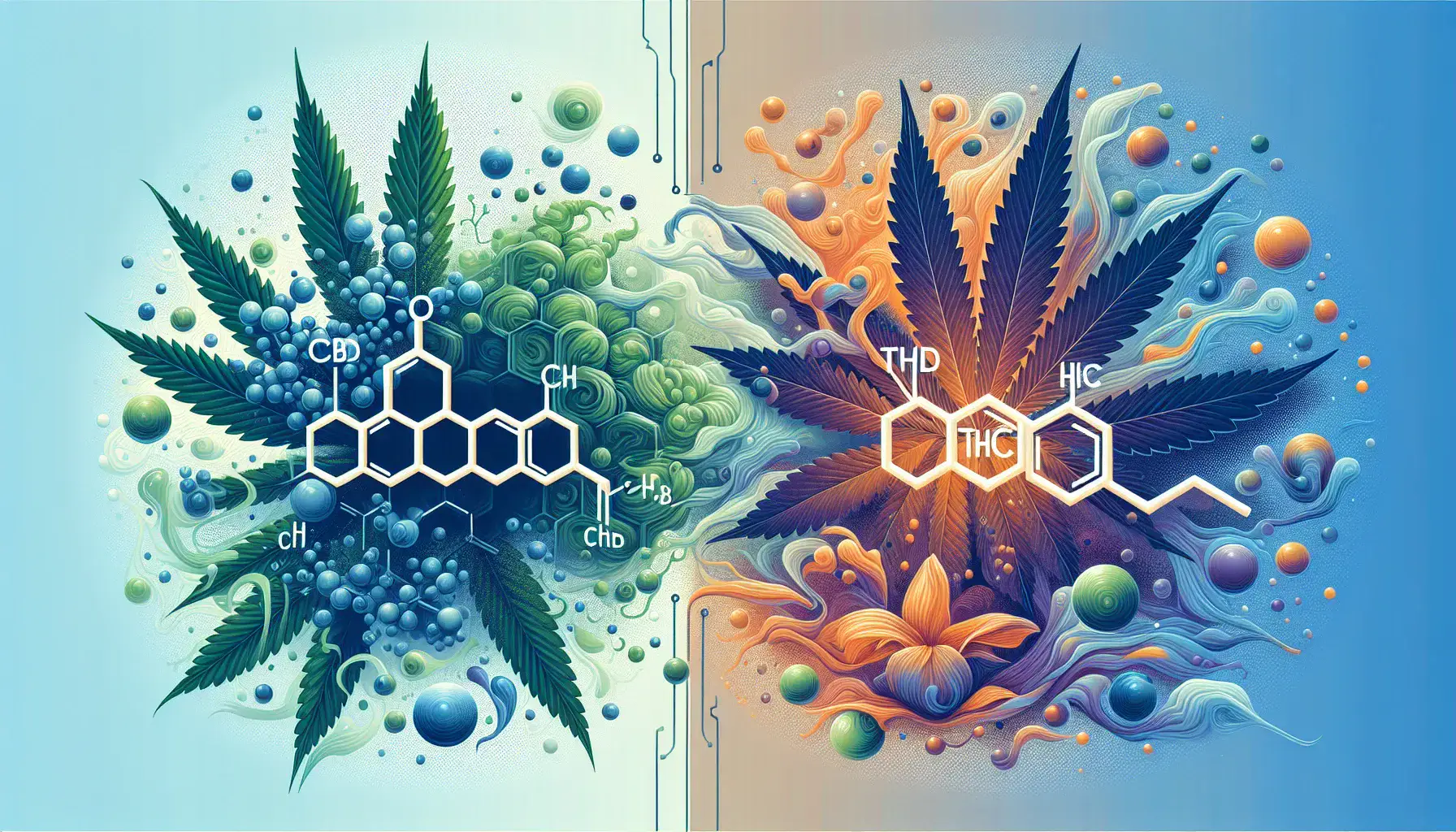
Standing in the supplement aisle, you've probably seen them side by side—CBD gummies next to THC edibles, both promising relief, relaxation, or something in between. The labels look similar. The prices overlap. But these two compounds? They interact with your body in fundamentally different ways.
Before you make a choice that could affect your sleep, your pain levels, or your workday, let's get clear on what actually separates CBD from THC—beyond the marketing hype.
The Same Plant, Different Effects
Both CBD (cannabidiol) and THC (tetrahydrocannabinol) come from the cannabis plant. They're the two most abundant cannabinoids found in cannabis, and they share an identical molecular formula: C₂₁H₃₀O₂. That's where the similarities end.
The critical difference lies in how each compound interacts with your body's endocannabinoid system—a complex network of receptors that regulate everything from mood and memory to pain perception and appetite.
How THC Works in Your Body
THC binds directly and strongly to CB1 receptors, which are concentrated in your brain and central nervous system. This binding triggers the signature effects most people associate with cannabis: euphoria, altered perception, increased appetite, and sometimes anxiety or paranoia.
Dr. Nora Volkow, Director of the National Institute on Drug Abuse (NIDA), explains that THC activates the brain's reward system, releasing dopamine at levels two to three times higher than natural rewards. This mechanism underlies both its therapeutic potential and its risk of dependence.
How CBD Works Differently
CBD takes a different approach. Rather than binding strongly to either CB1 or CB2 receptors, it modulates the endocannabinoid system indirectly. Think of it as a dimmer switch rather than an on-off toggle.
According to research published by the National Institutes of Health, CBD enhances your body's natural endocannabinoids while also interacting with serotonin receptors, vanilloid receptors involved in pain sensation, and other receptor systems. This broader, gentler mechanism explains why CBD doesn't produce intoxication—and why its therapeutic applications differ so significantly from THC.
The Legal Landscape: A Patchwork of Rules
The 2018 Farm Bill fundamentally changed how the federal government views cannabis. Under this legislation, hemp—defined as cannabis containing no more than 0.3% THC by dry weight—was removed from the Controlled Substances Act.
The FDA notes that while hemp-derived CBD is federally legal, the FDA has not approved CBD products for use in food or as dietary supplements. The agency has approved one CBD-based prescription drug, Epidiolex, for treating certain seizure disorders.
THC remains federally illegal under Schedule I of the Controlled Substances Act, though 38 states have legalized medical cannabis and 24 have approved adult recreational use. This creates a complex legal environment where your CBD gummy might be perfectly legal at home but problematic in a neighboring state.
THC: Benefits, Risks, and Considerations
Therapeutic Applications
The FDA has approved synthetic THC (dronabinol, sold as Marinol and Syndros) and a THC analog (nabilone, sold as Cesamet) for treating nausea and vomiting associated with chemotherapy and for appetite stimulation in AIDS patients.
Beyond these approved uses, research from Johns Hopkins Medicine suggests THC may help with:
- Chronic pain management — Multiple studies indicate effectiveness comparable to some traditional pain medications
- Muscle [CBD and multiple sclerosis](/blog/blog-cbd-multiple-sclerosis-2026-08-15) — Particularly in conditions like multiple sclerosis
- Nausea and appetite loss — Especially for patients undergoing chemotherapy
- Sleep disorders — Some users report improved sleep quality
The Risks Side of the Equation
THC isn't without drawbacks. According to CDC research, potential risks include:
- Impaired driving — THC affects reaction time, coordination, and judgment. Driving under its influence is both dangerous and illegal in all states.
- Cognitive effects — Regular, heavy use—particularly when begun in adolescence—may affect memory and learning.
- Mental health — THC can trigger anxiety, paranoia, and in predisposed individuals, may exacerbate or trigger psychotic episodes.
- Dependence — While less addictive than many substances, about 9% of users develop cannabis use disorder, rising to 17% for those who start in adolescence.
CBD: Benefits, Risks, and Considerations
What the Science Supports
The FDA's approval of Epidiolex for treating seizures associated with Lennox-Gastaut syndrome and Dravet syndrome represents the strongest clinical evidence for CBD's therapeutic potential. In clinical trials, Epidiolex significantly reduced seizure frequency compared to placebo.
Beyond epilepsy, a 2023 study in *The Permanente Journal found that CBD showed promise for:
- Anxiety — Moderate evidence suggests CBD may reduce anxiety symptoms without the intoxicating effects of THC
- Sleep disorders — Some studies report improved sleep quality, though mechanisms aren't fully understood
- Chronic pain — Evidence is mixed, but some patients report meaningful relief
- Inflammation — Preclinical research shows anti-inflammatory properties
The Safety Profile
The World Health Organization has stated that CBD exhibits no effects indicative of abuse or dependence potential in its pure form. Side effects, when they occur, tend to be mild—fatigue, changes in appetite, or digestive issues.
However, CBD isn't without concerns. A 2020 study published in JAMA found that some CBD products contain inconsistent amounts of the compound, and some contained detectable THC despite labeling claims. Additionally, CBD can interact with certain medications, particularly blood thinners, by affecting how your liver metabolizes drugs.
CBD vs THC at a Glance
Understanding the differences becomes clearer when we put them side by side:
_This chart highlights the key practical differences between CBD and THC for consumers making decisions._
Which One Should You Choose?
The answer depends entirely on what you're trying to address—and your personal circumstances.
Consider CBD If:
- You need to stay sharp for work or daily responsibilities — CBD won't impair your cognitive function
- You have a job that drug tests — Quality CBD from reputable sources shouldn't trigger positive results
- Anxiety is your primary concern — Research supports CBD's potential for anxiety without the paranoia THC can trigger in some people
- You're sensitive to THC's effects — Some people experience discomfort with even small THC doses
- You want to avoid intoxication entirely — CBD provides therapeutic potential without the "high"
Consider THC If:
- You're dealing with significant pain — THC's stronger receptor binding often provides more pronounced pain relief
- You have a legitimate medical need — Many states allow medical cannabis for qualifying conditions
- Appetite stimulation is important — THC's ability to increase appetite can be therapeutic for certain conditions
- Sleep is your primary struggle — Many users find THC more effective for sleep induction than CBD
- You live in a legal state and understand the risks — Adult consumers in legal states can make informed choices
Consider Products Containing Both
Here's something many people don't realize: CBD and THC work best together for some conditions. This phenomenon, called the "entourage effect," suggests that cannabis compounds synergize to enhance therapeutic benefits while potentially mitigating side effects.
A 2021 review in *Frontiers in Pharmacology found that CBD-to-THC ratios between 1:1 and 20:1 (CBD-dominant) showed promise for chronic pain, spasticity, and anxiety—often with fewer side effects than THC alone.
If you're curious about combining them, look for products with clear ratio labeling (such as 10:1 CBD:THC) from reputable manufacturers, and start with low doses.
Dosing: Start Low, Go Slow
This advice applies to both CBD and THC, but for different reasons.
For THC, starting with too much can mean an uncomfortable experience—elevated anxiety, paranoia, or dysphoria that can last for hours. Edibles are particularly tricky because their effects are delayed. A first-time THC user who doesn't feel effects after an hour might take more, only to have both doses hit simultaneously.
For CBD, the issue is more about waste and inconsistency. Taking more than your body needs provides no additional benefit and wastes money. Finding your optimal dose—a process sometimes called "titrating"—requires patience.
Start with the lowest recommended dose for your chosen product. Wait at least three hours before considering more. Keep notes on how you feel. This methodical approach helps identify your personal sweet spot while minimizing unwanted effects.
Quality Matters: What to Look For
Whether you choose CBD or THC, product quality varies enormously in an industry that's still maturing.
Red Flags to Avoid
- Products making disease treatment claims — The FDA has issued warning letters to companies marketing CBD as a cancer cure or COVID-19 treatment. Legitimate products don't make such claims.
- No third-party testing — Reputable brands provide certificates of analysis (COAs) from independent labs verifying cannabinoid content and testing for contaminants.
- Unrealistically low prices — Quality extraction and testing cost money. If it seems too good to be true, the product likely contains less CBD/THC than claimed or hasn't been properly tested.
Quality Indicators
- Certificate of Analysis (COA) — Should be recent, from an accredited lab, and match the product's batch number
- Clear cannabinoid content — Lists exact amounts of CBD, THC, and other cannabinoids
- Contaminant testing — Checks for heavy metals, pesticides, residual solvents, and microbial contamination
- Company transparency — Responsive customer service, clear sourcing information, and realistic labeling
Making Your Decision
There's no universal answer. Your choice between CBD and THC ultimately depends on your goals, your medical history, your local laws, and your personal preferences.
Here's what we know for certain: both compounds have legitimate therapeutic potential, both carry some risks, and both deserve respect and informed decision-making.
If you're new to cannabis products, starting with CBD makes sense for most people. It offers therapeutic benefits without intoxication, has a strong safety profile, and won't interfere with most daily activities. If you try CBD and find it insufficient for your needs—particularly for pain or sleep—then exploring products with some THC content might be the next step.
Whatever you choose, buy from reputable sources, start with low doses, and pay attention to how your body responds. The right product for you exists. Finding it just requires a bit of guidance and patience.
Sources & Further Reading
1. National Institute on Drug Abuse. "Cannabis (Marijuana) DrugFacts." 2024. https://nida.nih.gov/research-topics/cannabis-marijuana
2. U.S. Food and Drug Administration. "FDA Regulation of Cannabis and Cannabis-Derived Products, Including Cannabidiol (CBD)." 2024. https://www.fda.gov/news-events/public-health-focus/fda-regulation-cannabis-and-cannabis-derived-products-including-cannabidiol-cbd
3. World Health Organization. "Cannabidiol (CBD) Critical Review Report." 2018. https://www.apps.who.int/iris/bitstream/handle/10665/325279/9789241513271-eng.pdf
4. Centers for Disease Control and Prevention. "Cannabis and Public Health." 2024. https://www.cdc.gov/cannabis/health-effects/index.html
5. Shannon S, et al. "Cannabidiol in Anxiety and Sleep: A Large Case Series." *The Permanente Journal, 2019. https://www.ncbi.nlm.nih.gov/pmc/articles/PMC6326553/
6. Blessing EM, et al. "Cannabidiol as a Potential Treatment for Anxiety Disorders." *Neurotherapeutics, 2015. https://www.ncbi.nlm.nih.gov/pmc/articles/PMC4604171/
7. Maa E, Figi P. "The Case for Medical Marijuana in Epilepsy." *Epilepsia, 2014. https://www.ncbi.nlm.nih.gov/pmc/articles/PMC4006147/
8. Johns Hopkins Medicine. "Understanding Medical Cannabis." 2024. https://www.nida.nih.gov/research-topics/cannabis-marijuana
9. JAMA Network. "Cannabidiol Product Labeling and Quality in the United States." 2020. https://jamanetwork.com/journals/jamanetworkopen/fullarticle/2771265
10. Frontiers in Pharmacology. "The Entourage Effect: A Comprehensive Review of Cannabis Compounds." 2021. https://www.pubmed.ncbi.nlm.nih.gov/21749363/
Find Your Perfect CBD Product
Take our 2-minute quiz to get personalized recommendations based on your needs.
Take the Quiz →Disclaimer: This article is for informational purposes only and does not constitute medical advice. CBD products are not FDA-approved to treat, cure, or prevent any disease. Always consult with a qualified healthcare professional before starting any new supplement, especially if you have a medical condition or take medications.