CBD vs Capsaicin: Two Opposite Strategies for the Same Nerve
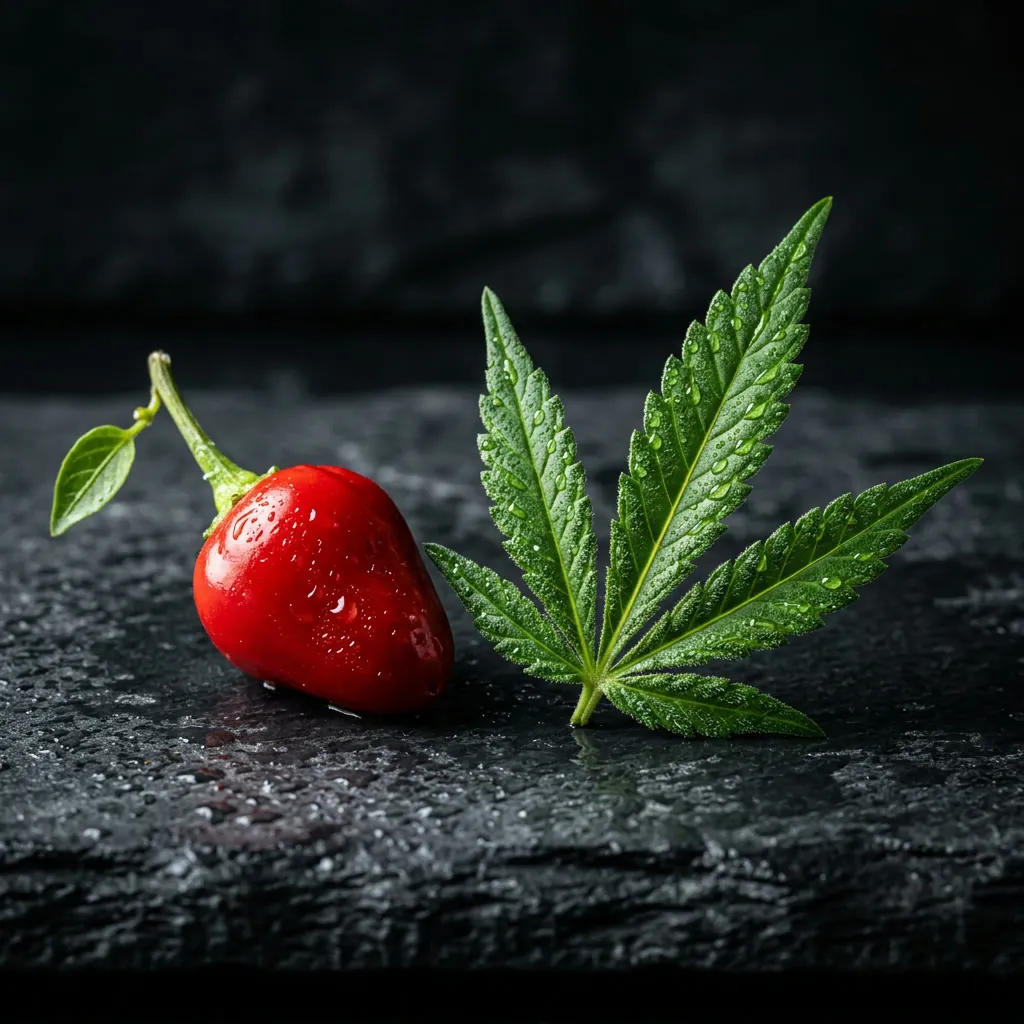
Two creams sit on the same shelf. Both promise relief for an aching knee or a burning foot. One is made from chili peppers, the other from hemp. Most people assume they work the same way, by quietening an overactive nerve. They do not. They converge on the same molecular address and then pull in almost opposite directions, which explains how each one feels and how fast it works.
Capsaicin is a blunt instrument used with precision. It shouts at a nerve until the nerve stops listening. CBD is a modulator that works through several systems at once, and recent research suggests its effect on pain can run in either direction depending on which channel is present. Understanding that split is more useful than any single study result.
One Nerve, Two Radically Different Approaches
Start with the plainest version. Capsaicin is an agonist. It binds the TRPV1 channel and opens it, deliberately, at full volume. The heat you feel is not a side effect, it is the mechanism. Nociceptors fire, substance P and other signalling peptides are released, and the tissue reports pain. Keep going, and the same neuron stops responding. The channel desensitises, the nerve terminal defunctionalises, and the burning fades into a dull nothing. That is the therapeutic window, and it is earned through a period of discomfort.
CBD does not work that way. It is not a clean on-switch for the channel, and its effects are spread across several receptors and enzymes rather than concentrated at one lock. A 2023 computational study in the Journal of Biomolecular Structure and Dynamics modelled how cannabinoids sit inside TRP channels and found that the binding geometries differ meaningfully between compounds. CBD occupies the channel in its own way, which is a polite way of saying the pharmacology is messier than a simple agonist story.
So the two products reach calm by different routes. One overstimulates and then silences. The other nudges a system that runs alongside the channel. Only one requires you to burn first.
What Capsaicin Does to a Nerve
TRPV1 is a heat sensor. It opens above roughly 42 degrees Celsius, and also in the presence of acid and certain inflammatory lipids. Capsaicin fits the same pocket, which is why a chili pepper tastes like a small fire. The receptor cannot tell real heat from a molecule that mimics it, so the brain receives a heat and pain signal with no external cause.
Repeated exposure changes the equation. The neuron depletes its signalling peptides, the receptor stops recycling efficiently, and the terminal becomes less excitable. Prolonged use produces a reversible loss of epidermal nerve fibre density. The nerve has not been soothed. It has been taken offline for a while.
That is why topical capsaicin is dosed by concentration and by patience. Over the counter formulations sit in low fractional percentages and are applied several times daily for weeks before benefit appears. The high concentration patch used for postherpetic neuralgia is a clinical procedure, applied under local anaesthetic because the initial pain would otherwise be intolerable.
How CBD Approaches the Same Tissue
CBD is a poor fit for the single target story. It has low affinity for cannabinoid receptors compared with THC, and much of what is observed in laboratory work points to indirect effects. It modulates TRPV1 rather than simply opening it. It interacts with serotonin and adenosine signalling, influences glycine receptors, and inhibits the enzyme that breaks down anandamide. The result is a broad, quiet shift in how a nerve terminal handles incoming signals rather than a single loud command.
A 2026 paper in the Journal of Pharmacology and Experimental Therapeutics compared minor cannabinoids directly and found that CBD, CBG, CBN and CBC each modulate TRP channels in distinct patterns. They are not interchangeable, and the differences are not subtle. If CBD were merely a weaker version of another cannabinoid, that study would have found a single gradient. It found separate profiles.
This is the honest reason CBD research is hard to summarise. A study that uses one preparation, one route, and one pain model tells you about that combination. It does not tell you what a bottle on a shelf will do.
TRPV1 Is the Shared Address
The convergence point matters because it explains interactions. A 2025 review in The Journal of Headache and Pain described functional crosstalk between the vanilloid system and the endocannabinoid system, meaning the two do not operate in separate compartments. They share machinery, and manipulating one changes the tone of the other. Apply capsaicin and you are not only activating a channel, you are shifting the local endocannabinoid conversation.
TRPV1 also turns out to be busier than the pain literature once assumed. A 2024 review in Progress in Neurobiology examined the channel's role in the pathophysiology of epilepsy, which is a long way from a sore knee. A receptor involved in seizure networks is a receptor with systemic consequences, and that broadens the safety question for anything that acts on it.
This convergence is also why stacking products is not neutral. A capsaicin cream and a CBD topical applied to the same area are not two independent interventions. They are two inputs into one shared signalling node, and nobody has published a clean dose response for that combination.
Where the Two Strategies Diverge
The practical differences follow from the mechanism, and none of them establishes superiority.
- Onset: capsaicin needs days to weeks of repeated use before desensitisation produces relief. CBD effects, when they occur, are often reported within an hour or two, though that timing is largely anecdotal.
- Sensation: capsaicin reliably burns on first application. CBD topicals typically produce nothing, which makes them easier to use and harder to evaluate.
- Predictability: capsaicin has a defined concentration and a visible response. CBD products vary in content, and independent testing keeps finding label inaccuracies.
- Reversibility: capsaicin desensitisation reverses after discontinuation. CBD's effects also fade, but the underlying pharmacological story is less well mapped.
None of these establishes superiority. They describe what each product does in use.
The Finding That Complicates CBD
Here is the part that deserves more attention than it gets. Two recent papers, one in The Journal of Neuroscience in 2026 and a 2025 preprint on the same work, report that the pro-nociceptive effects of CBD depend on TRPV1, while the antinociceptive effects do not. Read that carefully. The pain-relieving action runs through some other pathway. The pain-amplifying action runs through TRPV1. When TRPV1 is absent or blocked, the amplifying effect disappears.
In practical terms, CBD is not a one-directional analgesic. In an intact system with functioning TRPV1 channels, both effects are present at once, and the net result depends on dose, tissue, and context. For some people the balance lands on relief. For others it may land on increased sensitivity, which is a genuinely uncomfortable finding for a category marketed almost entirely on comfort.
The preprint and the journal article agree on the direction, which strengthens the signal. This is a mechanism with a name and a channel attached to it, not a single lab result.
What it does not mean is that CBD is useless for pain. It means the claim has to be narrower. CBD modulates pain signalling, and the modulation runs in both directions.
What the Capsaicin Evidence Actually Shows
Capsaicin has the advantage of a regulatory path. A 2024 review in American Family Physician on the prevention and treatment of diabetic peripheral neuropathy lists capsaicin among the topical options, alongside other agents with varying levels of support. The framing matters. Capsaicin appears as one tool among several, not as a first-line cure, and the review is careful about expectations.
The pattern across the literature is consistent. Topical capsaicin produces modest reductions in neuropathic and musculoskeletal pain for a portion of users. The high concentration patch produces larger effects in specific indications and requires clinical supervision. Stinging and application site reactions are common enough to drive discontinuation, which is a real limitation rather than a footnote.
So capsaicin earns its place by having a mechanism you can describe, a concentration you can measure, and a predictable if unpleasant induction period.
What the CBD Evidence Actually Shows
The CBD literature is broader, thinner, and harder to aggregate. Human trials exist, but they vary in preparation, route, and endpoint, and many are small. The most defensible statement is that CBD may help some people with some pain conditions, and that the effect is not reliably separable from placebo in every trial.
That is not a dismissal. It is the current state of a field that moved faster commercially than scientifically. For a fuller picture of where the human data sits, the overview of CBD and chronic pain walks through the trial landscape without overselling it.
The mechanism papers are stronger than the clinical ones. That gap defines the category.
Why Natural Does Not Mean Gentle
Both are plant derived and both can cause problems. Capsaicin is an irritant by design. It will burn eyes, lips, and broken skin, so wash hands immediately after application. Its mechanism is controlled injury to nerve terminals, which is a strange thing to call gentle.
CBD has a different risk profile. It inhibits several cytochrome P450 enzymes, so it can raise blood levels of other drugs, including some anticoagulants and antiseizure medications. Topical use carries far less systemic exposure than oral, but the interaction question does not vanish because the product is a cream. Anyone on narrow therapeutic index medication should raise it with a pharmacist before adding CBD to a routine.
Neither product treats the cause of pain. Neuropathy has drivers. Joint pain has drivers. A topical that changes the signal does not change the driver.
Sensitisation, Desensitisation, and What You Will Feel
The two strategies produce opposite sensory experiences, which is the clearest way to tell them apart in practice.
Capsaicin announces itself. The first several applications hurt more than the underlying problem, which is expected. Over one to two weeks the burning shortens and the baseline pain often softens. If nothing happens at all, the product may not be reaching the skin in adequate concentration, or the diagnosis may be wrong.
CBD usually announces nothing. A well formulated topical is odourless and silent. That silence is comfortable and also uninformative, because it gives no feedback about whether the active ingredient is present. This is where the delivery question becomes central, and the breakdown of CBD bioavailability and delivery methods explains why a cream that feels identical to a moisturiser may deliver almost nothing.
If you want to compare the two fairly, judge them on different clocks. Capsaicin is a two week trial with a known induction phase. CBD is a shorter trial with a much wider error bar.
Using Them Without Getting It Wrong
A few practical rules follow from the mechanism.
Test on a small area first, for either product. Capsaicin especially, because the reaction is guaranteed and varies by site. Never apply it to the face, and wash hands with soap immediately.
Do not layer the two on the same skin on the same day. The shared TRPV1 node makes the combination unpredictable, and no study tells you what it does in humans.
Give capsaicin the full induction period before deciding. Two weeks of consistent use is the minimum for a fair trial.
Treat CBD dose as unknown until you have read the certificate of analysis, if one exists. A product without third party testing is a guess. If you are choosing a format, the CBD topicals guide covers what to look for on a label and what the certifications actually mean.
Consider what you are treating. For a localised joint or a patch of neuropathic skin, a topical keeps systemic exposure low, which is the main argument for either over an oral option. For widespread pain, neither cream solves the problem.
Where Each One Fits Better
Capsaicin fits burning, well localised neuropathic pain and osteoarthritic joints where skin is intact and the user can tolerate an induction period. It has a concentration, a target, and a clinical literature that treats it as a legitimate option. Its weakness is comfort and adherence.
CBD fits people who cannot tolerate the capsaicin burn, or who already use cannabinoids and want a topical layer. Its weakness is evidence and consistency. The honest summary is that capsaicin has a smaller effect with better characterization, and CBD has a broader promise with weaker confirmation.
For the oral route and how the safety profiles differ, see CBD vs ibuprofen. If you have decided on a topical, the CBD creams and topicals range shows the formats and how the bases differ.
What the Channel Work Suggests Next
The most interesting thread in the recent literature is selectivity. If CBD, CBG, CBN and CBC each modulate TRP channels differently, as the 2026 comparison found, then treating them as interchangeable is a scientific error with commercial consequences. A product built around the wrong minor cannabinoid is not weaker, it is mismatched.
The crosstalk work points the same direction. If the vanilloid and endocannabinoid systems share machinery, the useful question is not cannabinoid versus capsaicin but which combination, at which ratio, for which tissue. That research is early and almost entirely preclinical. It does, though, reframe the comparison from a contest into a dosing problem.
The Bottom Line
CBD and capsaicin both act on TRPV1 and both can reduce pain signalling, but they get there by opposite routes. Capsaicin opens the channel hard, burns, and then desensitises the nerve terminal, which makes it predictable and uncomfortable in equal measure. CBD modulates the channel and several other systems at once, which makes it gentler and far less certain. The 2026 work showing that CBD's pro-nociceptive effect depends on TRPV1 while its antinociceptive effect does not is the single most important caveat in this category, because it means CBD can push pain in either direction in an intact system. Neither product is proven for pain, neither replaces treatment for the underlying cause, and the choice between them comes down to whether you want a mechanism you can feel working or a mechanism you have to take on faith.
Find Your Perfect CBD Product
Take our 2-minute quiz to get personalized recommendations based on your needs.
Take the Quiz →Disclaimer: This article is for informational purposes only and does not constitute medical advice. CBD products are not FDA-approved to treat, cure, or prevent any disease. Always consult with a qualified healthcare professional before starting any new supplement, especially if you have a medical condition or take medications.