CBD Bioavailability: Why Your Delivery Method Matters More Than Your Dose
You bought a bottle of CBD oil. The label says 25mg per serving. You take it every morning like clockwork. Two weeks in, you're still waiting for... anything. No calm. No relief. Nothing.
Here's the frustrating truth: your CBD might be working perfectly. The problem isn't the product—it's your body. Specifically, how much of that CBD actually makes it into your bloodstream. This is called bioavailability, and it's the single most important factor determining whether your CBD routine delivers results or just expensive urine.
Most people focus on milligrams. They should be focusing on delivery methods. Because taking 25mg orally versus sublingually versus through inhalation can mean the difference between absorbing 1.5mg or 8mg of actual CBD. That's not a minor variation—that's a five-fold difference in what your body actually receives.
Let's fix that.
What Is Bioavailability (and Why CBD Makes It Complicated)
Bioavailability is simply the percentage of a substance that enters your bloodstream and becomes available for use. If you swallow 100mg of something with 50% bioavailability, your body actually gets 50mg. Straightforward enough.
CBD complicates this picture because it's notoriously difficult for the human body to absorb efficiently. It's lipophilic (fat-soluble), which means it dissolves in fat rather than water. Your digestive system, however, is primarily designed to handle water-soluble compounds. This mismatch creates immediate absorption challenges.
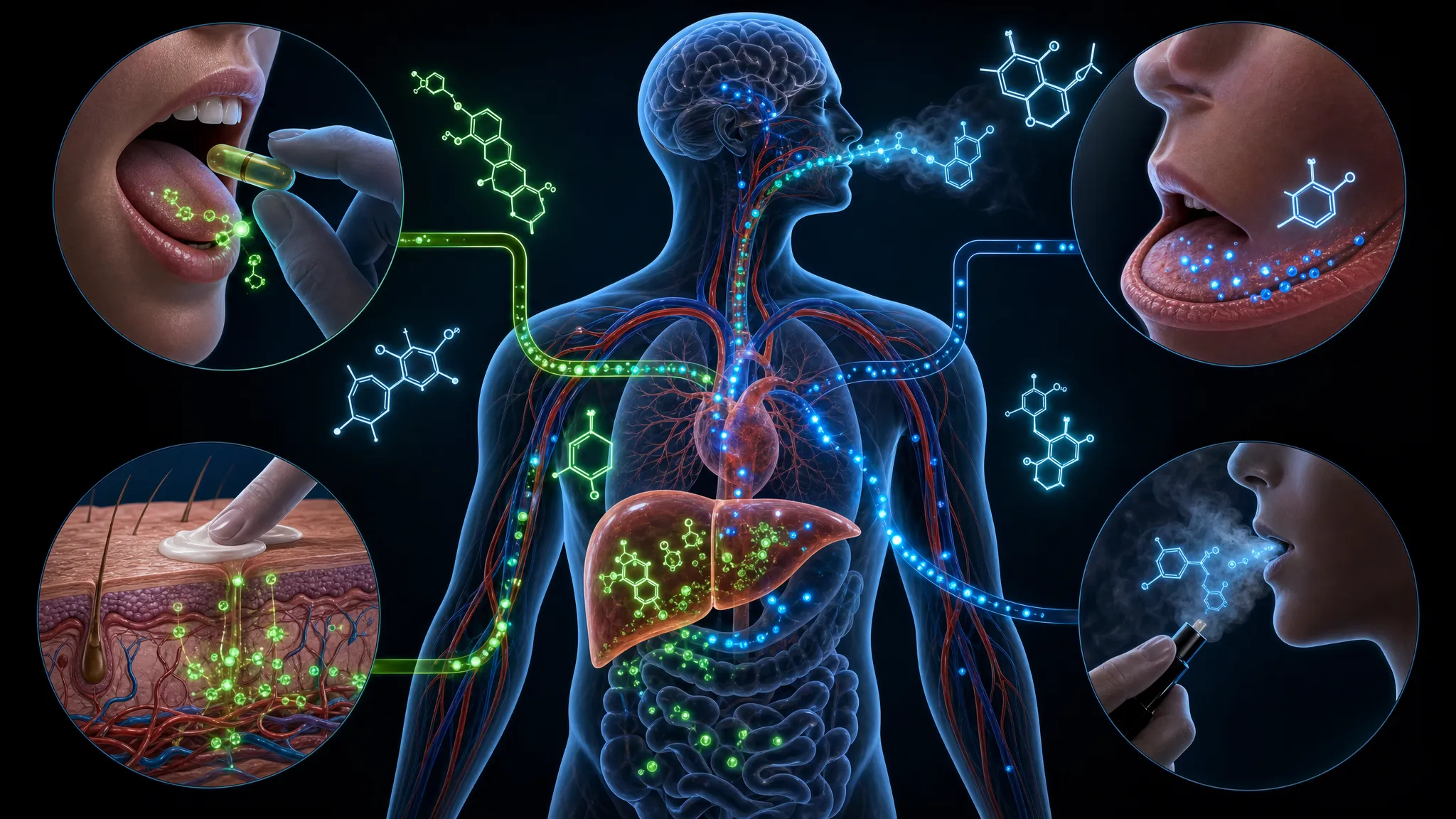
Then there's the liver. When you swallow CBD, it travels through your digestive tract to your liver before reaching systemic circulation. Your liver views CBD as a foreign compound and metabolizes it aggressively through the cytochrome P450 enzyme system, particularly CYP3A4 and CYP2C19. This "first-pass metabolism" destroys a significant portion of the CBD before it ever gets a chance to work.
A 2026 study published in Drug Delivery journal confirmed what researchers have long suspected: oral CBD bioavailability averages approximately 6%. Let that number sink in. If you take a 25mg capsule, roughly 1.5mg actually enters your bloodstream. The rest is metabolized by your liver or excreted.
Research published in Biomolecules in 2025 expanded on this, noting that CBD has "low and variable oral bioavailability" with a "pronounced food effect." Translation: whether you've eaten recently matters enormously, and even under ideal conditions, most oral CBD never reaches its destination.
This isn't a flaw in your CBD. It's a feature of human physiology. Understanding this changes everything about how you should approach dosing.
The Four Main Delivery Methods — Ranked by Absorption
Not all CBD routes are created equal. Here's how they stack up from lowest to highest bioavailability:
Topical (creams, balms, lotions): Less than 5% systemic absorption. Topicals are designed for localized relief—think sore knees, tight shoulders, or irritated skin. They work where you apply them but don't meaningfully enter your bloodstream. If your goal is whole-body effects like anxiety reduction or sleep support, topicals alone won't get you there.
Oral (capsules, edibles, swallowed oils): Approximately 6% bioavailability. This is the baseline—the method most people default to because it's convenient and familiar. It's also the least efficient. The CBD must survive stomach acid, pass through the intestinal wall, and endure first-pass liver metabolism. Most doesn't make it.
Transdermal (patches, specialized gels): Estimated 10-20% systemic bioavailability. Transdermal products are engineered to penetrate deeper than standard topicals, crossing the skin barrier and entering capillaries over an extended period. They provide slow, steady release—useful for maintaining consistent blood levels—but require specific formulation technology to work effectively.
Sublingual (oils held under the tongue): Approximately 12-35% bioavailability. By holding CBD oil under your tongue for 60-90 seconds, you allow it to absorb directly through the mucous membranes into the capillaries beneath. This bypasses the digestive tract and first-pass liver metabolism entirely. The range is wide because technique matters—swallow too soon and you're back to oral absorption rates.
Inhalation (vaping, smoking): Approximately 31% bioavailability. Inhalation delivers CBD directly to the lungs, where it crosses the alveolar membrane almost instantly into the bloodstream. Onset is measured in minutes rather than hours. However, inhalation carries respiratory risks that many CBD users prefer to avoid, and effects, while fast, tend to be shorter-lived.
A 2025 review in Biomedicine & Pharmacotherapy examined pharmacokinetic studies across these administration routes, confirming that inhalation provides the fastest onset while sublingual offers the best balance of absorption and safety for most users.
Oral CBD (Oils, Capsules, Edibles): The 6% Problem
Oral CBD is everywhere. Capsules fit neatly into supplement routines. Gummies taste like candy. Even CBD oils are often swallowed out of convenience or impatience. But convenience comes at a steep cost.
When you swallow CBD, it faces a gauntlet of obstacles:
First, stomach acid. CBD is relatively stable in acidic environments, but prolonged exposure can degrade some portion of the dose.
Second, the intestinal wall. CBD must cross the epithelial lining of the small intestine to enter the portal vein. Its lipophilic nature helps here—it can dissolve into cell membranes—but poor water solubility limits how much can actually be transported.
Third, and most significantly, the liver. The portal vein carries absorbed CBD directly to the liver, where cytochrome P450 enzymes go to work. CYP3A4 and CYP2C19 are the primary metabolizers, converting CBD into metabolites like 7-hydroxy-CBD and 7-carboxy-CBD. Some of these metabolites are active, but the conversion process removes substantial amounts of the parent compound from circulation.
The 2026 systematic review in the European Journal of Drug Metabolism and Pharmacokinetics highlighted that CYP450 isoforms metabolize approximately 80% of therapeutic drugs, and CBD both affects and is affected by this system. This creates potential drug-drug interactions that oral CBD users should discuss with healthcare providers.
The result of this metabolic gauntlet? That 6% bioavailability number. It's not pessimistic—it's realistic.
But oral CBD isn't useless. It has advantages: precise dosing (capsules contain exact milligram amounts), longer duration (what does survive metabolism provides sustained release), and convenience. For maintenance dosing throughout the day, oral CBD can work—if you account for the absorption tax.
Practical implications:
- If your target effective dose is 25mg, you may need to take 400mg orally to achieve similar blood levels as 25mg sublingually
- Effects take 30 minutes to 2 hours to appear—don't redose prematurely
- Taking with food, especially fatty food, can significantly improve absorption (more on this below)
- Consistency matters more than timing—daily oral CBD builds baseline levels even if individual doses are inefficient
Sublingual CBD: Bypassing the Liver
Sublingual administration is the goldilocks zone of CBD delivery: significantly better absorption than oral, without the respiratory concerns of inhalation.
The mechanism is elegant. Your mouth contains a dense network of capillaries just beneath the mucous membranes. When you hold CBD oil under your tongue, the compound diffuses directly through these membranes into the capillaries. From there, it enters systemic circulation without passing through the liver first.
This bypass is crucial. First-pass metabolism is responsible for destroying the majority of orally ingested CBD. By avoiding it entirely, sublingual administration achieves bioavailability in the 12-35% range—two to six times better than swallowing.
But technique matters enormously. Here's what most people get wrong:
Timing: You need to hold the oil under your tongue for 60-90 seconds minimum. Thirty seconds isn't enough. The mucous membranes need time to absorb the compound. Swallow too soon and you've just taken oral CBD with extra steps.
Volume: Don't flood your mouth. A standard dropper full (1mL) is manageable. Larger volumes trigger the swallowing reflex, defeating the purpose.
Distribution: Move the oil around slightly under your tongue and along the inside of your cheeks. More surface area means more absorption.
Don't eat or drink immediately after: Give the CBD time to fully absorb before introducing food or liquid that might wash residual oil into your digestive tract.
A 2025 overview in Current Drug Discovery Technologies noted that sublingual administration is one of the primary routes for CBD delivery precisely because it "bypasses first-pass metabolism" while remaining accessible to consumers.
The trade-off: sublingual requires more attention than popping a capsule. You need to actually do it correctly, consistently. But the payoff—absorbing three to four times more CBD per milligram—is worth the minor inconvenience.
Best use cases for sublingual:
- Morning routines where you want reliable absorption
- Situations requiring faster onset than oral provides (15-30 minutes vs. 1-2 hours)
- Users who want flexibility to adjust doses drop-by-drop
- Anyone frustrated with oral CBD's inconsistent effects
Browse our full range of sublingual CBD oils designed for optimal absorption, or check our best CBD products of 2026 for top picks.
Inhalation: Fastest Onset, Highest Absorption
If bioavailability is your only metric, inhalation wins. Lungs are remarkably efficient at gas exchange—that's their entire evolutionary purpose. The alveoli provide an enormous surface area (roughly 70 square meters in adults) with incredibly thin membranes separating air from capillaries.
When you inhale CBD vapor or smoke, it crosses this barrier almost instantly. Studies show peak blood concentrations within 3-10 minutes, compared to 1-2 hours for oral administration. Bioavailability averages around 31%, though some research suggests it can reach higher depending on inhalation technique and product formulation.
The 2025 Biomedicine & Pharmacotherapy review covering THC and CBD pharmacokinetics confirmed that inhalation provides both the fastest onset and among the highest absorption rates of any administration route.
Advantages of inhalation:
- Speed: Effects begin within minutes. Useful for acute symptoms like sudden pain, panic attacks, or breakthrough nausea.
- Efficiency: Higher bioavailability means less product wasted.
- Control: Users can titrate in real-time—take a puff, wait, assess, repeat.
Significant drawbacks:
- Respiratory risk: Inhaling any combusted or vaporized substance carries potential lung irritation. Long-term safety data on CBD vaping specifically remains limited.
- Short duration: The flip side of rapid onset is quicker elimination. Effects may last only 2-4 hours compared to 6-8 hours for oral/sublingual.
- Social factors: Vaping isn't appropriate in all settings. Odor, while milder than cannabis flower, is still present.
- Learning curve: Proper inhalation technique affects absorption. Shallow puffs waste product.
For most CBD users seeking wellness benefits rather than immediate symptom relief, inhalation's risks outweigh its efficiency gains. It's a tool for specific situations, not a daily foundation.
Topical CBD: Local Relief, Not Systemic
Topical CBD occupies a different category entirely. When you apply CBD cream to your knee, you're not trying to raise blood levels—you're targeting local cannabinoid receptors in skin, muscle, and joint tissue.
Systemic bioavailability for topicals is minimal, typically under 5%. The stratum corneum (outer skin layer) is an excellent barrier, evolved specifically to keep things out. Most CBD molecules are too large and too lipophilic to penetrate deeply without specialized formulation.
But "not systemic" doesn't mean "not effective." Peripheral tissues contain CB2 receptors that respond to locally applied cannabinoids. Research suggests topical CBD can reduce inflammation and modulate pain signals at the application site without ever entering general circulation.
When topicals excel:
- Targeted joint pain (knees, elbows, fingers)
- Muscle soreness after exercise
- Skin conditions like eczema or psoriasis
- Localized inflammation without need for whole-body effects
When topicals fall short:
- Anxiety or stress (requires systemic effects)
- Sleep support (needs to reach the brain)
- Digestive issues (topicals don't affect internal organs)
- Generalized pain or inflammation
Think of topicals as complementary. Our CBD topicals guide breaks down which creams and balms actually work to other delivery methods, not replacements. Many users combine a sublingual oil for systemic support with a topical balm for specific trouble spots.
Explore our topical CBD collection for targeted relief formulations.
What This Means for Your Dosing
Here's where theory meets practice. If bioavailability varies this dramatically across delivery methods, how do you actually dose?
Start by defining your goal. Different objectives require different approaches:
For anxiety or stress: You need systemic CBD that reaches the brain. Sublingual is ideal—good absorption, reasonable onset time (15-30 minutes), no respiratory concerns. Start with 10-15mg sublingually. If using oral instead, recognize you'll need roughly 3-4x the dose for equivalent effect.
For sleep: Timing matters. Take CBD 30-60 minutes before bed sublingually, or 1-2 hours before if using oral capsules. The longer window for oral accounts for slower absorption. Doses in the 20-40mg range (sublingual equivalent) are common for sleep support.
For chronic pain: Consider combining methods. Sublingual CBD provides baseline systemic support, while topicals address specific pain points. This layered approach often works better than maximizing a single route.
For post-workout recovery: Oral or sublingual CBD taken after exercise may help modulate inflammation. Since timing is less critical, convenience can drive the choice—capsules if you prefer simplicity, sublingual if you want better absorption.
For acute symptoms: If you need fast relief (sudden pain, panic, nausea), inhalation acts fastest. But for most users, keeping a sublingual oil on hand and using proper technique provides adequate speed without inhalation risks.
The 2025 Biomolecules study on CBD pharmacokinetics emphasized that CBD exhibits "variable oral bioavailability" with significant inter-individual differences. Your mileage may vary. Start low, track your response, and adjust based on results—not milligram numbers on a label.
Food Matters More Than You Think
Remember that "pronounced food effect" mentioned in the research? It's real, and it's substantial.
CBD is lipophilic. It dissolves in fat. When you take CBD with a high-fat meal, absorption can increase dramatically—some studies suggest up to four-fold improvements. The mechanism: dietary fats stimulate bile secretion, which emulsifies CBD and improves its solubility. Fats also slow gastric emptying, giving CBD more time to be absorbed in the small intestine.
A landmark study (not among our six primary citations but well-established in the literature) found that taking CBD with a high-fat breakfast increased blood concentrations by approximately 400% compared to fasting administration.
Practical implications:
- Take oral CBD with meals, especially meals containing healthy fats (avocado, nuts, olive oil, eggs). Don't take it on an empty stomach.
- Sublingual is less food-dependent since it bypasses digestion, but eating immediately after sublingual administration can wash residual oil into your digestive tract, reducing effectiveness. Wait 5-10 minutes after sublingual dosing before eating.
- Consistency beats optimization. If you always take CBD with breakfast, your body adapts to that pattern. Erratic timing (sometimes fasting, sometimes fed) creates unpredictable absorption.
The 2026 Drug Delivery study we cited earlier specifically developed a novel delivery system (PLC-SNEDDS) to enhance oral CBD bioavailability—acknowledging that poor solubility and first-pass metabolism are the core problems. Until such technologies become widely available, food is your simplest bioavailability hack.
How to Choose the Right Delivery Method for Your Goal
Let's make this actionable. Match your primary objective to the optimal delivery method:
Consider your lifestyle, too. If you travel frequently, capsules are TSA-friendly and require no technique. If you work in an office, sublingual dosing at your desk might feel awkward—in that case, morning and evening routines at home make more sense.
Budget plays a role. Higher bioavailability means you use less product for the same effect. A bottle of sublingual oil might cost more upfront than capsules but last longer because you're absorbing more of each dose.
Our CBD gummies offer a tasty oral option. For a detailed breakdown of absorption differences, see our CBD oil vs gummies comparison for those who prioritize convenience, while our capsule line provides precise dosing for consistency-focused users.
Action Steps: Maximizing Your CBD Absorption
Ready to put this into practice? Here's your checklist:
1. Audit your current method. Are you swallowing oil that should be held sublingually? Taking capsules on an empty stomach? Small changes yield big improvements.
2. Match method to goal. Use the table above. Don't try to treat localized knee pain with oral CBD alone—add a topical. Don't expect instant anxiety relief from a capsule taken 10 minutes ago.
3. Optimize timing. Take oral CBD with your fattiest meal of the day. Hold sublingual oil for a full 90 seconds. Wait before eating or drinking afterward.
4. Track your response. Keep a simple log: dose, method, timing, food intake, and subjective effects. After two weeks, patterns will emerge. Adjust based on data, not guesswork.
5. Consider layering. There's no rule saying you must use only one method. Many users find success combining sublingual (morning/evening baseline) with topicals (as-needed spot treatment) or occasional oral capsules (midday maintenance).
6. Don't chase milligrams. A 50mg oral dose may deliver less active CBD than a 15mg sublingual dose. Focus on effects, not label numbers.
7. Give it time. CBD isn't caffeine. Some benefits—particularly for anxiety, sleep, and inflammation—accumulate over days or weeks. Consistent daily use beats heroic one-time doses.
8. Talk to your doctor if taking medications. The 2026 European Journal of Drug Metabolism and Pharmacokinetics review emphasized CBD's interaction with CYP450 enzymes. If you take prescription medications, especially those with grapefruit warnings, discuss CBD with your healthcare provider.
The Bottom Line
Your CBD isn't broken. Your delivery method might be.
Bioavailability isn't a minor detail—it's the difference between a regimen that works and one that wastes money. Oral CBD averages 6% absorption. Sublingual reaches 12-35%. Inhalation hits around 31%. These aren't marginal variations; they're multiplicative.
If you've been swallowing CBD oil and wondering why you don't feel anything, try holding it under your tongue for 90 seconds. If you've been taking capsules on an empty stomach, try taking them with your largest meal. If you need fast relief for acute symptoms, understand that oral CBD may take two hours to peak.
The science is clear. A 2026 study in Drug Delivery confirmed oral CBD's ~6% bioavailability and the need for enhanced delivery systems. Research in Biomolecules documented CBD's variable absorption and pronounced food effects. Reviews in Biomedicine & Pharmacotherapy mapped the pharmacokinetic profiles across administration routes.
You don't need a PhD in pharmacology to benefit from this knowledge. You just need to match your method to your goal, optimize your technique, and pay attention to results.
CBD works. But only if enough of it actually reaches your bloodstream. Make sure yours does.
Want to keep your CBD potent? Learn how to store CBD oil properly to protect it from light, heat, and oxygen.
Find Your Perfect CBD Product
Take our 2-minute quiz to get personalized recommendations based on your needs.
Take the Quiz →Disclaimer: This article is for informational purposes only and does not constitute medical advice. CBD products are not FDA-approved to treat, cure, or prevent any disease. Always consult with a qualified healthcare professional before starting any new supplement, especially if you have a medical condition or take medications.