CBD for Horses: Dosing, Safety and the Honest State of the Evidence
Why Horse Owners Are Asking About CBD
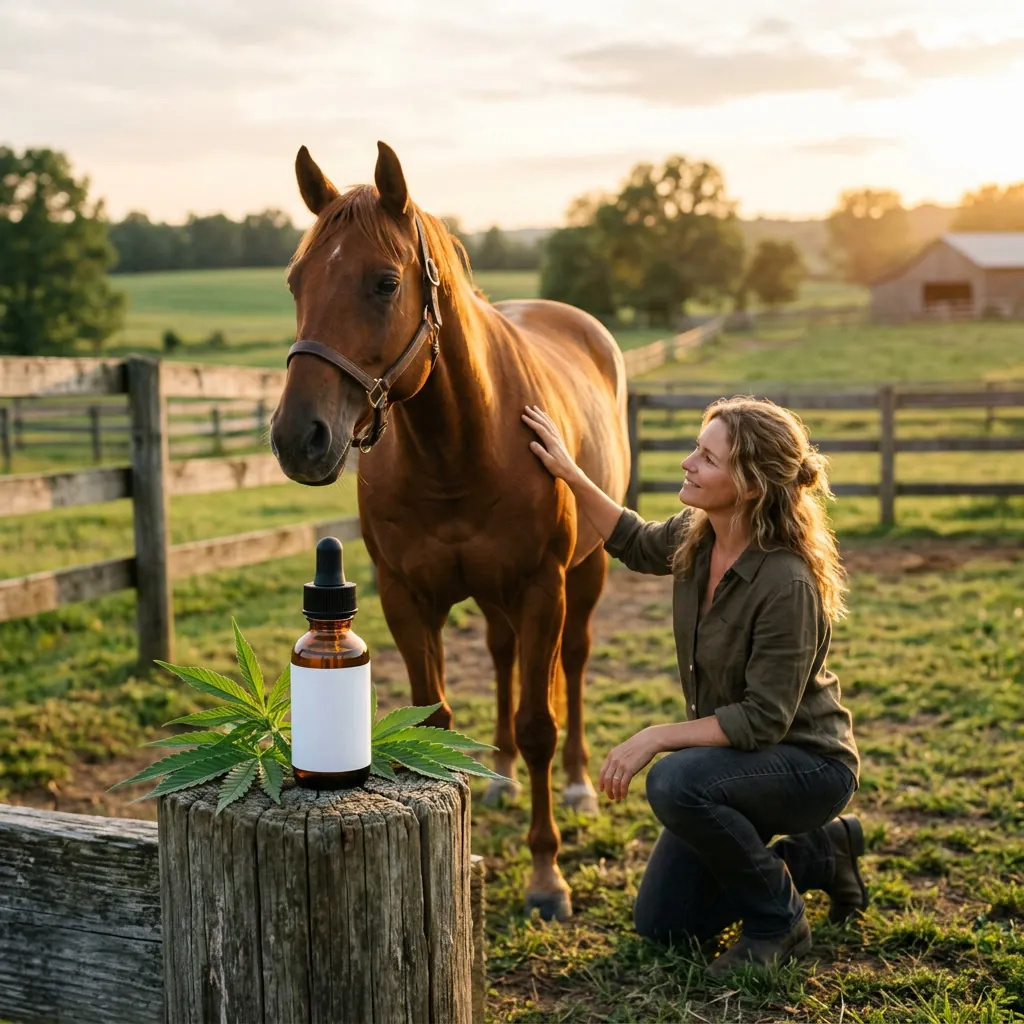
Your gelding is stiff coming out of the stall. He's short on the left front. The vet says it's arthritis, and you're rotating bute with a joint supplement while you worry about what long-term NSAIDs are doing to his gut and kidneys. Somewhere you read that people are giving horses CBD oil, and the barn chatter says it helps. So you start searching — and immediately hit a wall of confident marketing and wildly inconsistent dosing advice.
Here's the uncomfortable truth upfront: equine CBD research is genuinely early. We have real pharmacokinetic studies, a handful of small pain and behavior trials, and a lot of laboratory work. We do not have large, long-term controlled trials that tell you "give X milligrams per kilogram for Y condition and expect Z." Anyone who sells you certainty on horse CBD dosing is selling you something other than science.
That's not a reason to dismiss CBD for horses. It's a reason to approach it the way a careful owner approaches any new supplement: knowing what the data supports, what it doesn't, and where the real risks hide.
The Honest State of Equine CBD Research
If you search PubMed for cannabidiol and horses, you'll find a few dozen papers, and most of the substantive ones were published in the last three years. That's a small body of evidence compared to dogs, and a rounding error compared to human CBD research.
What that evidence base actually looks like:
- Pharmacokinetic studies — several, done in horses and ponies, measuring how CBD and its acidic cousin CBDA move through the bloodstream
- Safety/tolerability studies — a few, mostly short and small
- Pain and behavior trials — very few, small sample sizes, often with subjective outcomes
- In-vitro and cell studies — a growing pile, but test-tubes are not living horses
The recurring theme is that horses are not small dogs and not big humans. Their cannabinoid handling is different enough that you cannot simply scale a product label by body weight.
What We Know About CBD Pharmacokinetics in Horses
Understanding how CBD behaves in a horse's body explains almost every practical question about dosing. Several 2025 and 2026 studies have started to map this out.
A pharmacokinetic study of cannabidiol in Connemara ponies, published in Frontiers in Veterinary Science in 2025, characterized CBD and its two main phase I metabolites in horses for the first time in that breed. The key takeaway: CBD is transformed in the horse's liver into active metabolites, and the parent compound clears relatively quickly.
Oral Bioavailability: The Biggest Unknown
If there's one concept that should shape how you think about giving CBD to a horse, it's oral bioavailability — the fraction of a swallowed dose that actually reaches the bloodstream. In horses, we still don't have a clean number, and the studies that exist are humbling.
A 2025 study in Frontiers in Veterinary Science compared two CBD formulations — an oil and a paste — given orally at 1 mg/kg to eight healthy horses, both fed and fasted. The surprising result: there were no statistically significant differences between formulations or between fed and fasted states. The paste reached peak concentration faster, but overall exposure didn't change much. Horses appear to absorb CBD differently than dogs or humans, where food dramatically changes absorption.
Then there's the CBD-versus-CBDA split, which is genuinely one of the most interesting findings in equine cannabinoid science. The 2026 Journal of Veterinary Pharmacology and Therapeutics study found that after oral dosing, CBDA plasma concentrations were up to 67 times higher than CBD, and the CBDA area-under-the-curve was up to 36 times larger. A 2025 Cornell study in the American Journal of Veterinary Research found the same pattern: after 1 mg/kg twice daily, CBDA hit a maximum serum concentration of 103 ng/mL versus just 12 ng/mL for CBD.
Musculoskeletal Pain and Joint Comfort
Joint comfort is the number one reason owners reach for CBD, and this is where horse-specific evidence is thinnest — but not empty.
The most directly relevant study is a 2024 trial in Frontiers in Veterinary Science that enrolled 24 adult horses with chronic osteoarthritis, aged 11 to 18. Half received a CBDA 15% oil, half received a combined CBG/CBD oil (20% CBG, 10% CBD), dosed at 0.07 mg/kg daily for 14 days. Researchers tracked pain using the Horse Chronic Pain Scale and monitored heart rate, respiratory rate, blood pressure, and immune cell populations.
The results: pain scores dropped in both groups. White blood cells, monocytes, neutrophils, and CD8 cells all decreased, suggesting an immune-modulating effect. No horse needed rescue analgesia, and none showed adverse effects. Notably, the dose used — 0.07 mg/kg — is tiny compared to what most owners give.
A separate 2024 study in Frontiers in Veterinary Science found mature horses with osteoarthritis showed improved quality of life and pain relief when oral transmucosal CBD oil was added to an existing analgesic regimen — again, small and suggestive rather than definitive.
Then there's a 2025 study in the American Journal of Veterinary Research that tested whether CBD actually changes pain perception in healthy horses. Six horses received 3.48 mg/kg CBD oil or a placebo daily for three days. CBD raised the thermal pain threshold above baseline and placebo at a couple of time points — but had no effect on mechanical threshold, and the antinociception was described as "intermittent."
If you're considering CBD for a horse with joint disease, the realistic expectation is support, not treatment. It belongs alongside — never instead of — a proper veterinary pain plan.
Anxiety, Stress and Behavior
Behavior and stress are the second big driver of interest, and here the horse-specific research is a bit more developed, though still small.
Two companion studies published in Frontiers in Veterinary Science in 2023 examined a CBD-containing paste in horses. One investigated behavior, heart rate, and heart rate variability after three escalating doses; the other tracked behavior, heart rate, and cortisol after multiple administrations. Both used physiological measures — not just "the owner thought the horse seemed calmer."
The pattern across this work is that CBD was tolerated at the doses studied, with some behavioral observations suggestive of a calming effect, but the studies were small and not designed to prove clinical anxiety relief.
So what should you take from this? If your horse is anxious — trailer loading, clipping, farrier work, separation — CBD is not a sedative and not a replacement for a behavioral or veterinary assessment. For comparison, the CBD for dog anxiety evidence base is still modest, and horses are even less studied.
Skin, Sarcoids and Wound Healing
One of the more interesting frontiers is equine skin — specifically sarcoids, the locally invasive skin tumors common in horses and linked to bovine papillomavirus.
A 2026 study in the Journal of Veterinary Internal Medicine treated primary equine sarcoid cells with CBD at concentrations of 20, 6.75, 2.25, and 0.75 μM and measured cell viability, invasiveness, and matrix remodeling over 6 to 72 hours. This is a laboratory study, not a treatment trial — but it's the kind of early work that has to happen before anyone can responsibly test CBD on sarcoids in live horses.
Related laboratory work published in 2026 in Veterinary Research Communications found that a CBD-rich extract suppressed activation of the pro-inflammatory genes IL-1β and IL-6 in equine mesenchymal stem cells. Another 2025 study in the International Journal of Molecular Sciences found a CBD-rich extract primed equine stem cells toward immunomodulatory effects.
There's also a striking 2026 case report in Frontiers in Veterinary Science documenting a rescued gelding with a chronic open wound, a fibroblastic sarcoid, a ruptured suspensory tendon, and chronic joint disease. He was treated long-term with combined oral and topical THC-rich and CBD-rich full-spectrum oils, with gradual escalation to 0.5 mg/kg of each compound every 12 hours.
Important caveat: that's a single horse, using THC-containing products, in a palliative context. It's a data point, not a protocol. But it shows the direction clinical research may eventually take — and it's a reminder that topical and oral use in horses is being explored by veterinarians, not just owners.
If skin and coat support is what you're after more generally, our CBD for cats and CBD for pets guides cover the companion-animal side of topical use.
Safety and Adverse Effects
On safety, the news so far is reassuring — within the limits of short studies and small numbers.
The 2025 Cornell pharmacokinetic and safety study in the American Journal of Veterinary Research is the strongest evidence to date. Seven adult horses received CBD- and CBDA-rich oil at 1 mg/kg orally twice daily for six weeks, with a two-week washout. Researchers checked daily physical exams, periodic bloodwork, and even liver biopsies at the start and end of the study. Their conclusion: no clinically relevant changes in complete blood count or serum chemistry with either CBD or CBDA, and no significant liver abnormalities.
That's meaningful. The liver is a common worry with CBD in dogs and humans, and this study used the gold-standard measure — actual tissue — in horses.
The thermal-threshold study found no effect on heart rate, respiratory rate, or rectal temperature at 3.48 mg/kg. The osteoarthritis trial required no rescue analgesia and reported no adverse effects. A 2026 Frontiers in Veterinary Science study administering oral CBD to Connemara ponies — including seven with equine metabolic syndrome — over 21 days added to the safety picture in a metabolically fragile population.
That said, absence of detected harm in a few small studies is not proof of long-term safety. Nobody has run a multi-year CBD study in horses, and drug interactions — especially with NSAIDs, also liver-metabolized — are largely unstudied in this species.
Do not give CBD to a pregnant or lactating mare, a horse with known liver disease, or a horse on prescription medication without talking to your vet first.
Why You Can't Copy Dog or Human Dosing
This section could save you money, or a horse's health. Here's why body-weight scaling fails:
- Absorption differs by species. In humans and dogs, food strongly changes CBD absorption. In horses, a 2025 study found fed versus fasted made no statistically significant difference.
- CBDA behaves differently in horses. In horses, CBDA reaches the bloodstream far more efficiently than CBD — up to 67 times higher plasma concentration in one study. That is not what happens in most other species.
- Metabolism differs. The horse's liver processes CBD into its own set of metabolites, characterized in ponies only in 2025.
- The studied doses are tiny. The osteoarthritis trial used 0.07 mg/kg. The safety study used 1 mg/kg twice daily. A 500 kg horse at 1 mg/kg gets 500 mg per dose — which is far more than most retail "horse CBD" bottles suggest, and far less than some owners guess.
Put together, "my dog takes 10 mg so my horse needs 100 times that" is not a dosing strategy.
The safest path is to work with your vet: start low, document everything, and treat CBD like any off-label medication.
Legality and Regulatory Status for Horses
The legal picture for horse CBD is stricter and messier than the pet-supplement aisle suggests.
CBD and CBDA are prohibited substances in equine competition under major racing and sport regulations. The 2026 study in the Irish Veterinary Journal is directly relevant: it fed twelve Standardbred horses low doses (10 to 15 mg) of CBD or CBDA twice daily for three days, simulating accidental exposure through contaminated feed. CBD was only sporadically quantifiable in plasma, but CBDA was detected in most horses for up to 48 hours — and both were quantifiable in urine, with CBDA present longer and at higher concentrations.
> The lesson for anyone with a competition horse: even tiny involuntary exposure through feed can produce a positive test. CBD is a strict-liability risk in sport.
Outside competition, the situation varies. In the United States, hemp-derived CBD products with less than 0.3% THC are federally legal, but veterinary use is not FDA-approved for any animal, and state rules vary. Many products marketed for horses are supplements, not approved drugs, meaning nobody has verified their contents or claims. In many racing jurisdictions internationally, cannabinoids remain banned outright.
If your horse competes in any sanctioned discipline, assume CBD is off the table unless you have documentation clearing it.
How to Choose a CBD Product for Your Horse
Given how early the science is, product quality may matter more than any dosing guess. Horse-specific guidance:
- Third-party lab testing, every batch. Look for a certificate of analysis (COA) showing cannabinoid content and a contaminant screen. If a brand can't provide it, walk away.
- Know your CBD-to-CBDA ratio. Since CBDA appears far more orally available in horses, full-spectrum products may deliver different exposure than pure CBD isolate. Not automatically better — just different.
- Check the THC content. Keep THC as low as possible; for competition horses, even trace THC is a regulatory problem.
- Avoid sweetened or flavored products. Sugars and additives are a bad idea for horses prone to laminitis or metabolic syndrome.
- Buy from brands that disclose source and extraction method. Vague "proprietary blend" language is a red flag.
- Match the form to the horse. Oils and pastes can be syringed orally; topicals suit localized skin use.
Our broader CBD for pets and CBD for senior dogs guides walk through what good labeling and testing look like, and the same standards apply to equine products. The CBD for pets category is a reasonable starting point — just confirm with your vet first.
Bottom Line
CBD for horses is a real, fast-moving research area — but it is not yet a solved one. The honest summary of the 2023-to-2026 literature is this: horses tolerate CBD and CBDA well in short studies, CBDA is surprisingly well absorbed, CBD produces modest and inconsistent pain-threshold effects, and we still lack large trials for joint pain, anxiety, or skin conditions. The osteoarthritis and behavior studies that exist are small and promising, not definitive.
If you want to try CBD for your horse, do it with realistic expectations and clean data: pick a third-party-tested product, start low, log behavior and comfort daily, and keep your veterinarian in the loop. Never use CBD as a substitute for proper pain management or a lameness workup. And if your horse competes, understand that cannabinoids are strict-liability prohibited substances — the risk is not worth it.
Equine CBD may well become a genuine tool in the years ahead. For now, it's a supplement to treat cautiously, not a miracle to trust.
Find Your Perfect CBD Product
Take our 2-minute quiz to get personalized recommendations based on your needs.
Take the Quiz →Disclaimer: This article is for informational purposes only and does not constitute medical advice. CBD products are not FDA-approved to treat, cure, or prevent any disease. Always consult with a qualified healthcare professional before starting any new supplement, especially if you have a medical condition or take medications.