CBD for Perimenopause: What It Can Actually Help With — And Where the Evidence Runs Out
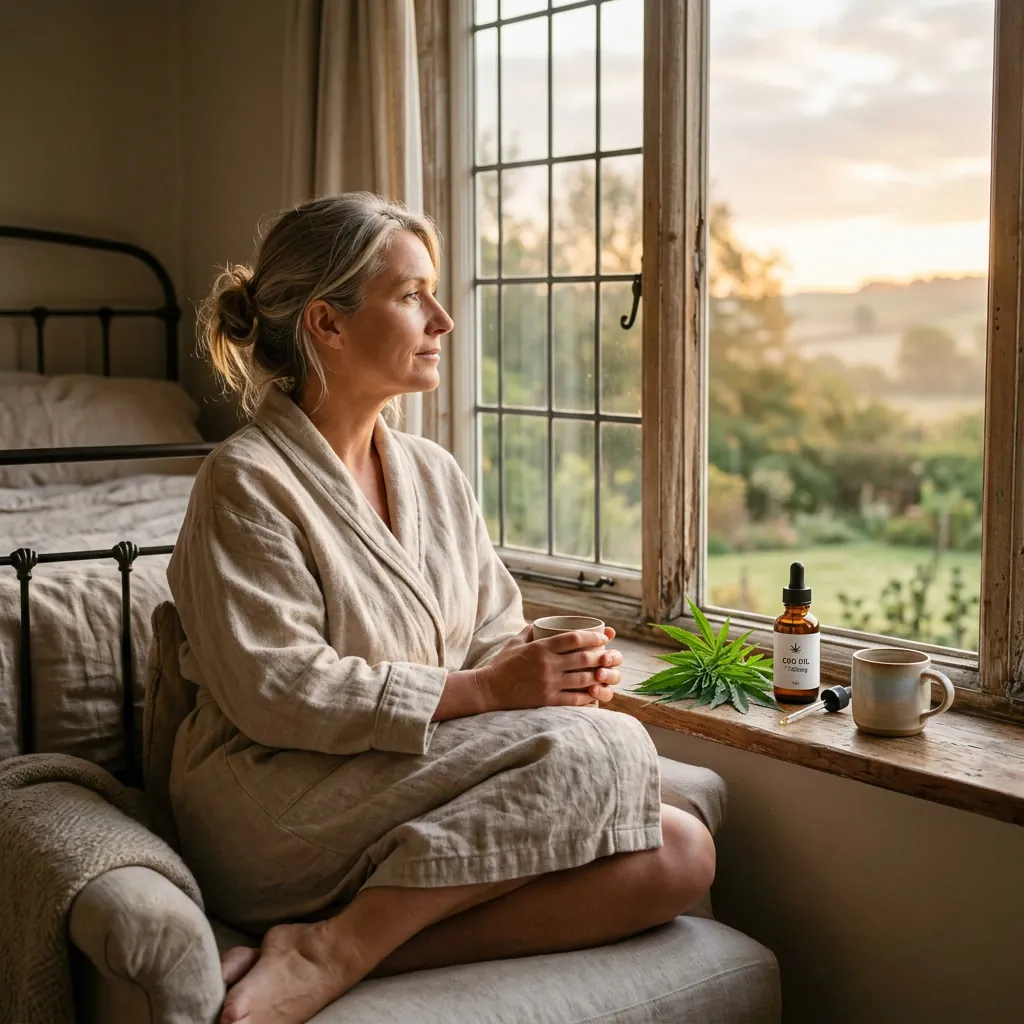
You slept badly again. You woke at 3 a.m. drenched, threw off the covers, then lay there with your heart going a little too fast and your mind running through every worry you had managed to park during the day. By morning the irritation had settled into your bones, along with an ache in your knees that wasn't there two years ago. You are 46. Your periods are still coming, just not on schedule. Your doctor says your bloodwork is "normal." And somewhere between the brain fog and the hot flashes, someone in a Facebook group told you that CBD changed their life.
So you start Googling, and you find two extremes. One camp promises CBD is a gentle miracle for every symptom of the change. The other insists it is an unregulated wellness fad with no evidence whatsoever. Neither is telling you the truth, which is messier and more useful than either story.
Perimenopause is the decade-long run-up to menopause, and the symptoms that send women searching for help — hot flashes, broken sleep, anxiety, joint aches — are real, common, and under-treated. This guide covers what the research actually shows, where it is silent, and how to try CBD without wasting money or taking a risk you didn't know about.
First, What Perimenopause Actually Is
Menopause is a single moment in time: the day that marks 12 months since your last period. Perimenopause is everything that leads up to it — on average four to eight years, sometimes longer — when your hormones are not declining in a tidy straight line but swinging up and down unpredictably.
That irregularity is the whole point. Estrogen can spike higher than it ever did in your 20s one month and crater the next. Progesterone falls earlier and more steadily. The result is a moving target of symptoms that arrive, vanish, and return, which is exactly why perimenopause is so hard to pin down and so easy to dismiss.
It is also why a single blood test rarely tells you much. During perimenopause, hormone levels can look totally normal on the day you are tested and be completely different a week later. Diagnosis is usually based on symptoms and age, not on a lab value.
Why Almost Nobody Talks About It
Perimenopause sits in an awkward blind spot. It isn't the dramatic milestone of menopause, and it isn't the culturally familiar territory of PMS or pregnancy. Women in their 40s are often at peak career and caregiving load, so fatigue and mood swings get blamed on stress, and joint pain gets blamed on aging.
There is a research gap too. Much of the clinical guidance women are handed was built around menopause itself, or around hormone therapy started after periods have stopped. The perimenopausal years — the ones where most women first feel something is wrong — are comparatively under-studied.
What that means for you: if you feel dismissed, you are not imagining it. The system is genuinely behind on this stage of life. That also means you should be cautious about anyone who claims to have a definitive answer, whether they are selling hormone panels or hemp oil.
The Symptoms Women Actually Seek Help For
When researchers survey midlife women about why they use cannabis or CBD, the answers are strikingly consistent, and they are not the answers the marketing usually leads with.
A 2023 cross-sectional survey in BMJ Open, led by researchers at the University of Alberta, asked 1,485 women aged 35 and over about their cannabis use and menopause symptoms. Among the 499 current users, the most common reasons for use were:
- 65% → sleep
- 45% → anxiety
- 33% → muscle and joint achiness
More than three-quarters of those current users said they were using it for medical reasons, and 74% said it helped. It is worth reading that number carefully. "It helped" is a self-report, not a clinical trial result — but it is a strong signal about what women are actually reaching for, and it does not match the hot-flash-forward picture most articles paint.
Hot flashes and night sweats remain the signature perimenopausal complaint, and they are the one place where CBD's evidence is thinnest. More on that below.
What the CBD Evidence Actually Shows
Here is the honest headline: there is no high-quality clinical trial showing that CBD treats perimenopausal hot flashes, night sweats, or mood symptoms. What exists is a mix of small human studies, surveys, and basic science — useful for context, not for promises.
The most commonly cited human study is a 2023 case series in Cannabis and Cannabinoid Research (PMID 37721991). Two postmenopausal women with osteopenia took 100 mg or 300 mg of oral CBD daily for 12 weeks. CBD was well tolerated with no adverse events, and markers of bone turnover shifted — but the researchers found no notable change in sleep disturbance, depression, anxiety, stress, or quality of life. Two people, no control group. It is a safety signal, not proof of symptom relief.
A 2026 study in the Journal of Neuroendocrinology (PMID 42476954) compared CBD with hormone therapy in rats whose estrogen had been suppressed, looking at memory and the endocannabinoid system. It is genuinely interesting for the mechanism — estrogen and the endocannabinoid system talk to each other — but it is an animal model, and you cannot dose yourself into a rat result.
For anxiety and sleep, the picture comes from broader research, not from menopause studies. A large 2026 systematic review and meta-analysis in Lancet Psychiatry (PMID 41856154) pooled 54 randomized trials of cannabinoids for mental health conditions. It found no significant effect on anxiety outcomes, some evidence of increased sleep time in people with insomnia, and generally low-certainty evidence overall.
And a 2026 systematic review of CBD brain-imaging studies in Frontiers in Neuroimaging (PMID 42494831) concluded there is "a lack of consistent evidence" for CBD's acute effects on stress and anxiety-related brain activity.
Put together, the honest summary is this: CBD may help some people sleep a little better and feel a little calmer, but the strongest trials say the anxiety effect is not reliably there, and nobody has shown it works on the core perimenopausal symptoms.
The Gap Between Marketing and Evidence
Perimenopausal and menopausal women are a fast-growing CBD customer segment, and the industry knows it. That is why you see "hormone balancing" tinctures and "menopause relief" gummies with zero clinical backing behind the label.
There is nothing illegal about most of that, because CBD sold as a supplement is not held to the standard of a drug. It does not have to prove it works. It only has to avoid claiming to treat a disease.
The result is a wide-open space for confident nonsense. Phrases like "balances your hormones" have no established mechanism for CBD at consumer doses. If a product promises to fix your estrogen, it is telling you something the science cannot currently support.
None of this means CBD is worthless. It means you should separate two questions: does this product probably help me sleep or feel calmer, and is it making a claim nobody can back up? The first can be a reasonable experiment. The second is a reason to close the tab.
Why Midlife Women Are a Growing CBD Demographic
There are good reasons this shift is happening, and most of them are about gaps in care rather than marketing genius.
Women in perimenopause often feel rushed or dismissed in short appointments. Hormone therapy is not right for everyone, antidepressants help some symptoms but bring trade-offs, and the most disruptive symptoms — the 3 a.m. wake-ups, the low-grade anxiety — fall into a space with no clean pharmaceutical answer.
So women do what women have always done when the system leaves a gap: they self-educate and experiment. A 2024 qualitative study in Menopause (PMID 38980742) interviewed 12 midlife women using cannabis for menopause symptoms and found a recurring theme — limited information, a limited role for healthcare providers, stigma, and a heavy reliance on self-education and word of mouth.
That is not a great way to make health decisions. It is, however, an honest description of the situation. The more you know going in, the better your odds of a sensible experiment.
Practical Dosing and Timing, If You Decide to Try
If you are going to try CBD, treat it like a small personal experiment with a clear endpoint, not a leap of faith. Nothing here is medical advice for your specific situation, and if you take prescription medication you should read the next section before anything else.
Start low and go slow. A reasonable starting point for many people is 10–20 mg of CBD once daily, taken in the evening if sleep is your main target. Give it 2–3 weeks before judging it. If nothing changes, you can increase by 5–10 mg at a time, but do not chase a bigger number just because a bottle suggests 50 mg.
Track it. Keep a simple note of dose, time, how you slept, and how you felt. Patterns show up faster than you would expect, and they protect you from the trap of crediting CBD for a good week that was actually just a calm week.
Match timing to the symptom. Evening for sleep and night sweats. Late afternoon or early evening if anxiety builds as the day winds down. CBD is not a fast-acting rescue tool the way some people describe it; it builds a background level in your system.
Be realistic about the ceiling. If sleep is your goal, it is worth understanding how CBD compares to alternatives before you spend a lot — our breakdowns of CBD vs melatonin for sleep and CBD vs magnesium for sleep are a good place to start.
Choosing a Product Form
The form matters less than the dose and the label, but it changes how fast you feel anything and how easy it is to fine-tune.
Oils and tinctures are the most flexible for titration, since you can measure partial doses. This is usually the best place to start if you are experimenting with dose. You can browse CBD oils and tinctures for reference.
Gummies and edibles are convenient and consistent per piece, which makes them easy to track, but harder to adjust in small increments. See CBD gummies and edibles.
Capsules and softgels give you a fixed dose with no measuring and no taste, which suits people who want routine over flexibility. Look at CBD capsules and softgels.
Topicals are for localized aches, not for systemic symptoms like hot flashes or anxiety. If joint pain is your main complaint, CBD topicals and creams are the relevant category — though as with everything else here, the evidence for perimenopausal joint pain specifically is thin.
Whichever form you choose, read the third-party lab report. If a brand will not publish one, that tells you everything.
Interactions to Watch, Especially With HRT and Antidepressants
This is the section to take seriously. CBD is not inert, and the single most-studied issue is how it interacts with the liver enzymes that clear many common medications.
CBD is processed in part by the CYP3A4 enzyme, and a 2026 in vitro study in the European Journal of Drug Metabolism and Pharmacokinetics (PMID 42728549) examined how CYP3A4 activity shapes blood levels of CBD and its active metabolite. A 2026 modeling study in The AAPS Journal (PMID 42711610) specifically predicted CBD pharmacokinetics in older adults — a reminder that age changes how the body handles a dose.
In plain terms, CBD can slow the breakdown of other drugs and raise their levels. That matters most for:
- Blood thinners such as warfarin
- Antidepressants, including SSRIs
- Anti-seizure medications
- Some blood pressure and cholesterol medications
- Hormone therapy, which is metabolized through overlapping liver pathways
For many women, hormone therapy and CBD are the two things they are most likely to combine, and that combination has barely been studied. It is not automatically dangerous, but it is not something to guess at either.
> ⚠️ Talk to your prescriber before adding CBD if you take any daily medication. Bring the actual product and its stated dose. Pharmacists are often more useful than anyone here, because drug interactions are literally their field.
Our broader guide on CBD and menopause goes deeper on the hormone-therapy conversation if that is the stage you are in.
When to See a Doctor Instead
CBD is not the right tool for everything, and there are clear signals that you need clinical care, not a supplement.
See a doctor if your symptoms are interfering with work, relationships, or your ability to function. See one if you have bleeding between periods, bleeding after sex, or bleeding after menopause — that always needs evaluation. See one if the low mood has tipped into persistent sadness, loss of interest, or thoughts of harming yourself; that is not a CBD problem, and it needs real treatment.
If it turns out your symptoms overlap with something else, the cause may be different from what you assumed. Heavy, painful periods are worth investigating on their own, and our guides on CBD for PMS and menstrual cramps and CBD for endometriosis cover those paths. PCOS, which can resemble perimenopause in its cycle chaos, is covered in CBD for PCOS.
And if you are recently postpartum and reading this because the symptoms feel familiar, that is a very different hormonal situation — CBD for postpartum recovery is the more relevant read.
A good perimenopause conversation with a clinician can cover hormone therapy, non-hormonal prescription options, sleep strategies, and lifestyle changes. CBD can be one line item in that plan, but it should not be the whole plan.
Action Steps
1. Pin down what you are actually trying to fix — sleep, anxiety, hot flashes, or joint pain. Each has a different best option.
2. Get the basics right first. Consistent sleep timing, alcohol reduction, and strength training do more for perimenopausal symptoms than most supplements.
3. If you take any prescription medication, check with your prescriber or pharmacist before starting CBD.
4. Start at 10–20 mg in the evening, keep a two-week log, and adjust slowly. Do not buy a high-dose bottle on day one.
5. Choose a brand that publishes third-party lab results and states the CBD dose per serving clearly.
6. Set a review date. If nothing has changed in four to six weeks at a sensible dose, stop, and put the money toward something with better evidence.
7. Keep your doctor in the loop. Perimenopause has real treatment options, and self-managing with CBD alone should not mean managing alone.
Bottom Line
Perimenopause is a years-long hormonal transition, not a single event, and the symptoms that drive women to try CBD — poor sleep, anxiety, joint aches — are real and under-served. But the evidence for CBD in this specific stage of life is genuinely thin. A small case series found no notable effect on sleep or anxiety in postmenopausal women, animal and imaging work is suggestive but preliminary, and the largest recent meta-analysis of cannabinoids for mental health found no reliable anxiety benefit and only low-certainty evidence for sleep. What CBD offers is a modest, low-risk experiment for some people — one that deserves a clear dose, a short trial, and a doctor who knows what you are taking. It is not a hormone therapy, and it is not a cure. Approached honestly, it can be a small tool in a much bigger toolkit. Approached as a miracle, it will disappoint you, and so will the bottle that promised it wouldn't.
Find Your Perfect CBD Product
Take our 2-minute quiz to get personalized recommendations based on your needs.
Take the Quiz →Disclaimer: This article is for informational purposes only and does not constitute medical advice. CBD products are not FDA-approved to treat, cure, or prevent any disease. Always consult with a qualified healthcare professional before starting any new supplement, especially if you have a medical condition or take medications.