The Endocannabinoid System: How CBD Actually Works in Your Body
You've probably heard the phrase "CBD works with your body's endocannabinoid system" a hundred times. But what does that actually mean? Picture this: you're lying in bed after a stressful day, your shoulders tight, your mind replaying the same conversation on a loop. You reach for a CBD oil, take a few drops under your tongue, and wait. An hour later, you feel a little more settled. Is it placebo? Or is something real happening beneath the surface?
The honest answer is that something real is happening — and it's happening inside a network most people have never heard of, even though it was only discovered a few decades ago. The endocannabinoid system, or ECS, is one of the most important regulatory systems in your body, and it's the reason CBD has become so popular. Understanding how it works won't just satisfy your curiosity. It will help you choose better products, set realistic expectations, and get more value from every drop you take.
What Is the Endocannabinoid System?
The endocannabinoid system is a cell-signaling network that helps your body maintain balance, or homeostasis. It's involved in regulating sleep, mood, appetite, pain perception, immune response, and stress — a system that has drawn interest in conditions like long COVID. Think of it as a master thermostat that constantly reads the conditions in your body and makes small adjustments to keep everything running smoothly.
What makes the ECS remarkable is how recently we learned about it. Scientists were studying how THC produces its effects in the brain when they realized there had to be a natural system in the body that THC was mimicking. That search led to the discovery of the ECS in the early 1990s, and it fundamentally changed how researchers think about cannabis and the human body.
The ECS is made up of three main components that work together like a lock, a key, and a cleanup crew.
The Three Main Components of the ECS
To understand how CBD works, you need to know the three pieces of the puzzle:
- Endocannabinoids, the body's own signaling molecules
- Cannabinoid receptors, the docking stations on your cells
- Metabolic enzymes, the cleanup crew that breaks everything down
Each component plays a specific role, and together they form a feedback loop that your body uses constantly, whether or not you ever touch a cannabis product.
Endocannabinoids: The Body's Own Keys
Endocannabinoids are molecules your body produces naturally. The name comes from "endo," meaning inside, and "cannabinoid," because they act on the same receptors that plant cannabinoids like THC and CBD do. The two most studied endocannabinoids are anandamide and 2-arachidonoylglycerol, usually shortened to 2-AG.
Anandamide is sometimes called the "bliss molecule" because of its role in mood and reward. It's produced on demand, meaning your body makes it when it's needed rather than storing it for later. 2-AG is more abundant and plays a major role in pain signaling and immune function. Together, they help your body respond to stress, injury, and changes in its environment.
CB1 and CB2 Receptors: The Docking Stations
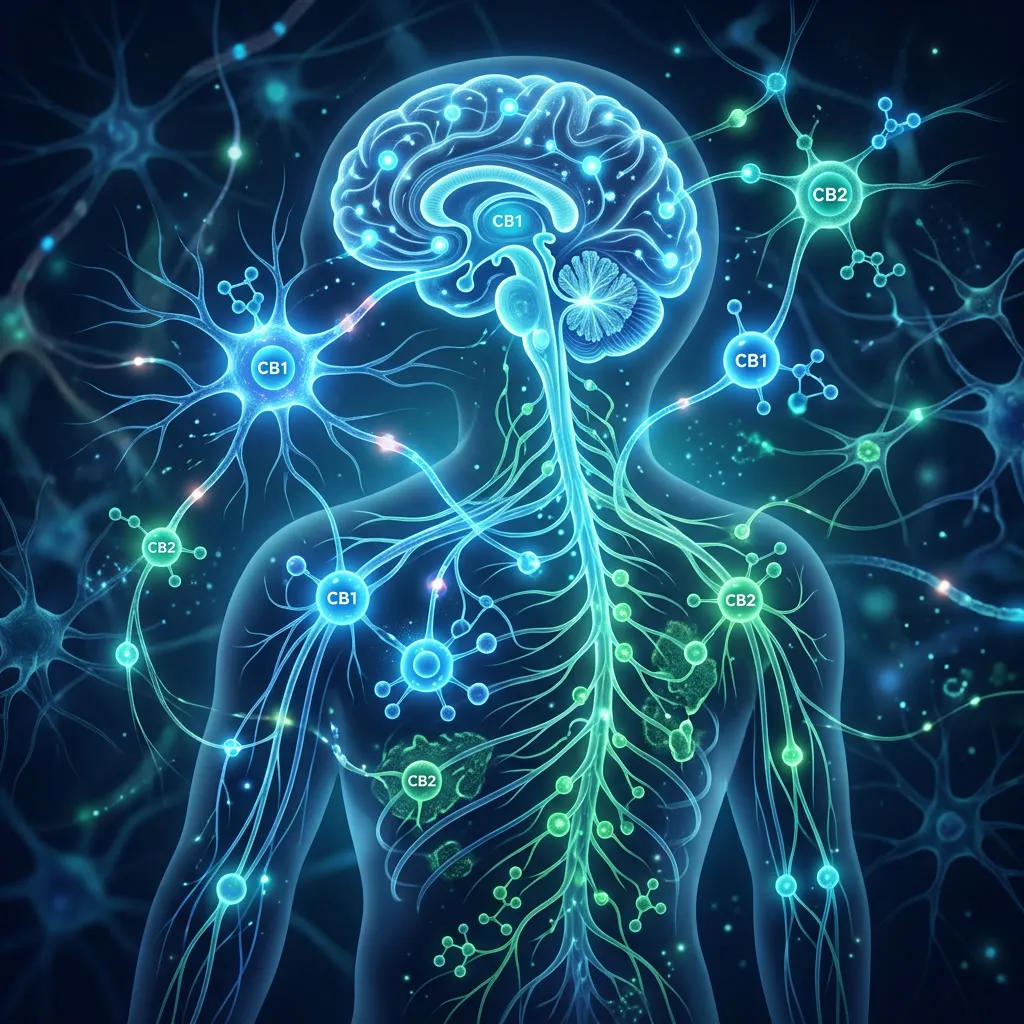
Cannabinoid receptors are proteins on the surface of your cells. When an endocannabinoid binds to a receptor, it triggers a response inside the cell. There are two main types, and they're located in different parts of the body.
CB1 receptors are found most densely in the brain and central nervous system. They influence mood, memory, appetite, and pain perception. This is where THC does most of its work, which is why THC produces a psychoactive effect. CB2 receptors are found more heavily in the immune system and peripheral tissues. They're involved in inflammation and immune response, which is why they matter so much for anyone interested in CBD for discomfort.
The location of these receptors is a big part of why cannabis affects so many different systems at once. Your body is dotted with these docking stations, and the ECS uses them to send signals all over.
Metabolic Enzymes: The Cleanup Crew
Once an endocannabinoid has done its job, it needs to be broken down so the signal doesn't keep firing. That's the job of metabolic enzymes. The two most important are fatty acid amide hydrolase, or FAAH, which breaks down anandamide, and monoacylglycerol lipase, or MAGL, which breaks down 2-AG.
This cleanup step matters more than you might think. If anandamide hangs around longer, its effects last longer. And as you'll see, this is one of the key ways CBD influences the system.
How the ECS Maintains Homeostasis
The ECS's core job is homeostasis — keeping your internal environment stable despite constant changes around you. When you're hot, your body sweats to cool down. When you're hungry, you eat. When you're stressed, your heart rate rises. The ECS is involved in coordinating many of these adjustments.
Here's how the loop works in practice. When your body detects a disturbance, it produces endocannabinoids on demand. Those molecules travel to nearby receptors and bind to them, triggering a response that helps correct the imbalance. Once the job is done, enzymes break the endocannabinoids down, and the system returns to baseline.
What's striking is that the ECS is always active, even in people who have never consumed cannabis. It's not a system that exists to process THC or CBD. It's a fundamental part of human biology that those plant compounds happen to interact with.
How CBD Interacts With the ECS
This is where things get interesting, because CBD works very differently from THC. THC binds strongly to CB1 receptors, which is why it produces a high. CBD, on the other hand, does not bind strongly to CB1 or CB2 receptors. It works indirectly, through several different pathways at once.
One of the most important effects is on the enzyme FAAH. By inhibiting FAAH, CBD may help anandamide stay active in the body for longer. Instead of being broken down quickly, the "bliss molecule" gets more time to do its work. This is one reason CBD is associated with a sense of calm without the intoxicating effects of THC.
CBD also interacts with other receptors outside the classic cannabinoid pair. It acts on TRPV1, a receptor involved in pain and temperature perception, and it influences serotonin receptors, which play a role in mood and anxiety. It can even affect the way other cannabinoids bind to receptors, which is part of why the entourage effect matters.
Recent research has continued to map these pathways. A 2025 review in the International Journal of Molecular Sciences examined the endocannabinoid system in human disease, detailing how CBD and other phytocannabinoids interact with CB1 and CB2 receptors and the enzymes that regulate them. A 2026 review in Biomedicines took a similar look at the ECS in neuropsychiatric disorders, exploring how dysregulation of the system contributes to conditions like anxiety and depression — and how modulating it may offer therapeutic potential.
The takeaway is that CBD is a gentle, indirect modulator rather than a strong lock-and-key activator. It nudges the system toward balance instead of switching it on hard. That's a big part of why CBD feels different from THC and why it's generally well tolerated.
Endocannabinoids vs. Phytocannabinoids
It's easy to get these two categories confused, so let's make the distinction clear. Endocannabinoids are produced inside your body. Phytocannabinoids are produced by plants, most famously cannabis. The "phyto" prefix means plant.
THC and CBD are the two most famous phytocannabinoids, but cannabis produces many others, including CBG and CBN. When you take a CBD product, you're introducing plant-derived cannabinoids into a system that already has its own internal version. The plant compounds can support, mimic, or influence the activity of the body's natural endocannabinoids.
This is why the quality and composition of your product matters. A full-spectrum product contains a range of phytocannabinoids and other plant compounds, which some research suggests work better together than in isolation. That synergy is called the entourage effect, and it's a key reason many people prefer full-spectrum oils over isolates. You can read more about how these compounds work together in our companion guide to the entourage effect.
The Clinical Endocannabinoid Deficiency Hypothesis
If the ECS helps maintain balance, what happens when it isn't working properly? That's the question behind the clinical endocannabinoid deficiency hypothesis, or CECD. Proposed by researcher Ethan Russo, the hypothesis suggests that some people may have a chronically low level of endocannabinoid activity, which could contribute to conditions like migraine, fibromyalgia, and irritable bowel syndrome.
It's important to be clear that CECD is a hypothesis, not a proven diagnosis. There's no widely accepted test for it, and the evidence is still developing. But the idea has gained attention because it offers a framework for why some people seem to respond well to cannabinoid-based products. If your ECS is underactive, supporting it with phytocannabinoids might help restore balance.
Recent reviews have kept this conversation alive. A 2025 review in the International Journal of Molecular Sciences examined how ECS dysregulation is linked to a range of human diseases, and a 2026 review in Biomedicines explored how altered endocannabinoid signaling contributes to neuropsychiatric conditions. Both underscore that while the ECS is clearly important, the science of diagnosing and treating endocannabinoid deficiency is still in its early stages. Treat CECD as an interesting and plausible theory rather than settled science.
Why This Matters for Choosing CBD Products
Understanding the ECS changes how you shop for CBD. If CBD works indirectly and gently, then consistency and quality matter more than chasing a single dramatic effect. Here's what the science suggests you should look for:
- A product with a clear, third-party-tested potency so you know what you're getting
- A full-spectrum or broad-spectrum formula if you want the potential benefits of the entourage effect
- A delivery method that actually gets the CBD into your system, since absorption varies widely
- A consistent daily routine, because gentle modulation often builds over time
The delivery method is especially important. CBD taken under the tongue absorbs differently than CBD swallowed in a capsule, and the difference can be significant. If you're new to this, our guide to bioavailability and delivery methods breaks down how each option works and which might suit you best.
CBD and Inflammation: A Closer Look
Because CB2 receptors are concentrated in the immune system, there's a lot of interest in how CBD might influence inflammation. Preclinical studies indicate that CBD can affect inflammatory pathways, and this is one of the most active areas of research. However, it's important to distinguish between what happens in a lab dish and what happens in a human body.
Some research suggests CBD may help support a healthy inflammatory response, but the evidence in humans is still building. If inflammation is your main concern, it's worth reading our dedicated guide to CBD and inflammation for a more detailed look at the current state of the science.
The Discovery of the ECS
The story of the ECS is a reminder of how young this field really is. In the 1960s, Raphael Mechoulam's team at the Hebrew University of Jerusalem identified the structure of THC, the main psychoactive compound in cannabis. That work laid the foundation for everything that followed.
Decades later, in 1992, Mechoulam's team discovered anandamide, the first endocannabinoid found in the human body. It was a landmark moment because it proved that the body produces its own cannabinoid-like molecules. The discovery of 2-AG followed, and researchers gradually mapped out the receptors and enzymes that make up the system.
The fact that the ECS was only discovered in the early 1990s is worth sitting with. It means we're still in the early chapters of understanding it. Much of what we know is real and well-documented, but there's also a lot we don't know yet — which is why responsible brands and writers avoid overpromising. The recent wave of reviews, including the 2025 and 2026 papers we've referenced, shows how quickly the field is still evolving.
What CBD Can and Can't Do
With the ECS in mind, let's set realistic expectations. CBD is not a cure-all, and it doesn't work the same way for everyone. What the science supports is that CBD interacts with a real, important system in your body, and many people report feeling calmer, more comfortable, and better rested when they use it consistently.
What CBD is not is a magic switch. It doesn't bind to receptors the way THC does, so it won't produce a dramatic, immediate high. Its effects tend to be subtle and cumulative. That's actually a feature for many people, because it means CBD can be used regularly without intoxicating effects.
If you're considering CBD for a specific health condition, it's always worth talking to a healthcare professional. CBD can interact with certain medications, and it's not a substitute for medical treatment.
How to Get Started With CBD
If you're ready to try CBD, here's a simple path forward. Start with a product that has a clear label and third-party testing. Choose a delivery method that fits your lifestyle, and begin with a modest dose. Keep a simple journal of how you feel, and adjust slowly over a week or two.
For most beginners, a CBD oil or tincture is a good starting point because it's easy to adjust the dose drop by drop. If you prefer something more convenient and consistent, capsules and softgels offer a set dose in a familiar format. Either way, give it time. Because CBD works indirectly through the ECS, the effects often build gradually rather than appearing all at once.
The Bottom Line
The endocannabinoid system is a real, essential part of your biology, and it's the reason CBD has become so widely used. It's made up of endocannabinoids like anandamide and 2-AG, CB1 and CB2 receptors, and metabolic enzymes like FAAH and MAGL. Its job is to help your body maintain balance, and it does this constantly, whether or not you use cannabis.
CBD works with this system indirectly. It doesn't bind strongly to CB1 or CB2 receptors the way THC does. Instead, it inhibits FAAH to help anandamide last longer, acts on receptors like TRPV1 and serotonin receptors, and supports the broader balance of the system. That's why CBD tends to feel gentle and calming rather than intoxicating.
The science is still young — the ECS was only discovered in the early 1990s — but the fundamentals are well established, and recent reviews in the International Journal of Molecular Sciences and Biomedicines continue to deepen our understanding of how it works. When you choose a quality product, use a delivery method that absorbs well, and stay consistent, you're giving your body's own regulatory system a helping hand. That's not hype. That's just how CBD actually works.
Find Your Perfect CBD Product
Take our 2-minute quiz to get personalized recommendations based on your needs.
Take the Quiz →Disclaimer: This article is for informational purposes only and does not constitute medical advice. CBD products are not FDA-approved to treat, cure, or prevent any disease. Always consult with a qualified healthcare professional before starting any new supplement, especially if you have a medical condition or take medications.