CBD for Swelling: What the Evidence Can and Cannot Deliver
You roll an ankle on a Tuesday, and by Thursday it looks like a different ankle. Someone tells you CBD is anti-inflammatory and will bring the swelling down. You have a bottle in a drawer. The question of whether to use it is more interesting than either the marketing or the sceptics suggest.
This article is about CBD and swelling specifically. Not pain, not anxiety, not sleep. Swelling, which is a distinct process with a distinct biology, and which responds to different things than pain does.
The Short Answer
CBD has demonstrated anti-inflammatory effects in laboratory and animal models, and some of those models involve swelling. There is no human trial showing that CBD reduces swelling after an injury in any way you could measure at home. The gap between those two statements is the whole article.
What Swelling Actually Is
Swelling, or oedema, is fluid accumulating where it should not be. After an injury, it happens because blood vessels become more permeable, allowing plasma to leak into surrounding tissue, which is part of the inflammatory response that begins the healing process.
That framing matters because it means swelling is not simply a fault. It is an early phase of repair. The body is delivering cells and signalling molecules to the damaged area, and the fluid is the transport medium.
This is why indiscriminately suppressing inflammation after injury has repeatedly disappointed in trials. The response you are trying to blunt is also the response doing the work. Ice, compression, elevation and early gentle movement work not because they eliminate inflammation but because they manage its consequences without switching it off.
What the 2023 Onward Research Actually Shows
The CBD research on swelling splits into two groups, and conflating them is where most content goes wrong.
The first group is formulation science. A 2026 paper in Materials Today Bio described an in situ cannabidiol-loaded sponge attenuating cerebral oedema. A 2026 study in Pharmaceutics examined an amorphous solid dispersion hydrogel for transdermal delivery. A 2026 paper in Gels described 3D-printed mucoadhesive buccal films. A 2026 study in the International Journal of Molecular Sciences reported a cannabidiol-loaded nanosphere hydrogel.
These are real studies and they are about getting CBD to a specific tissue at a measured concentration, using a delivery system designed for the purpose. They tell you something is being investigated. They tell you nothing about whether rubbing an oil on your ankle does anything.
The second group is inflammation biology. A 2026 paper in Cellular and Molecular Biology Letters described a novel cannabidiol-derived TRP channel modulator. A 2026 study in Pharmaceutics reported CBD promoting epithelial restoration and reducing inflammation. A 2026 paper in Nutrients evaluated anti-inflammatory effects of Cannabis sativa extracts. A 2026 study in the International Immunopharmacology journal reported cannabidiol synergising with methotrexate to attenuate rheumatoid arthritis in a model.
That last one is worth pausing on because rheumatoid arthritis involves joint swelling, and the CBD finding is about synergy with an existing drug rather than replacement of it. That pattern, adjunct not substitute, recurs throughout the cannabinoid literature and is the most reliable thing you can learn from it.
The third small group is veterinary. A 2025 study in Frontiers in Veterinary Science examined efficacy, pharmacokinetics and safety of a liposomal synthetic cannabinoid. Pet owners ask this question constantly, and the honest answer is that the veterinary evidence is no stronger than the human evidence.
Why the Delivery Route Changes Everything
This is the most useful practical thing in the article.
Swelling after an injury sits in tissue, not in blood. To affect it, a compound has to reach that tissue at a meaningful concentration. Oral CBD does not distribute evenly, and a substantial fraction is metabolised before it reaches the bloodstream at all.
A CBD topical applied to intact skin faces the stratum corneum, which exists precisely to keep things out. How much crosses depends on the formulation, the vehicle, whether an occlusion dressing is used, and the thickness of the skin at that site. Reviews of topical cannabinoids consistently note that formulation determines everything, and that most commercial products have never been tested for penetration at all.
The CBD hydrogel and nanosphere papers above exist because researchers know this. They are engineering delivery systems specifically because a simple oil does not solve the problem.
The Timing Question After an Injury
If you are going to try CBD for swelling, timing matters more than dose, and the conventional wisdom is not what people assume.
Most of the visible swelling in the first 24 to 48 hours is not something you should be aggressively fighting with CBD or anything else. Elevation and compression reduce it mechanically without altering the underlying biology. That is why they work reliably and why they have survived decades of scrutiny.
After the acute phase, the useful work is restoring movement. Swelling that persists beyond a few weeks is a different problem and usually means the tissue is being loaded incorrectly or the injury is more significant than assumed. A supplement is the wrong response to persistent swelling, because persistent swelling is information.
What the Evidence Does Not Show
Stated plainly:
- It does not show that CBD reduces swelling after an injury in humans.
- It does not show that a CBD topical penetrates to the tissue where swelling sits.
- It does not show a dose, a concentration, or a formulation that works.
- It does not show that CBD is a substitute for ice, compression, elevation, or assessment by a clinician.
- It does not show that reducing swelling speeds recovery. Some evidence suggests the opposite in the early phase.
- It does not show that products marketed as anti-inflammatory contain what the label claims.
When Swelling Is Not an Injury
This section exists because the most dangerous thing about self-treating swelling is misidentifying it.
Swelling in one leg, particularly with pain in the calf, warmth and redness, can be a deep vein thrombosis, and CBD has no role in that situation. That is a medical emergency.
Swelling in both legs can indicate heart failure, kidney disease or liver disease. It is a sign of a systemic problem, not a local one.
Swelling with breathlessness, chest pain, or a swollen face and throat is an emergency and should be treated as anaphylaxis.
Swelling in a joint with fever and an inability to bear weight suggests infection, which damages a joint permanently if it is not treated quickly.
Sudden swelling in one arm after surgery on that side, or after a venous line, is worth urgent assessment.
None of those should be treated with a supplement. If any of that describes what you are looking at, the answer is a clinician today rather than an article.
The Interaction Question
CBD inhibits the enzymes that clear a long list of drugs, including anticoagulants, some blood pressure medicines, and several drugs used for inflammatory conditions.
If you are taking anything for inflammation or clotting, adding CBD changes the levels of what you are already on. That is not a theoretical concern in someone taking methotrexate, which is exactly the drug in the rheumatoid arthritis study above. Our guide to CBD and blood thinners covers the mechanism, and the liver safety guide explains why the enzyme pathway is the crux of most CBD interactions.
What Actually Helps Swelling
This is not an exciting list, and it is the list with evidence behind it.
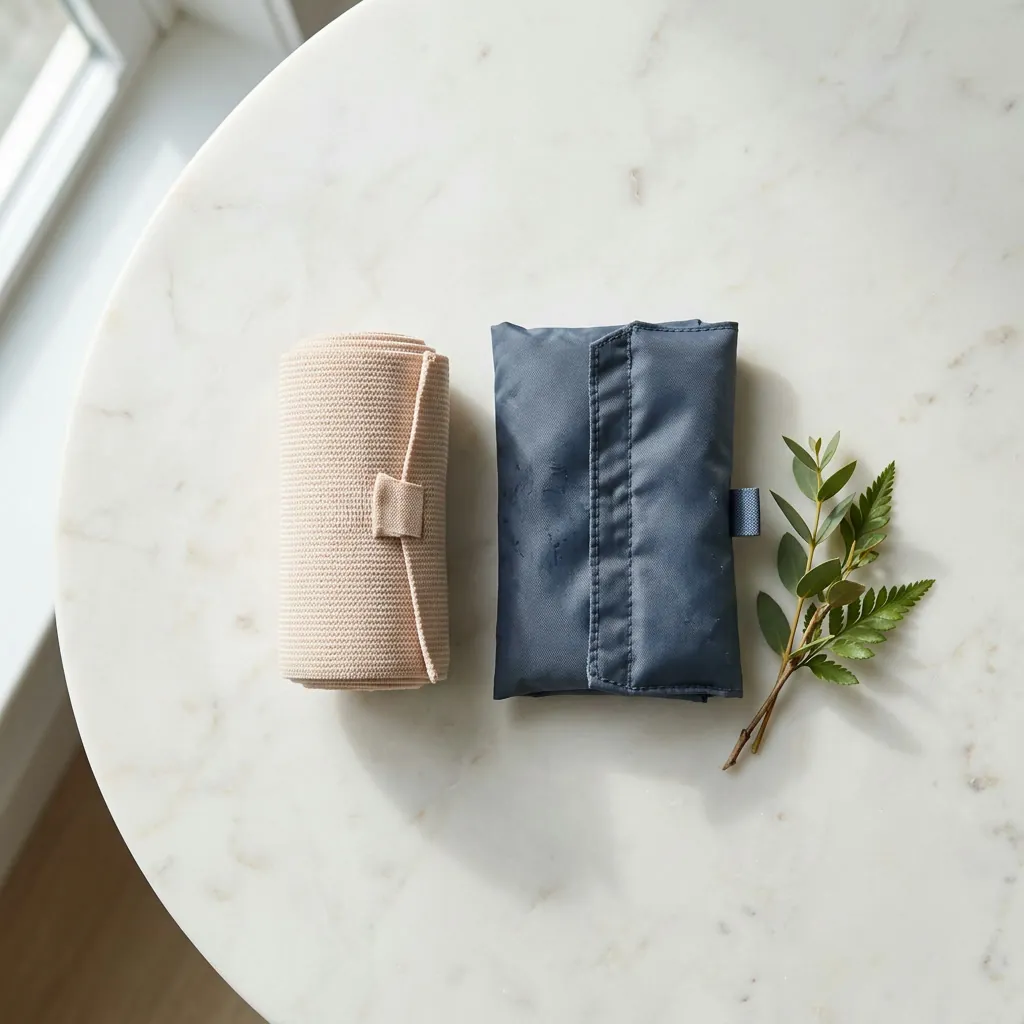
Elevation above heart level reduces the hydrostatic pressure that drives fluid into tissue. Compression does the same from the outside. Gentle movement of the surrounding joints pumps fluid through the lymphatic system, which has no pump of its own. Early assessment identifies the injuries that need more than conservative care.
If you want to add CBD on top of that, do it as an addition and tell whoever is treating you. What you should not do is substitute it for the basics, because the basics are the part that works.
Where CBD Might Genuinely Fit
The most defensible use in this territory is not swelling at all.
An injury that keeps you awake, or that makes you anxious about whether it will heal, is a sleep and distress problem rather than a CBD and swelling problem. CBD has been studied for both with modest and inconsistent results. Addressing sleep during recovery has a plausible route to helping you feel better, and our guide to CBD and physical therapy covers the rehabilitation side.
That is a different claim from reducing swelling, and only one of the two survives contact with the research.
How to Read a CBD and Swelling Study
Most of the papers in this field will be read by nobody except researchers, and the ones that reach you will reach you through a headline. Here is the checklist that separates a real finding from a press release.
First, what model. A mouse paw injected with carrageenan, a chemical irritant, is the standard laboratory model of swelling. It produces a reliable, measurable increase in paw volume, and it is about as far from a human ankle sprain as you can get while still being called inflammation. A rat with an induced arthritis is closer. A human with a sprained ankle is the only model that answers the question you actually have, and almost nobody studies it because it is expensive and the effects are small.
Second, what was measured. Paw volume measured with callipers is a reproducible laboratory number. A person's own sense that their ankle looks less puffy is not a measurement. Trials that report the first are doing science. Claims that rest on the second are anecdote, however sincerely offered.
Third, how was it given. Injection into the joint, injection under the skin, a formulated hydrogel applied to shaved skin, and an oil swallowed with breakfast are four entirely different pharmacokinetic situations. Most consumer claims borrow credibility from the first three while describing the fourth.
Fourth, what was the comparator. A study comparing CBD to nothing tells you that time passed and the animal recovered, which it would have done anyway. A study comparing CBD to an established anti-inflammatory, and finding it comparable or better, is a real claim. Those studies exist in this literature and they are a minority.
Fifth, what did the authors actually conclude. A surprising number of papers end with a sentence about therapeutic promise while the data show a modest effect in a small number of animals at a dose with no human equivalent. That sentence is where the overclaiming gets manufactured, and it is not usually the authors' fault. It is the press release's.
The Swelling Timeline Nobody Explains
Swelling after an injury follows a predictable course, and knowing it changes what you should do at each stage.
In the first hours, vessels dilate and become leaky, and fluid accumulates. This is the phase where elevation and compression do the most work, because they act mechanically on the pressure gradient rather than on the biology.
Over the next two to three days, the leaked fluid is gradually cleared by the lymphatic system while new blood vessels form and repair cells arrive. Gentle movement helps here because muscle contraction is what pushes lymph along. Complete rest, counterintuitively, slows this phase.
From roughly day three to week six, the tissue remodels. Swelling at this stage usually reflects loading that is either too much or too little. It is a feedback signal, not a disease.
Beyond six weeks, persistent swelling means something specific is wrong. It might be inadequate rehabilitation, a tendon or ligament that has not healed as expected, a joint that is not moving properly, or a diagnosis that was missed at the outset. None of those are addressed by adding a supplement.
The reason this timeline matters for the CBD question is that it tells you which phase a study was modelling. Most laboratory work models the first few hours. Most people asking the question are somewhere in the middle weeks. Those are not the same problem.
What the Delivery Science Is Actually Telling Us
It is worth reading the formulation papers properly, because they contain an implicit admission.
When researchers publish a paper about a cannabidiol-loaded nanosphere hydrogel, or an amorphous solid dispersion, or a 3D-printed mucoadhesive film, they are not doing that because CBD works easily. They are doing it because plain CBD does not reach the target tissue in useful quantities, and they are trying to solve that problem.
That is a legitimate and interesting line of research. It is also the strongest available argument against assuming a bottle of oil will do the same job.
Skin is a barrier with a purpose. The stratum corneum is a layer of dead, keratinised cells arranged specifically to keep water in and everything else out. Molecules cross it based on size, lipophilicity, charge and concentration gradient. CBD is lipophilic enough to be plausible, which is why topicals are marketed at all, but the actual flux depends on the vehicle, and most commercial products have not been tested for it.
If you want to know whether a topical penetrates, the only honest answer is that the manufacturer should be able to show you data. Most cannot, and the ones who can usually put it in a technical document rather than on the label.
The Expectation Problem
There is a specific trap in this subject that deserves naming.
Rubbing something on a painful, swollen area feels good. That is not a placebo effect in the dismissive sense. Massage has its own evidence base, touch alters pain perception, and the ritual of care has real psychological value during an injury that has made you feel helpless.
All of that is genuine, and none of it is CBD.
This means that a person who applies a CBD balm and feels better has learned something true, which is that the application helped. They have not learned that the CBD in it did anything. Separating those two requires a blinded trial, and blinded trials of topicals are rare precisely because the tingling, the smell and the texture all give the product away.
So the honest position is not that people are imagining their relief. It is that the relief is real and the attribution is unproven.
Questions People Actually Ask
Is CBD better than ibuprofen for swelling?
There is no head-to-head human trial that would let anyone answer this. Ibuprofen has decades of trial data, a known mechanism, a known dose and a known risk profile. CBD has none of those in this context. That is not a claim that ibuprofen is safer, because it is not risk-free either, particularly for the stomach and kidneys. It is a claim about the state of the evidence.
Can I use it alongside ice and compression?
Nothing in the literature suggests a problem with that combination, and nothing suggests a benefit either. If you are going to try it, adding it to the things that work is the sensible order rather than replacing them.
Does it matter whether it is full-spectrum or isolate?
For swelling specifically, nobody has tested the difference in humans. For other outcomes the entourage argument is plausible and unproven. The practical consideration is that full-spectrum products contain THC, which has its own effects and its own interaction profile.
How long before I would know?
This is the question that exposes the weakness in the whole premise. If you cannot define what you would measure, at what time, and what result would change your mind, then you are not running an experiment. You are hoping. For an injury, the outcome that matters is whether you can return to normal activity, and that is determined by rehabilitation rather than by the supplement.
Is a CBD cream safer than an oral oil?
Generally yes, in the narrow sense that less reaches the bloodstream, which means fewer systemic interactions. Our liver safety guide explains why systemic exposure is the thing that drives interaction risk. Less absorption is a genuine advantage for a topical, and also the reason it is less likely to do anything at all.
What about swelling from a chronic condition rather than an injury?
That is a different question with a different literature, and the answer depends entirely on which condition. Swelling from heart failure, kidney disease or lymphoedema is not an inflammation problem and CBD is not a plausible intervention. Swelling from an inflammatory arthritis is an inflammation problem, and even there the evidence is animal models and synergy studies rather than standalone efficacy.
Bottom Line
The CBD research on swelling is real but preclinical, and much of it is about engineering better delivery systems rather than demonstrating that a product works. There is no human evidence that CBD reduces post-injury swelling, no established dose, and no reason to substitute CBD for elevation, compression, movement and assessment.
Swelling that is new, one-sided, painful, or accompanied by fever is a reason to seek care rather than a reason to try a supplement.
Find Your Perfect CBD Product
Take our 2-minute quiz to get personalized recommendations based on your needs.
Take the Quiz →Disclaimer: This article is for informational purposes only and does not constitute medical advice. CBD products are not FDA-approved to treat, cure, or prevent any disease. Always consult with a qualified healthcare professional before starting any new supplement, especially if you have a medical condition or take medications.