How to Use CBD for Nerve Pain and Sciatica: What the 2023–2026 Research Actually Shows
It starts without warning. You bend over, and suddenly a bolt of electricity shoots from your lower back down into your leg. Or maybe it's not dramatic — just a persistent burning tingle in your foot, a creeping numbness in your toes. If you've felt this, you know: nerve pain is different from ordinary muscle soreness. Sciatica, diabetic neuropathy, pinched nerves — they share that strange signature of pain that seems to travel rather than stay put.
If you're living with this, you've probably tried heat, stretching, painkillers — and you may wonder whether CBD could help. It's a fair question, and the science has moved forward in recent years.
Here's the honest picture up front: CBD is not a cure for nerve damage, and it's not a replacement for the medication your doctor prescribed. But a growing body of 2023–2026 research suggests CBD may genuinely help calm neuropathic pain and the anxiety that often travels with it.
What Nerve Pain and Sciatica Actually Are
Before we talk about CBD, it helps to understand what's happening in your body. Neuropathic pain isn't caused by tissue damage or inflammation in the usual sense — it comes from the nervous system itself misfiring. When a nerve is compressed, irritated, or damaged, it can send faulty pain signals to the brain even when there's no obvious injury to complain about.
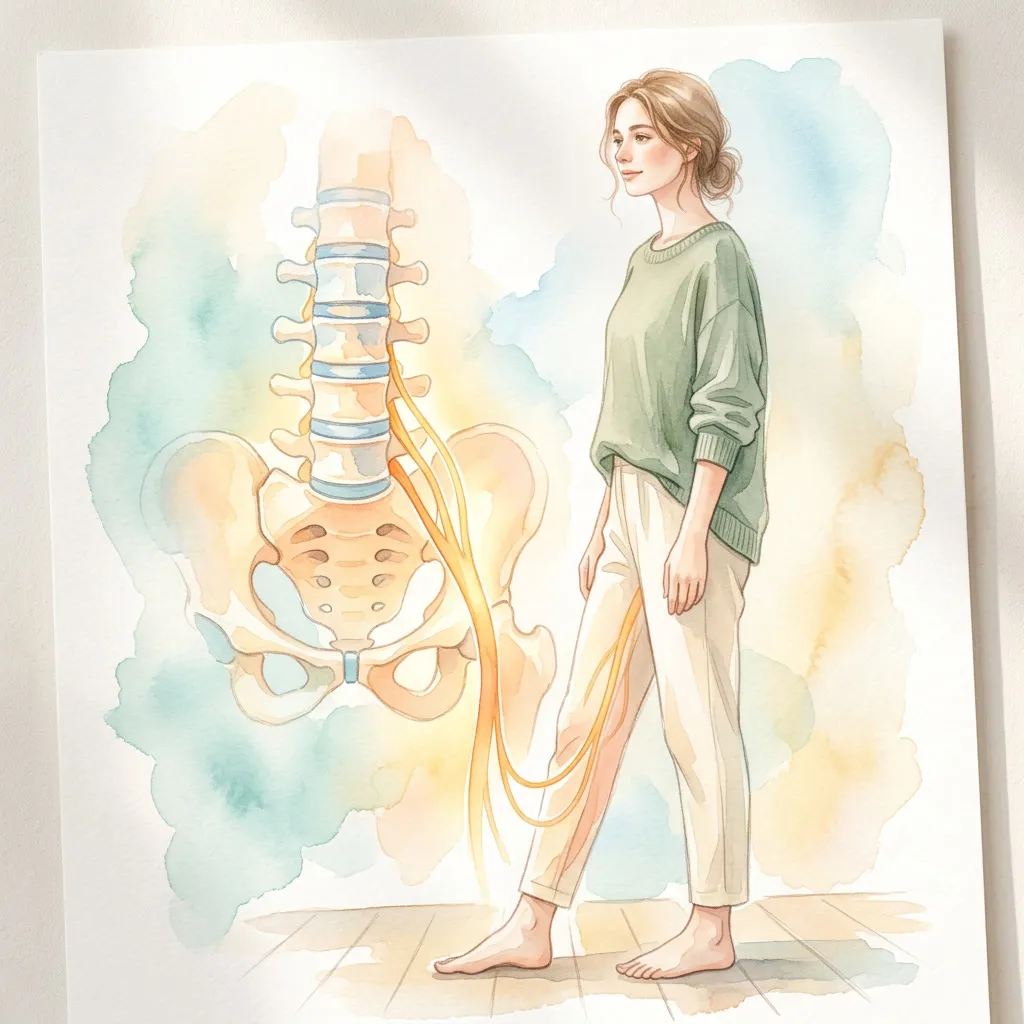
Sciatica is one of the most common forms of nerve pain. It happens when the sciatic nerve — the longest nerve in your body, running from your lower back down each leg — gets compressed or irritated, often by a herniated disc, bone spur, or tight muscle. The result is the classic shooting, burning, or tingling pain that radiates down one leg, sometimes with numbness or weakness.
- Shooting pain that travels down the leg, sometimes all the way to the foot
- Burning or electric sensations, like a hot wire under the skin
- Pins and needles — that familiar prickling, "asleep" feeling
- Numbness or weakness in part of the leg or foot
- Worse with sitting — sciatica often flares when you've been in one position for a while
Other common neuropathic pain conditions include diabetic neuropathy (nerve damage from high blood sugar, often in the feet), post-herpetic neuralgia (nerve pain after shingles), and nerve pain following surgery or injury. What they share is that the pain is neurological — which is exactly why a compound that interacts with the nervous system, like CBD, has attracted scientific curiosity.
Why Researchers Think CBD Could Help Nerve Pain
To understand CBD's potential, you need to meet the endocannabinoid system (ECS) — a widespread signaling network in your body that helps regulate pain, mood, sleep, and inflammation. It runs throughout your nervous system, including the pain pathways that carry those faulty signals from an irritated nerve up to your brain.
CBD doesn't get you high the way THC does, and it doesn't bind tightly to the classic cannabinoid receptors. Instead, it works in subtle, indirect ways — influencing how pain signals are processed, dampening inflammation around irritated nerves, and potentially calming the nervous system's overall sensitivity. Researchers describe CBD less as a traditional "painkiller" and more as a modulator of how your body perceives and processes pain.
A 2026 pharmacological review in the Central Nervous System Agents in Medicinal Chemistry examined the mechanisms of cannabinoids for neuropathic pain, covering how they may reduce the excessive signaling that drives nerve pain and how that science is translating into clinical practice. The takeaway: the mechanistic rationale for CBD in neuropathic pain is solid — the question is how well it works in real people.
> "The pharmacological rationale for targeting the endocannabinoid system in neuropathic pain is compelling, and clinical translation is increasingly the focus of current research."
The 2026 Research: Five Studies Worth Knowing
Let's be concrete about the actual evidence. Here's what recent peer-reviewed research specifically tells us about CBD and nerve pain.
Cannabinoids for Neuropathic Pain: A Mechanistic Review
A 2026 review in the Central Nervous System Agents in Medicinal Chemistry took a deep look at how cannabinoids address neuropathic pain — the mechanisms involved, and the current state of clinical translation. Reviews like this matter because they synthesize dozens of studies and give us the clearest picture of where the science stands. The consistent thread: neuropathic pain is a strong target for cannabinoid-based approaches, though researchers emphasize the need for more large-scale human trials.
CBD in the Brain's Insular Cortex
Perhaps the most fascinating recent finding comes from a 2026 study in Psychopharmacology. Researchers found that cannabidiol in the anterior insular cortex — a brain region involved in processing pain and emotion — attenuated chronic neuropathic pain and comorbid anxiety. This matters for two reasons. First, it points to a specific brain mechanism for CBD's effects on nerve pain. Second, it connects pain and mood — anxiety and depression are extremely common companions to chronic nerve pain, and this study suggests CBD may help with both at once.
Topical CBD for Localized Pain
Not all CBD research involves the brain. A 2026 study in Cannabis and Cannabinoid Research evaluated a CBD-containing topical formulation for localized pain in fibromyalgia over a 12-week pilot. While fibromyalgia isn't exactly sciatica, it's a chronic pain condition, and the study is useful evidence that topical CBD applied to the skin can have measurable effects on localized pain — highly relevant if you're considering a cream for a specific spot.
Better Delivery: Nanolipid Formulations
One of the biggest practical problems with CBD is absorption — a lot of what you swallow doesn't make it into your bloodstream. A 2026 paper in Pharmaceutics addressed this head-on by examining cannabis-based nanolipid formulations for pain management. The idea is that these tiny lipid-based structures improve how much CBD your body actually absorbs, making the compound more effective at a given dose. For anyone frustrated that "CBD didn't seem to do anything," delivery and formulation are often the real culprit — not the CBD itself.
Monitoring Cannabinoids in Pain Management
Finally, a 2026 paper in the Journal of Pharmaceutical and Biomedical Analysis reviewed biosensing technologies for cannabinoid monitoring in pain management. This is a technical but important development: as CBD becomes a more common tool for pain, reliable ways to measure cannabinoid levels in the body help researchers understand dosing, consistency, and what therapeutic levels actually look like. It's a sign that the field is maturing from anecdote toward measurement.
Taken together, these 2026 studies don't claim CBD is a miracle cure. What they show is that the field is converging on a consistent story: CBD appears to modulate pain signaling at the nervous-system level, works through the brain's pain-and-emotion centers, can be delivered topically for localized relief, and is becoming easier to absorb and to measure. That's meaningful progress.
Topicals vs. Oils vs. Capsules for Nerve Pain
One of the most common questions is: which format should I use? It depends on where your pain is and how you want it to work.
Topicals and Creams
For pain that's localized to one area — say, your lower back or the path of your sciatic nerve — a topical cream, balm, or lotion makes intuitive sense. You apply it to the skin over the painful area, and the CBD works locally, often alongside soothing ingredients like menthol or arnica. A 2026 study in Cannabis and Cannabinoid Research evaluating a CBD topical for localized pain suggests this approach is worth taking seriously.
The catch: topicals don't reach your bloodstream in meaningful amounts, so they're best for localized discomfort, not whole-body nerve pain that radiates widely.
Browse our selection of CBD topicals and creams designed for targeted relief.
Oils and Tinctures
For systemic effects — that is, relief that reaches your whole body — oils and tinctures taken under the tongue are the most versatile option. Sublingual absorption means the CBD enters your bloodstream relatively quickly, and you can fine-tune your dose drop by drop. Given that nerve pain often involves widespread or radiating symptoms, this is why many people start with an oil.
A 2026 study in Psychopharmacology showing CBD's effect on chronic neuropathic pain in the brain's insular cortex is relevant here — that kind of central, whole-body effect points toward systemic delivery rather than just topical application.
Explore CBD oils and tinctures for flexible, adjustable dosing.
Capsules and Softgels
Capsules and softgels are the convenience option. Each capsule contains a fixed dose, so there's no measuring and no guessing — you just swallow it like a vitamin. The trade-off is that oral CBD takes longer to kick in (an hour or more) and, historically, absorption has been lower, though newer formulations are improving this. A 2026 paper in Pharmaceutics on nanolipid formulations is exactly the kind of research aimed at making oral CBD more effective.
Capsules are great if you want a consistent, low-maintenance daily routine for chronic nerve pain — the "set it and forget it" approach.
See CBD capsules and softgels for pre-measured daily dosing.
Which Should You Choose?
A practical framework:
- Localized pain in one spot → try a topical first for fast, targeted relief
- Widespread or radiating pain → a sublingual oil for systemic coverage
- Consistent daily maintenance → capsules for simplicity and routine
- Combination → many people use a daily oil or capsule and a topical for flare-ups
If you're weighing options and want a deeper look at how these fit into a broader pain strategy, our guide to CBD for chronic pain walks through the full picture.
How to Dose CBD for Nerve Pain
Dosing is where a lot of people go wrong — either starting too low and giving up, or too high and feeling nothing but disappointment (and a lighter wallet). There's no one-size-fits-all number, but there are sensible principles.
Start Low and Go Slow
The most reliable advice in the entire CBD field is also the most boring: start low, and increase slowly. Your body has its own endocannabinoid tone, and CBD affects everyone differently based on weight, metabolism, and symptom severity.
A Practical Starting Framework
- Beginners: 10–20mg per day, taken in one or two doses
- Moderate users: 25–50mg per day, split across the day if needed
- Experienced users: 50–100mg per day, often for more severe or chronic pain
For neuropathic pain, some people find they need to be patient — nerve pain can respond differently than ordinary muscle pain, and it may take consistent daily use over a couple of weeks before you notice a shift.
How to Take It
- Oils/tinctures: Hold under the tongue for 60–90 seconds before swallowing for best absorption
- Topicals: Apply to the painful area and massage in; reapply as needed
- Capsules: Take with food (especially something containing fat) to improve absorption
- Timing: Many people dose in the morning and evening to maintain steady levels
For a deeper, step-by-step breakdown, our CBD dosage guide is the place to start — it's built around exactly this kind of practical, adjustable approach.
Realistic Expectations: CBD Is Support, Not a Cure
Let's be completely honest, because you deserve accuracy over hype. CBD is not a cure for nerve damage, and the research does not support CBD replacing prescription medications for neuropathic pain — which often include nerve-pain-specific drugs like gabapentin or pregabalin.
What the 2023–2026 research does support is more modest and more credible:
- CBD may help modulate neuropathic pain signaling and inflammation around nerves
- CBD may ease the anxiety and mood symptoms that so often travel with chronic pain
- CBD is generally well-tolerated, with a better safety profile than many traditional pain medications
- CBD works best as a complementary layer — alongside, not instead of, your doctor's treatment plan
> The emerging picture is that CBD is a useful supporting tool for nerve pain — not a replacement for medical care, but a legitimate option to discuss with your doctor for symptom relief.
This framing matters. When you treat CBD as a complement rather than a miracle, you're more likely to use it sensibly, stick with it long enough to judge its real effects, and keep your actual medical treatment intact.
Safety and Drug Interactions
CBD is generally well-tolerated, but it is not risk-free, and the most important concern is interactions with other medications. Because CBD is processed by the same liver enzymes (the CYP450 system) that break down many drugs, it can change how those drugs behave in your body.
Pay special attention if you take:
- Blood thinners (like warfarin) — CBD can increase their effects
- Anti-seizure medications
- Certain antidepressants
- Blood pressure medication
- Any medication with a grapefruit warning — CBD interacts similarly
The rule of thumb is simple: talk to your doctor or pharmacist before adding CBD, especially if you take prescription medication. This isn't a formality — it's the single most important safety step in this entire guide.
Other practical considerations:
- Choose third-party-tested products — labeling accuracy varies, and independent lab results matter
- Start with a low dose to see how your body responds
- Avoid CBD if you're pregnant or breastfeeding unless your doctor says otherwise
- Watch for drowsiness — especially if you also take sedating medications
Action Steps
1. Talk to your doctor first. Especially if you take prescription medication, confirm that CBD is safe to add alongside your current treatment.
2. Pick your format. For localized sciatic pain, consider a topical; for systemic or radiating pain, consider an oil or tincture; for daily convenience, consider capsules.
3. Start low. Begin with 10–20mg per day and keep your existing treatment exactly as prescribed — CBD is complementary, not a substitute.
4. Track your symptoms. Keep a simple journal of dose, timing, pain level, and any side effects for two to three weeks.
5. Adjust slowly. If you see no effect after a week, increase gradually, using our CBD dosage guide to stay on track.
6. Reassess with your care team. Check back in after a few weeks and adjust based on what you actually experienced.
Bottom Line
Nerve pain and sciatica are genuinely difficult conditions, and CBD is not a cure and not a replacement for medical treatment. But the 2023–2026 research — mechanistic reviews, brain-focused studies, and better delivery methods — paints a credible picture: CBD appears to help modulate neuropathic pain signaling, may ease the anxiety that travels with chronic pain, and can be delivered topically or systemically. It's a legitimate supporting tool, not a magic bullet.
If CBD is something you're curious about, that's reasonable — just approach it the right way. Talk to your doctor, choose a third-party-tested product in the format that fits your symptoms, start low, and keep your existing treatment in place. That's what separates a useful addition from another disappointing bottle.
Find Your Perfect CBD Product
Take our 2-minute quiz to get personalized recommendations based on your needs.
Take the Quiz →Disclaimer: This article is for informational purposes only and does not constitute medical advice. CBD products are not FDA-approved to treat, cure, or prevent any disease. Always consult with a qualified healthcare professional before starting any new supplement, especially if you have a medical condition or take medications.