CBD for Bruxism and Teeth Grinding: What the 2026 Research Suggests
You wake up with a dull ache in your jaw, your temples tight, your teeth feeling worn. Maybe your partner has told you that you grind at night, or your dentist has pointed to flattened molars and asked if you're stressed. If that sounds familiar, you're not alone. Bruxism — the involuntary clenching and grinding of teeth, most often during sleep — affects a huge share of adults, and it's notoriously hard to treat. When conventional options like mouthguards and stress management feel limited, many people start wondering whether CBD could help.
It's a reasonable question, and the research is genuinely starting to look at it. In 2026, a hypothesis paper in Frontiers in Neuroscience proposed the endocannabinoid system as a target for bruxism, and a small but growing set of clinical trials has tested CBD in people who grind their teeth. But here's the honest part: this is emerging science, not established treatment. There is no clinical trial that proves CBD cures bruxism, and no one should treat it as a replacement for dental care.
This guide walks through what bruxism is, the stress and anxiety link, what the 2026 research actually says, the related evidence on CBD for anxiety and sleep, the honest limitations, and a practical how-to if you're curious about trying it.
What Is Bruxism, Exactly?
Bruxism is the repetitive grinding, clenching, or gnashing of teeth. It can happen while you're awake (awake bruxism, usually clenching) or while you sleep (sleep bruxism, usually grinding). Sleep bruxism is the more common and more damaging form, because you're not aware of it and the forces involved can be surprisingly strong — some people generate jaw-closing forces far beyond what normal chewing produces.
The condition is classified as a repetitive masticatory muscle activity rather than a simple habit. It's multifactorial, meaning it doesn't have one single cause. Stress and anxiety are strongly associated with it, but so are sleep disorders, certain medications, caffeine and alcohol, and even genetics. For many people, it's a combination of factors that builds up over time.
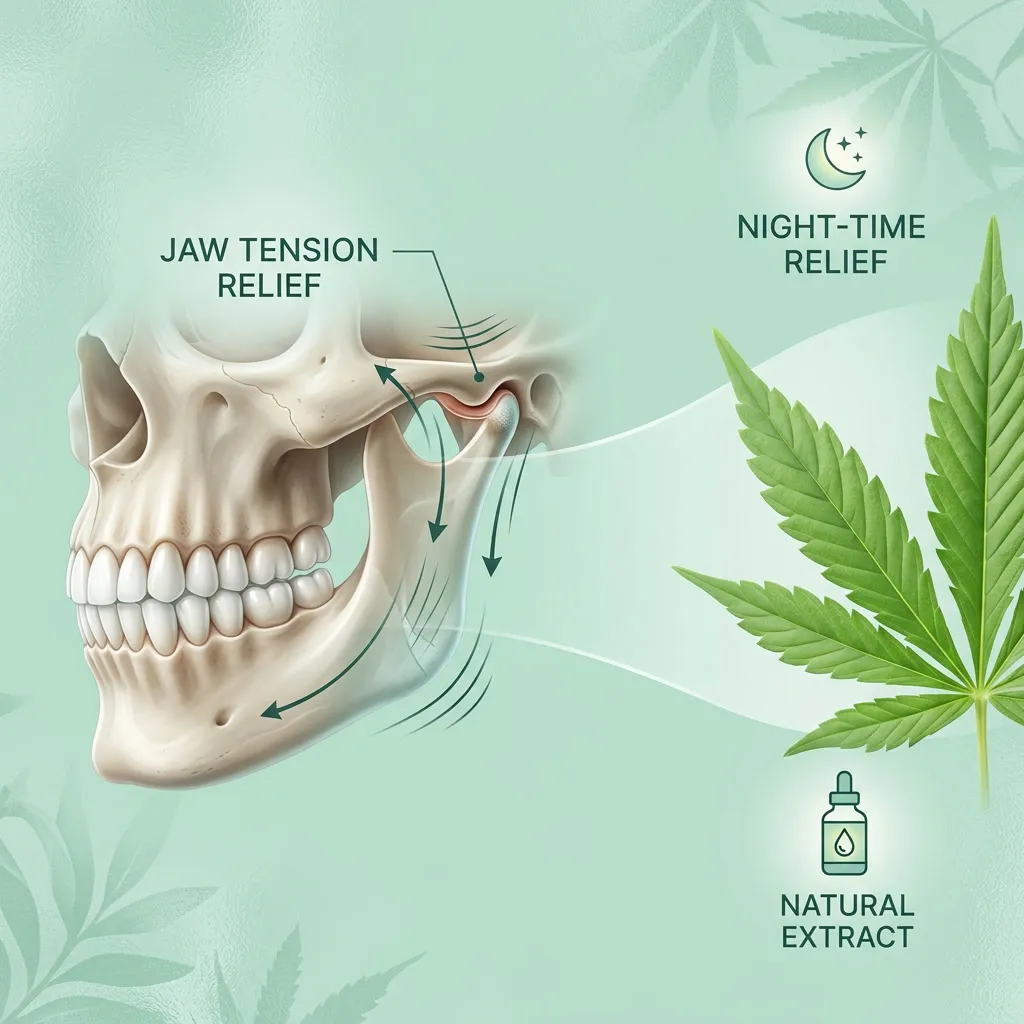
Why does it matter? Because the consequences are real. Chronic grinding wears down tooth enamel, can cause tooth sensitivity and fractures, and puts strain on the temporomandibular joint (TMJ) and the muscles of the jaw, face, and neck. That's why bruxism is closely tied to temporomandibular disorders, or TMDs — the most common non-dental source of pain in the maxillofacial region.
The Stress and Anxiety Connection
If you grind your teeth, you've probably noticed it gets worse during stressful periods. That's not a coincidence. Stress and anxiety are among the strongest and most consistently reported triggers for bruxism, particularly awake clenching. The link makes biological sense: stress activates the same neural pathways involved in motor control, emotional regulation, and muscle tension, and bruxism sits right at the intersection of all three.
This is one reason the endocannabinoid system has drawn attention. The ECS is a homeostatic regulator that helps modulate pain, mood, sleep, and stress responses. Because it touches so many of the systems involved in bruxism, researchers have begun to ask whether modulating it could help — which brings us to the 2026 hypothesis paper. If you want the deeper picture on how CBD interacts with your stress pathways, our guide to CBD and cortisol covers the science in detail.
The 2026 Hypothesis: The Endocannabinoid System as a Target
In 2026, a paper in Frontiers in Neuroscience laid out a detailed hypothesis: that the endocannabinoid system could be a target for bruxism. The authors describe bruxism as a motor behavior of predominantly central origin, tied to dysregulation of dopaminergic, serotonergic, GABAergic, and glutamatergic pathways — the same neurotransmitter systems involved in motor control, emotional regulation, and stress responsivity.
Their argument is that the ECS is uniquely positioned to integrate these systems. It influences pain processing, sleep-wake dynamics, and motor output, and it interacts with the neural circuits implicated in bruxism. The paper proposes a translational model in which ECS-mediated neuromodulation might influence the central mechanisms behind bruxism, including motor pattern generation, stress responsivity, and nociceptive processing.
Here's the crucial caveat: this is a hypothesis paper, not a proof. The authors are explicit that they are proposing a model for future research, not prescribing a treatment. It's an important scientific step — it gives researchers a framework to test — but it is not evidence that CBD works for bruxism. Treat it as a promising direction, not a conclusion.
What the Clinical Trials Actually Found
While the 2026 paper is a hypothesis, there is a small but real body of clinical trial evidence on CBD and bruxism. The most direct is a 2024 randomized, double-blind trial in the Journal of Clinical Medicine. Sixty patients with sleep bruxism and muscle-related TMDs were split into three groups: a 10% CBD formulation, a 5% CBD formulation, and a placebo. Over 30 days, the researchers measured muscle tension, pain, and bruxism intensity using surface electromyography and a device called Bruxoff. The results pointed to myorelaxant, pain-relieving, and bruxism-reducing effects in the CBD groups.
A 2025 follow-up in Pharmaceuticals looked at topical CBD gel applied to the masseter muscles nightly for 30 days in 60 patients with bruxism-associated muscle pain. Both the 5% and 10% CBD groups showed statistically significant improvements in sleep quality and migraine-related disability compared to placebo, with no significant difference between the two concentrations.
A 2025 pilot study in the Journal of Clinical Medicine tested a CBD gel, with and without a clay-based delivery enhancer called halloysite, in 20 adults with TMD. Both formulations significantly reduced masseter muscle activity, with average reductions around 37% in surface EMG readings. The halloysite version produced a more consistent response, though the difference between formulations wasn't statistically significant.
And a 2025 systematic review in the Journal of Clinical Medicine pulled together 10 studies on CBD for orofacial and upper-quarter pain. It concluded that CBD shows analgesic, anti-inflammatory, and muscle-relaxant effects in chronic myofascial TMDs and bruxism, particularly when applied topically or intraorally — while noting that results for acute pain were inconsistent and that studies varied widely in dosage and formulation.
The Honest Limitations
Before you get too excited, let's be clear about what this evidence does and doesn't show.
First, the sample sizes are small. The largest trial had 60 patients; the pilot had 20. That's enough to suggest a signal, but not enough to establish a treatment. Second, most of the positive results come from the same research group, and independent replication is still needed. Third, the studies used topical or intraoral gels applied to the jaw muscles — not the oral oils most people buy. That's a meaningful difference, because a gel applied directly to the masseter muscle is a very different intervention from swallowing a few drops of oil.
Fourth, and most importantly, there is no large, definitive clinical trial proving CBD reduces bruxism. The 2026 paper is a hypothesis. The trials are promising but preliminary. Anyone who tells you CBD is a proven cure for teeth grinding is overstating the science.
The Indirect Route: CBD for Anxiety, Stress, and Sleep
Even if the direct evidence is early, there's a plausible indirect route. Because stress and anxiety are major drivers of bruxism, and because poor sleep makes everything worse, anything that genuinely calms anxiety or improves sleep could, in theory, help reduce grinding. This is where the broader CBD evidence is stronger. The same logic applies to the tension that builds up in your jaw and neck — we've covered how CBD may help with tension headaches in a separate guide.
A 2026 systematic review in Frontiers in Neuroimaging examined functional neuroimaging studies of CBD under stress and anxiety conditions. It found that CBD may affect brain regions associated with stress and anxiety, though the authors noted the evidence is still limited and the pattern of modulation isn't fully consistent.
A 2026 randomized crossover trial in the Journal of Psychopharmacology tested low-dose CBD (20 to 200 mg) in 70 healthy volunteers. At 200 mg, CBD produced a modestly higher pleasant drug effect than placebo, but the authors emphasized that evidence for psychotropic effects at non-clinical doses is sparse and inconsistent.
Real-world data adds a practical angle. A 2026 cross-sectional study in Frontiers in Pharmacology looked at patients using CBD-rich medical cannabis oil under clinical supervision and found associations with improved quality of life and sleep satisfaction, measured with the Pittsburgh Sleep Quality Index.
The takeaway: CBD's effects on anxiety and sleep are real but modest and variable. If CBD helps you feel calmer and sleep better, it's reasonable to think that could translate into less clenching — but it's an indirect, individual effect, not a guaranteed mechanism.
How to Think About Dosing and Timing
If you're curious about trying CBD for bruxism, here's a sensible, conservative approach. There's no established dose for bruxism specifically, so the guidance below is general and based on how CBD is typically used for anxiety and sleep.
Start low and go slow. A common starting point is 10 to 20 mg of CBD once daily, taken in the evening. Because bruxism is mostly a nighttime problem, evening dosing makes sense — you want the effects to overlap with sleep. Track your response for one to two weeks before changing anything.
If you don't notice anything, you can increase gradually by 5 to 10 mg every few days, up to a reasonable range. Some people find 25 to 50 mg more effective for anxiety and sleep. But more isn't automatically better, and higher doses can cause drowsiness or digestive upset in some people.
Timing matters. For sleep-related grinding, take your dose roughly 30 to 60 minutes before bed. For daytime clenching, a smaller morning or midday dose might be more appropriate. Keep a simple journal: dose, timing, how you slept, how your jaw feels in the morning. Patterns usually show up within a couple of weeks.
Which Format Makes Sense
The clinical trials used topical or intraoral gels applied to the jaw muscles, which is worth noting. If you want to mirror that approach, a CBD balm or topical applied to the masseter muscle (the thick muscle at the angle of the jaw) could be a reasonable choice — though the trials used intraoral gels, which aren't the same as a surface balm.
For most people, though, an oral oil or tincture is the most practical option, because it's easy to dose precisely and it delivers CBD systemically, which is what you'd want for anxiety and sleep effects. CBD oils and tinctures are the most common format for this kind of use.
Whichever format you choose, look for a product with third-party lab testing, a clear CBD content per serving, and minimal THC. Full-spectrum products contain trace amounts of other cannabinoids, which some people find more effective, but if you're sensitive or drug-tested, a broad-spectrum or isolate product is safer. And since bruxism is ultimately a problem in your mouth, it's worth reading our broader guide to CBD for dental and oral health to see how the compound interacts with oral tissues.
Safety and Side Effects
CBD is generally well tolerated, but it's not risk-free. Common side effects include drowsiness, dry mouth, diarrhea, and changes in appetite. It can also interact with certain medications — notably blood thinners, antidepressants, and seizure medications — because it affects liver enzymes that process drugs. If you take any prescription medication, talk to your doctor before starting CBD.
There's also a practical safety point specific to bruxism: CBD should not replace a mouthguard or dental care. If you're grinding enough to damage your teeth, a custom-fitted night guard from your dentist is the proven first-line protection. CBD, at best, is a complementary tool — not a substitute for protecting your teeth.
When to See a Dentist
Bruxism can cause real, permanent damage, so it's worth taking seriously. See a dentist if you notice any of these signs:
- Worn, flattened, chipped, or sensitive teeth
- Jaw pain, stiffness, or difficulty opening your mouth fully
- A clicking or popping sound in your jaw
- Morning headaches or earaches
- Your partner reports loud grinding at night
A dentist can assess the damage, fit you for a night guard, and refer you to a specialist if the problem involves the TMJ. If stress and anxiety are driving your grinding, a mental health professional can help with that side of things. CBD might be a useful addition to your routine, but it's not a replacement for any of these steps.
Frequently Asked Questions
Is CBD proven to stop teeth grinding?
No. There's promising early evidence from small clinical trials, and a 2026 hypothesis paper proposes the endocannabinoid system as a target, but there's no large, definitive trial proving CBD reduces bruxism. Treat it as emerging science, not established treatment.
How long does it take to know if CBD helps?
Most people need one to two weeks of consistent evening dosing to judge whether it's helping with sleep, tension, or morning jaw soreness. Keep a simple journal and adjust gradually.
Should I use a topical or an oil for bruxism?
The clinical trials used topical or intraoral gels on the jaw muscles, so a topical is a reasonable mirror of that approach. But for the anxiety and sleep effects that indirectly help bruxism, an oral oil is more practical and easier to dose.
Can CBD replace my night guard?
No. A custom night guard is the proven way to protect your teeth from grinding damage. CBD, at best, is a complementary tool for the muscle tension and stress side of things — not a replacement for dental protection.
Is CBD safe to take every night?
CBD is generally well tolerated, but it can cause drowsiness, dry mouth, or digestive upset, and it can interact with certain medications. If you take prescription drugs, check with your doctor first.
The Bottom Line
Bruxism is common, stressful, and genuinely hard to treat, so it's understandable that people are looking at CBD. The 2026 hypothesis paper in Frontiers in Neuroscience gives the idea scientific credibility by proposing the endocannabinoid system as a target, and a small set of clinical trials has shown promising effects on muscle tension, pain, and sleep in people who grind their teeth. But this is early-stage evidence — small studies, mostly from one research group, using topical gels rather than the oils most people buy.
The most honest way to think about CBD for bruxism is as a complementary tool. If it helps you feel calmer, sleep better, and wake with less jaw tension, that's a genuine win — and the indirect evidence on CBD for anxiety and sleep supports that possibility. Just don't expect it to be a cure, and never let it replace a night guard or a dentist's advice. Start low, go slow, track your response, and talk to your doctor if you take other medications.
Citations
- PMID 42459362 | Frontiers in Neuroscience | 2026 | Endocannabinoid system modulation in bruxism: a neurobiological hypothesis and translational model of ECS-targeted intervention
- PMID 38592260 | Journal of Clinical Medicine | 2024 | Cannabidiol Intervention for Muscular Tension, Pain, and Sleep Bruxism Intensity — A Randomized, Double-Blind Clinical Trial
- PMID 40732351 | Pharmaceuticals (Basel) | 2025 | Expanding the Therapeutic Profile of Topical Cannabidiol in Temporomandibular Disorders: Effects on Sleep Quality and Migraine Disability in Patients with Bruxism-Associated Muscle Pain
- PMID 41517391 | Journal of Clinical Medicine | 2025 | Halloysite-Assisted Delivery of Cannabidiol for the Management of Temporomandibular Pain: A Pilot Study
- PMID 40565932 | Journal of Clinical Medicine | 2025 | Cannabidiol for Orofacial and Upper-Quarter Pain: A Systematic Evaluation of Therapeutic Potential
- PMID 42494831 | Frontiers in Neuroimaging | 2026 | Functional neuroimaging of Cannabidiol in stress and anxiety: a systematic review
- PMID 42454450 | Journal of Psychopharmacology | 2026 | Acute behavioural effects of low-dose cannabidiol: A randomised crossover trial in healthy volunteers
- PMID 42558508 | Frontiers in Pharmacology | 2026 | Real-world quality of life and sleep outcomes in patients treated with THC- and CBD-rich Cannabis oil: a cross-sectional study
Find Your Perfect CBD Product
Take our 2-minute quiz to get personalized recommendations based on your needs.
Take the Quiz →Disclaimer: This article is for informational purposes only and does not constitute medical advice. CBD products are not FDA-approved to treat, cure, or prevent any disease. Always consult with a qualified healthcare professional before starting any new supplement, especially if you have a medical condition or take medications.