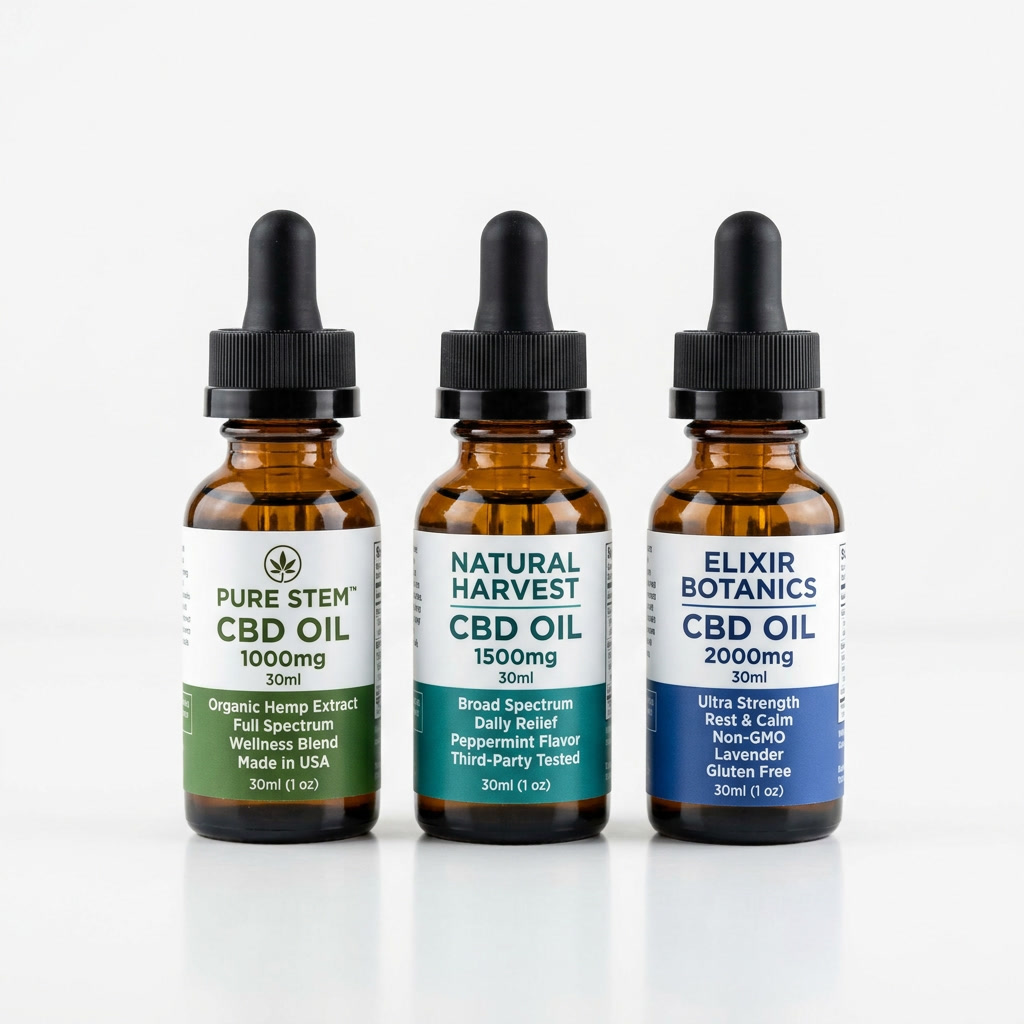
PEA Is Not CBD, and It Is Selling Fast for a Reason
You walk into a health shop looking for something for a bad shoulder that has been grumbling for eight months. Two bottles catch your eye. One says CBD. The other says palmitoylethanolamide, which nobody can pronounce, and it costs about the same. The person behind the counter shrugs and says people buy both.
That shrug is where most people stop, and it is a bad place to stop. These are two different molecules with two different mechanisms, two different evidence bases, and two very different safety profiles. The fact that both end up in the same pain aisle is a marketing accident, not a scientific one.
Here is what the research actually supports, where the hype outruns the data, and how to decide which one belongs in your cabinet.
What PEA Actually Is
Palmitoylethanolamide is a fatty acid amide. Your body makes it. It belongs to the same broad family as anandamide, the endocannabinoid that gets most of the attention, but it does not work the way people assume.
PEA does not bind CB1 or CB2 receptors in any meaningful way. It does not get you high and it carries no psychoactive effect at all. Instead it works through what researchers call an entourage effect at the cellular level. It raises levels of anandamide by competing for the enzyme that breaks it down, and it acts on peroxisome proliferator activated receptor alpha, usually written PPAR alpha.
A 2025 review in Biomedicines laid out the mechanism plainly. PEA is a multifunctional molecule with documented roles in neuroprotection, chronic pain signalling, and immune modulation. The paper describes it as acting on mast cells and glial cells, damping the inflammatory signalling that keeps a nerve or joint sensitised long after the original injury healed.
That is a different story from CBD. CBD is a promiscuous molecule that touches dozens of targets. PEA is narrow and specific. Narrow is not worse. In pharmacology, narrow often means predictable.
What the Pain Trials Show
PEA has something CBD mostly lacks in pain research. It has meta-analyses of double-blind randomised controlled trials.
A 2023 systematic review and meta-analysis in Nutrients pooled double-blind randomised trials of PEA in chronic pain. The findings supported a reduction in pain intensity across the included studies, with a safety profile that looked clean. That is the strongest form of evidence short of a single very large trial.
A 2024 follow-up in the same journal looked specifically at extended treatment with micronised oral PEA, meaning the particle size was reduced to improve absorption. The review again found support for pain reduction, and it addressed a practical question, whether longer courses keep working or fade.
Then in 2025, a meta-analysis in Nutrition Reviews revisited the whole field. That paper was notable because it deliberately tackled the literature gaps that earlier reviews had glossed over. It did not overturn the earlier findings, but it did push the confidence level down from "strong" to "reasonable," which is the honest place to land.
For diabetic neuropathic pain specifically, a 2026 systematic review and meta-analysis in the Journal of Diabetes and Metabolic Disorders examined efficacy, safety, and tolerability. Neuropathic pain is the hardest pain to treat and the one where patients are most desperate, so evidence in that population matters more than evidence in a general mixed-pain sample.
The pattern across all four papers is consistent. Effect size is modest. Tolerability is good. The trials are mostly small and mostly European. Nobody has run the kind of 3,000 patient trial that would settle it.
What the CBD Pain Trials Show
CBD has far more public attention and considerably messier evidence.
A 2025 narrative review in Cureus examined long acting synthetic cannabidiol for chronic pain. A 2024 review in Pain and Therapy looked at natural cannabis extracts and clinical benefits across pain indications. Both describe real signal and both describe serious methodological limits, including inconsistent dosing, variable product quality, and the fact that most trials use purified CBD while most people buy full spectrum oil.
The bioavailability problem is the one that bites hardest. A 2025 study in the Journal of Cannabis Research compared oil based and oil free formulations for enhancing CBD bioavailability. The conclusion was not subtle. The delivery format changes how much CBD actually reaches your bloodstream, sometimes by a factor of several.
A 2025 randomised single dose crossover study in the same journal compared two novel oral CBD formulations in healthy volunteers under fed conditions. The two products behaved differently. Same molecule, same milligram number on the label, different pharmacokinetics.
That means the question "does CBD work for pain" is partly unanswerable, because the answer depends on which CBD. A 2026 review in Molecules on CBD in dietary supplements made the same point at length, noting that route of administration and formulation are routinely ignored in consumer discussion while being decisive in the pharmacology.
The Label Problem Nobody Escapes
If you are choosing between PEA and CBD, product quality matters more than most people realise, and it matters far more for CBD.
A 2024 study in Frontiers in Pharmacology analysed commercial CBD product samples for label accuracy and contamination. The results were not reassuring. Measured cannabinoid content frequently diverged from the stated amount.
A 2026 analysis in the Journal of Cannabis Research used HPTLC to validate commercial CBD oils and found widespread label inaccuracy. The paper's title, Not What It Seems, is not marketing. It is the finding.
A 2025 study in Cannabis and Cannabinoid Research tested CBD gummy products by LC-MS/MS and found cannabinoid concentrations that did not match labels. Gummies are the fastest growing CBD category and among the least reliably dosed.
PEA sits in a different regulatory space. It is sold as a supplement or in some countries as a food, and it is a single synthetic or semi-synthetic compound rather than a plant extract with dozens of minor cannabinoids that vary by batch. That does not make every PEA product trustworthy. It makes the analytical problem simpler.
Where Each One Fits
This is the part that matters when you are standing in that shop.
Choose PEA when the problem is nerve pain, joint pain with an inflammatory component, or pain that has outlasted the original injury. The trial base, while imperfect, is built on double-blind randomised designs. The side effect profile is boring in the best way. It does not interact with much.
Choose CBD when you want a broader effect, including on sleep, anxiety, or the stress component that amplifies pain. CBD's evidence in anxiety and sleep is more developed than its evidence in pain. If your shoulder hurts and you also cannot sleep, CBD is doing two jobs.
Consider both only if you understand the interaction surface. Both influence the endocannabinoid system, and a 2024 study in BMJ Mental Health showed that oral CBD and THC produce dose dependent changes in serum anandamide and related N-acylethanolamines in healthy volunteers. Stacking two compounds that both raise anandamide is not automatically a good idea. It is a pharmacokinetic experiment you are running on yourself.
Do not assume higher dose is better with either. The dose response for CBD in particular is not linear. Some people do better on 15mg than 50mg. PEA trials typically used 300mg to 600mg twice daily, which is far above what most casual users take.
What to Check Before You Buy
The practical checks are short and they filter out most of the market.
Look for a batch specific certificate of analysis, not a generic one from eighteen months ago. The COA should show measured cannabinoid content by an accredited lab, plus a screen for heavy metals, pesticides, and residual solvents. If the brand cannot produce one for the batch you are holding, that is your answer.
For PEA, look for micronised or ultra micronised. Particle size affects absorption and the extended treatment review in Nutrients focused on micronised formulations for exactly that reason. Plain crystalline PEA at 300mg is not the same as micronised PEA at 300mg.
Check the carrier for CBD oils. A 2025 bioavailability comparison found oil based and oil free systems behave differently, so the carrier is not cosmetic. MCT oil is common and reasonable. Nano emulsions absorb faster but the evidence on whether faster means better for chronic pain is thin.
Check whether the product contains THC. Full spectrum products often do, at levels under the legal limit but high enough to matter if you are drug tested, driving, or sensitive to THC.
The Honest Limits
Two things need saying clearly.
First, neither PEA nor CBD is a substitute for treating the cause of pain. If a joint is mechanically damaged, no supplement fixes the mechanics. If a nerve is compressed, no capsule decompresses it. Supplements modulate the signalling around a problem. They do not remove the problem.
Second, the PEA literature is promising but small. The 2023 meta-analysis, the 2024 extended treatment review, and the 2025 reanalysis all draw on trials with modest sample sizes. The 2026 diabetic neuropathy review is the most specific and the most useful, and even it cannot claim the evidence is definitive.
CBD's literature is larger, louder, and in some ways weaker, because product variability contaminates everything. A trial using pharmaceutical grade CBD tells you very little about the bottle in your hand.
How to Run Your Own Comparison
If you want to find out which works for you, treat it as a controlled experiment rather than a hope.
Pick one. Do not start both at once because then you learn nothing.
Use a consistent dose for at least three weeks. Nerve pain and inflammatory pain both respond slowly. A single dose tells you almost nothing.
Track pain on a simple zero to ten scale at the same time each day, plus sleep quality and how much you needed to modify your activity. Write it down. Memory is a terrible measuring instrument for pain.
At three weeks, decide. If nothing moved, either the dose was too low, the product was poor quality, or the molecule is wrong for your problem. Try the other one, again alone.
If something moved, hold the dose and stop escalating. More is not better. The PEA trials that showed benefit used fixed doses, not escalating ones.
The Bottom Line
PEA and CBD are not competitors. They are different tools for overlapping problems, and the marketing has flattened that difference into a shelf of bottles with similar price tags and no explanation.
PEA has the cleaner trial design and the narrower mechanism. CBD has the broader effect and the far messier product landscape. For pure nerve or joint pain, the PEA meta-analyses are the stronger evidence base, even with their limitations. For pain tangled up with sleep and stress, CBD does more work at once.
Whichever you choose, the certificate of analysis matters more than the milligram number on the front of the bottle. A 2026 HPTLC analysis found commercial CBD oils routinely do not match their labels. That single fact should change how you shop far more than any marketing claim.
Start with one product, one dose, three weeks, and a written record. Treat it like a test you are running. Because that is exactly what it is.
If you want to compare specific formulations side by side, our CBD oil and tincture range lists the carrier and the measured potency for every product, and the capsule and softgel range is the easier route if you want a fixed dose you do not have to measure. For background on how CBD clears your system and what it does and does not interact with, see our breakdown of CBD drug interactions and the guide to CBD tolerance. If pain is your main problem, the CBD for pain category is the place to start.
Find Your Perfect CBD Product
Take our 2-minute quiz to get personalized recommendations based on your needs.
Take the Quiz →Disclaimer: This article is for informational purposes only and does not constitute medical advice. CBD products are not FDA-approved to treat, cure, or prevent any disease. Always consult with a qualified healthcare professional before starting any new supplement, especially if you have a medical condition or take medications.