CBG vs CBD: What Actually Differs, and What Does Not
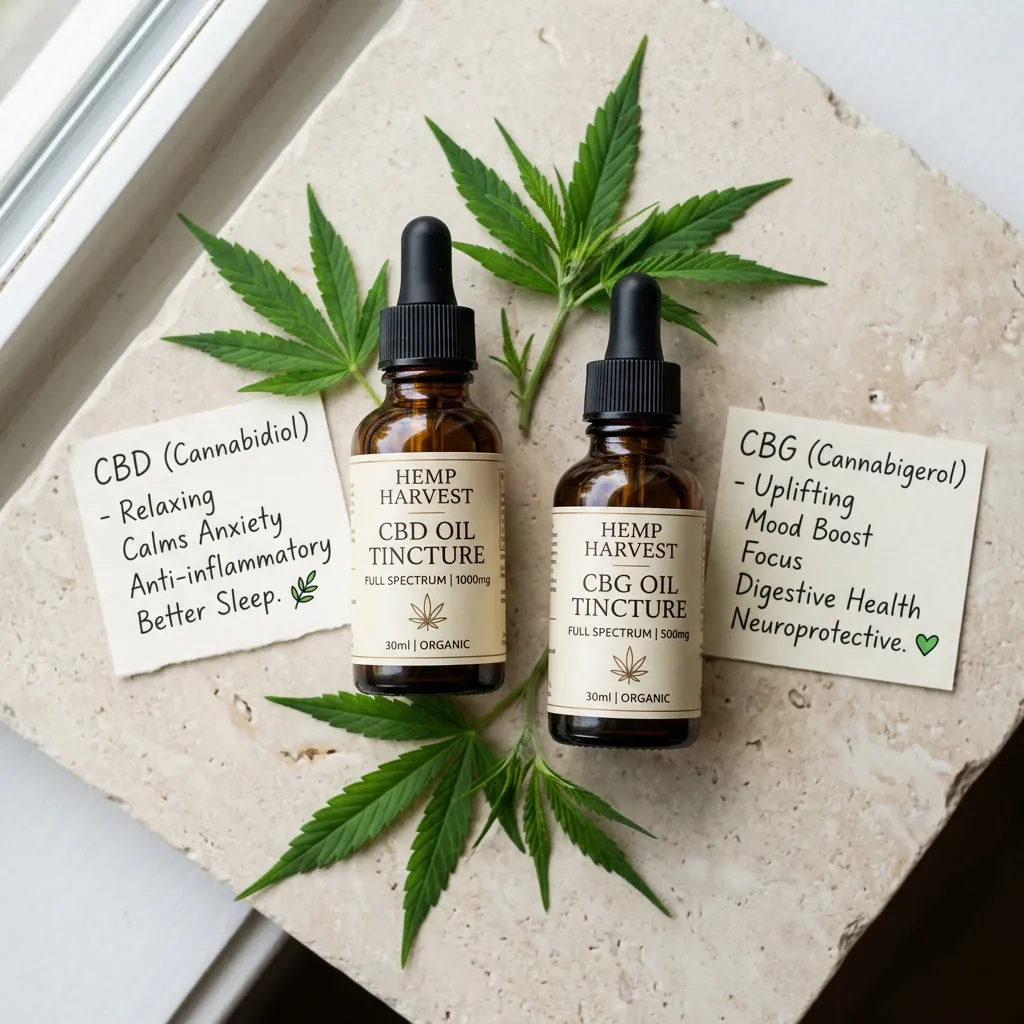
If you have spent any time browsing hemp products lately, you have probably noticed CBG nudging its way onto the shelf right next to CBD. The bottles look almost identical. The labels make nearly the same promises. It is easy to assume these are basically the same thing with a different letter in front, and to pick whichever one is on sale.
That assumption is understandable, and it is also mostly wrong, though not in the way the marketing usually suggests. CBG (cannabigerol) and CBD (cannabidiol) are both cannabinoids that come from the cannabis plant, and both are non-intoxicating for most people. Past that shared starting point, they differ in where they come from, how much of them a plant actually contains, and how they behave once they are inside the body. The honest catch is that CBD has years of human research behind it, while CBG is still mostly a laboratory story. So the useful question is not which one is stronger. It is which claims are genuinely supported, and which are simply borrowed from CBD because the two keep getting lumped together. Let us walk through what we actually know, including the parts that are still wide open.
Why These Two Get Compared So Often
Walk into any shop and you will see CBG sold in the same formats as CBD, with the same language on the label. That is not an accident. Both are sold as oils and tinctures, both are marketed for calm and balance, and both are pitched as the gentler, legal cousin of THC. When two products share a shelf, a price band, and a set of promises, shoppers naturally assume they work the same way and differ only in strength.
There is a little logic behind the comparison. CBG and CBD are both cannabinoids, meaning they belong to the same broad family of plant compounds that interact with the body's endocannabinoid system. Both are generally described as non-intoxicating. Both have attracted research interest for inflammation, pain, and skin. That is where the tidy parallel ends.
The differences start at the very beginning of the plant's life. CBG is often called the "mother cannabinoid" because it is the chemical the plant builds first. As the plant matures, enzymes convert CBG into other cannabinoids, including CBD and THC. By the time a plant is ready to harvest, most of the CBG has been used up in that conversion, which is why raw CBG is typically present in only tiny amounts compared with CBD. This single fact shapes almost everything else, from how the two are farmed to why CBG tends to cost more and why its research is further behind.
The Basic Difference: Where Each One Comes From
To understand the two, it helps to picture the plant as a small factory. Early on, cannabis plants produce CBGA, the acidic form of CBG. As the plant grows, enzymes act on CBGA and steer it down different paths. One path leads to THCA and eventually THC. Another path leads to CBDA and eventually CBD. CBG is the starting material, and CBD is one of the finished products built from it.
That means a plant that has been bred for CBD will usually contain very little CBG by the time it is harvested. Growers who want meaningful amounts of CBG have to plan for it differently. They may harvest earlier, choose specific genetics, or rely on selective breeding to slow the conversion down. The upshot for you as a shopper is simple. CBG is scarcer in nature, harder to produce at volume, and often more expensive per milligram. When a bottle advertises a large dose of CBG, that is a claim worth checking against a lab report rather than trusting at face value.
How CBG and CBD Interact With the Body
On the surface, both compounds are described as working with the endocannabinoid system, a wide network of receptors and signaling molecules involved in mood, sleep, appetite, pain, and immune response. But "working with" the system is a vague phrase that hides real differences.
CBD is best known for its indirect activity. Rather than plugging directly into the main cannabinoid receptors, it influences how other signals are handled, including the body's own endocannabinoids and various enzyme pathways. This indirect style is part of why CBD has such a broad, gentle reputation, and part of why it can interact with certain medications.
CBG is studied more for how it binds to specific receptors, and for how it affects particular enzyme systems in cells. Some of those pathways overlap with CBD and some do not. The practical point is that these are not interchangeable compounds. They nudge different corners of the same large system. If you are new to either one, it helps to start with a plain explanation of what CBD is and how it is typically used, which we cover in our guide to what CBD is.
What the Lab Research Shows, and How Early It Is
Here is the part that deserves the most honesty. Most of the exciting CBG headlines come from studies done in isolated cells, in test tubes, or in animals. Those studies are genuinely useful. They help scientists figure out which pathways are worth pursuing and where to focus future human trials. But cell and animal results often do not carry over to people in the way the headlines imply, and the phrase "in vitro" is doing a lot of quiet work in most of those stories.
With CBD, the situation is different. CBD has been through far more human research, including trials that looked at how it behaves in real patients over real periods of time. It also has an approved prescription form for specific seizure conditions. None of that makes CBD a cure-all, and it does not mean every over-the-counter CBD claim is proven. It simply means the body of evidence is deeper and more mature. For CBG, that body of evidence is still thin. That gap in maturity is the single most important difference between the two, and it does not appear in any advertisement.
The Liver Question: A Shared Concern
One area where both compounds get watched closely is the liver. A 2025 study in the journal Scientific Reports used a human quad culture liver chip to evaluate the potential liver effects of several cannabinoids together, including CBD, cannabinol, cannabichromene, and CBG. The liver chip is a lab model, not a living person, so the results are a signal for further study rather than a verdict. Still, the takeaway is worth noting. When researchers test multiple cannabinoids in the same liver model, they test them because the liver is where these compounds are processed, and because high doses of some cannabinoids have raised liver-related questions in the past.
For a regular shopper, this is less about panic and more about proportion. High doses taken daily, especially alongside other medications, deserve caution. If you take prescription drugs or have any liver condition, talk to a clinician before adding any cannabinoid, CBD or CBG. This is one of the few areas where both compounds sit in the same conversation, and where a little caution goes a long way.
A Closer Look at the AhR Pathway
One of the more specific differences to emerge from recent lab work involves a cellular switch called the AhR, short for aryl hydrocarbon receptor. A 2026 study in the journal Food and Chemical Toxicology found that CBG and CBD differ in their ability to affect this AhR pathway in vitro. In plain terms, the two compounds do not push the same cellular buttons in the same way.
The AhR pathway is involved in how cells respond to certain environmental and chemical signals, and it has drawn interest in inflammation and skin research. The fact that CBG and CBD diverge here is a genuinely useful finding, because it shows the two are not simply interchangeable doses of the same thing. It is still an in vitro result, meaning it comes from cells in a dish rather than people. So treat it as a clue about biology rather than a promise about your body. The broader theme holds, though. When scientists look closely, CBG and CBD behave differently, and those differences are real enough to study.
Pain and Nerve Research
Search the internet and you will find plenty of talk about cannabinoids and pain, which is why we wrote a full guide on CBD for chronic pain. The academic picture is more measured than the shop talk.
A 2025 paper in Contemporary Clinical Dentistry looked at the use of CBD and CBG in the treatment of trigeminal neuralgia and postherpetic pain, two painful nerve conditions. This is notable because it places both compounds in a clinical pain context rather than a lab dish, and because it covers CBG specifically, which is rare. Even so, the honest framing is that this is an early look at a difficult pain category, and one paper does not settle how well either compound works, or for whom, or at what dose. Nerve pain is notoriously hard to treat, and no cannabinoid is currently a standard first-line answer for it.
There is also a 2026 study in the British Journal of Pharmacology that examined how CBD and CBG ameliorate steatotic liver disease through mechanisms involving phosphocreatine buffering and lysosomal restoration. That is dense, but the plain version is that both compounds showed effects on liver cell stress in this model. Again, this is mechanistic research, and it points toward pathways worth following rather than a treatment you can buy. The takeaway is familiar by now. Promising mechanism, early stage, no human proof yet.
Why CBG Research Trails CBD So Far Behind
There are practical reasons CBG is studied less, and none of them are mysterious. First, CBG is scarce in the plant, so it is harder and more expensive to source in the quantities research needs. Second, CBD already had a head start, with years of public attention, funding, and human trials that built momentum and familiarity. Third, regulators and researchers tend to follow the evidence that already exists, so a compound with a thinner base attracts fewer studies, which keeps the base thin.
This is a quiet feedback loop, and it is worth understanding if you shop for these products. When a CBG label borrows claims from CBD research, it is leaning on a body of evidence that was never gathered for CBG. That does not make CBG useless or fake. It means the honest answer to "does CBG do this" is often "we do not know yet, and anyone who says otherwise is guessing." For CBG in particular, the maturity of the evidence is the story.
What This Means If You Are Shopping
So how do you use any of this without a science degree? Start by separating what is proven from what is plausible. CBD has a deeper human evidence base, so a CBD product making modest, careful claims has more behind it than a CBG product making the same claims. CBG is promising in the lab, but that promise has not yet been translated into human outcomes for most of the things it is sold for.
Then think about what you actually want. If you are exploring oils and tinctures for general daily use, our CBD oils and tinctures range is a reasonable starting point, and it is worth knowing the difference between single-compound and multi-compound products. That distinction is explained well in our guide to CBD isolate versus full spectrum. If you are curious about concentrated formats such as CBG, remember that a higher concentration is not the same as a stronger guarantee. It is just more milligrams of a compound we are still getting to know.
Price is another honest signal. Because CBG is costly to produce, a suspiciously cheap CBG product is a reason to slow down and read the paperwork. A real lab report tells you what is actually in the bottle, and that matters more than any front-of-label claim.
Reading Labels and Lab Reports
Whatever you choose, the label is your first line of defense. A trustworthy product will tell you the exact amount of each cannabinoid, not just the total, and it will point you to a batch-specific lab report. That report should be recent, matched to the bottle in your hand, and clear about what was tested.
This is where a lot of CBG and CBD marketing quietly unravels. Vague totals, missing batches, and reports that cannot be matched to a product are common. If you want a step-by-step method for checking these documents, our guide on how to read a COA breaks down what each section means and which numbers actually matter. A few minutes with a real report will tell you more than an hour of browsing product pages. It is the difference between trusting a promise and verifying a fact.
Action Steps
If you want to move from reading to doing, here is a short, practical path.
1. Decide what you are actually after. Write down whether you want general daily support, a specific format, or a single compound, and let that guide you instead of the loudest label.
2. Choose based on evidence, not hype. CBD has the deeper human research base. Treat CBG as promising but early, and be skeptical of any CBG claim that sounds like a settled fact.
3. Check the lab report before you buy. Match the batch to the bottle, confirm the individual cannabinoid amounts, and walk away if the paperwork cannot be matched.
4. Start low and go slow. Whichever compound you try, begin with a small amount, keep notes on how you feel, and give it time before deciding anything.
5. Talk to a clinician if you take medications. This matters most for the liver-related questions that apply to both CBD and CBG, and for anyone managing a health condition.
6. Keep your expectations honest. Non-intoxicating cannabinoids are not a cure, and the difference between a good product and a great one is usually transparency, not marketing.
Bottom Line
CBD and CBG are related, but they are not the same. CBG is the plant's starting material, CBD is one of the compounds built from it, and by harvest time most CBG has been converted into something else. That is why CBG is scarcer, costlier, and far less studied. In the lab, the two clearly behave differently, from how they affect the AhR pathway to how they act in liver models and pain research, and the studies we looked at here show real, specific divergence. What they do not show is proof that CBG delivers on the human outcomes it is often sold for.
So the calm, honest conclusion is this. CBD earned its reputation over years of research, including human trials, and even then the claims around it deserve scrutiny. CBG is genuinely interesting, but it is early, and much of what is said about it is borrowed from CBD rather than proven for CBG. If you want the safer bet on evidence, choose products with clear, verifiable lab reports and modest claims. If you are curious about CBG, go in with open eyes, start small, and let transparency, not enthusiasm, make the decision for you.
Find Your Perfect CBD Product
Take our 2-minute quiz to get personalized recommendations based on your needs.
Take the Quiz →Disclaimer: This article is for informational purposes only and does not constitute medical advice. CBD products are not FDA-approved to treat, cure, or prevent any disease. Always consult with a qualified healthcare professional before starting any new supplement, especially if you have a medical condition or take medications.