Is CBD Legal in My State? A 2026 Guide to CBD Legality by State
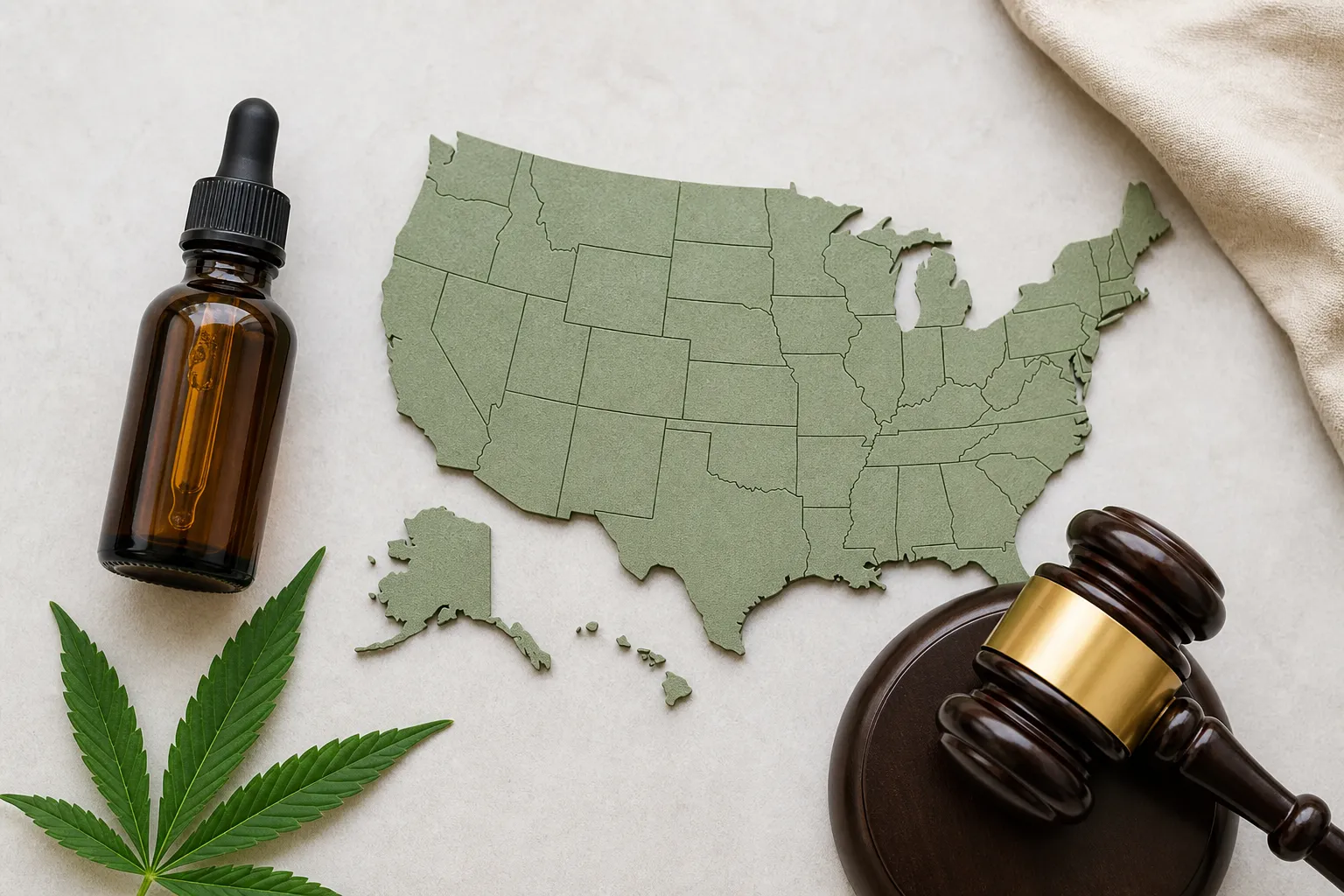
You finally decided to try CBD for your morning anxiety or that nagging back pain, and then you hit the wall: is CBD actually legal where you live? It's a fair question, and the answer is more complicated than a simple yes or no. The truth is that CBD's legality depends on a patchwork of federal rules, state laws, and one very important detail: where the CBD came from and how much THC it contains. One product might be perfectly legal in your state while a nearly identical bottle is not. This guide breaks down the 2026 landscape of CBD legality by state, explains the key distinctions that matter, and gives you practical steps to verify the rules where you live. We'll keep it factual and general, and we'll be clear about when you should double-check with local authorities, because state laws change and this is not legal advice.
The 2018 Farm Bill: The Federal Baseline
The starting point for almost all CBD law in the United States is the 2018 Farm Bill. This federal law removed hemp, defined as cannabis containing no more than 0.3% THC by dry weight, from the list of controlled substances. That single change made hemp-derived CBD federally legal, creating the modern CBD market you see in stores and online today.
Under the Farm Bill, hemp is treated differently from marijuana, which remains a federally controlled substance. The key takeaway is that the federal government considers hemp-derived CBD with under 0.3% THC to be legal to grow, process, and sell across state lines. This is the baseline that most states build their own rules on top of.
However, the Farm Bill did not force states to legalize hemp. It gave states the authority to regulate hemp production within their borders, and it left room for states to impose their own restrictions. That is why you can drive across a state line and suddenly find different rules about what you can buy and carry.
Hemp-Derived CBD vs Marijuana-Derived CBD: The Key Distinction
The single most important thing to understand about CBD legality is the difference between hemp-derived CBD and marijuana-derived CBD. These are not the same product in the eyes of the law, even though the CBD molecule itself is identical.
Hemp-derived CBD comes from cannabis plants that contain less than 0.3% THC. Because of the Farm Bill, this type of CBD is federally legal and available in most states without a prescription. It is the kind you find in gummies, oils, and topicals at health stores and online retailers.
Marijuana-derived CBD comes from cannabis plants that contain more than 0.3% THC. This type of CBD is only legal in states that have legalized medical or recreational cannabis, and it is typically sold through licensed dispensaries. If you live in a state without a legal cannabis program, marijuana-derived CBD is not legally available to you, even if hemp-derived CBD is.
This distinction matters because many people assume all CBD is the same. It is not, and the legal consequences of buying the wrong type can be significant. If you are still getting your bearings, our guide to what CBD is and the differences between CBD and THC are good places to start.
The 0.3% THC Rule and What It Means
The 0.3% THC threshold is the legal dividing line between hemp and marijuana, and it has real consequences for the products you buy. A product with 0.3% THC or less is considered hemp under federal law. A product with more than that is considered marijuana, regardless of how much CBD it contains.
For consumers, this means the THC content of a product is often more important than the CBD content when it comes to legality. A full-spectrum CBD oil that contains trace amounts of THC is federally legal as long as it stays under the 0.3% threshold. But some states have set their own, stricter THC limits, and a product that is legal federally may not be legal in your state.
It is also worth noting that the 0.3% figure is a dry-weight measurement, which is a technical detail that matters for testing and compliance. For everyday buyers, the practical takeaway is simple: check the label, know the THC content, and understand that "full spectrum" does not automatically mean "legal everywhere."
States That Fully Allow Hemp-Derived CBD
The majority of states follow the federal Farm Bill and allow the sale and possession of hemp-derived CBD with under 0.3% THC. In these states, you can generally buy CBD products from retailers, online, and in some cases at pharmacies and grocery stores without a special license or prescription.
These states typically have their own hemp programs that mirror the federal rules. They allow hemp cultivation, processing, and retail sales, and they treat hemp-derived CBD like any other legal consumer product. If you live in one of these states, the main thing to watch is product quality and labeling, not legality.
That said, even in permissive states, there can be local variations. Some cities and counties have their own ordinances, and some states have added labeling or testing requirements that go beyond the federal baseline. The general rule is that hemp-derived CBD is legal, but you should still verify the specifics for your area.
States With Restrictions or Stricter Rules
A smaller group of states has imposed restrictions on hemp-derived CBD that go beyond the federal baseline. These states may limit the types of products that can be sold, restrict CBD in food and beverages, or require products to be registered or approved before they can be sold.
Some states, for example, have taken the position that CBD cannot be added to food or drinks because the FDA has not approved it as a food additive. Others have restricted inhalable CBD products or placed limits on the potency of edibles. A few states have historically been more restrictive about hemp-derived CBD altogether, though many of these have loosened their rules over time.
The practical implication is that a product that is legal in one state may be restricted or unavailable in another. If you are buying CBD in a state with stricter rules, it is especially important to buy from reputable brands that comply with local requirements and to check your state's specific regulations.
States Where Marijuana-Derived CBD Is Legal
In states with medical or recreational cannabis programs, marijuana-derived CBD is available through licensed dispensaries. This is the higher-THC cousin of hemp-derived CBD, and it is subject to the same state cannabis laws as other marijuana products.
In medical-only states, you typically need a qualifying condition and a recommendation from a healthcare provider to purchase marijuana-derived CBD. In states with adult-use legalization, anyone of legal age can buy it from a licensed retailer. In both cases, the products are regulated by the state's cannabis authority and are not available through the same channels as hemp-derived CBD.
If you are interested in marijuana-derived CBD, the rules depend entirely on your state's cannabis program. If your state does not have one, this type of CBD is not legally available to you, and you should stick with hemp-derived products.
Delta-8 THC and Other Hemp Cannabinoids
Delta-8 THC is a separate and more complicated story. It is a hemp-derived cannabinoid that produces a mild psychoactive effect, and it occupies a legal gray area that varies widely by state.
Because Delta-8 can be derived from hemp, some states treat it as legal under the Farm Bill. But many states have explicitly banned or restricted Delta-8, citing concerns about its psychoactive effects and the lack of regulation. The result is a patchwork where Delta-8 is legal in some states, restricted in others, and banned outright in a growing number.
Other hemp-derived cannabinoids, such as Delta-10 THC, HHC, and THC-O, face similar uncertainty. Their legal status is often unclear, and it can change quickly as states pass new laws. If you are considering any of these products, the safest approach is to check your state's current rules and to be aware that the legal landscape is far less settled than it is for standard hemp-derived CBD.
The FDA's Position on CBD
The FDA has not approved CBD as a food additive or a dietary supplement. The only FDA-approved CBD product is Epidiolex, a prescription medication used to treat certain forms of epilepsy. This is a critical distinction that affects both legality and safety.
Because the FDA has not approved CBD for food or supplement use, the agency has taken the position that CBD cannot legally be added to food, beverages, or dietary supplements. This is why some states restrict CBD in edibles and why the regulatory status of CBD products remains unsettled at the federal level.
For consumers, the FDA's position means that CBD products are largely unregulated for safety and quality. There is no federal standard for what a CBD product must contain, which is why third-party testing and reputable brands matter so much. It also means that the legal status of CBD could change if the FDA or Congress acts, so the current landscape is not necessarily permanent. Before you buy anything, our CBD safety guide walks through what to look for on a label and how to choose a trustworthy product.
How to Check Your State's Current Laws
Because state laws change and vary so much, the most reliable way to know if a product is legal where you live is to check with official sources. Your state's department of agriculture typically oversees hemp programs and can tell you what is legal to grow and sell. Your state's attorney general or department of health can provide guidance on consumer rules.
You can also look for your state's hemp program website, which usually publishes the relevant statutes and regulations. Many states have dedicated pages explaining what is and is not allowed, including any restrictions on Delta-8 or other cannabinoids.
The key point is to verify, not assume. Laws are updated frequently, and a product that was legal last year may not be legal this year. When in doubt, contact your state's authorities directly or consult a legal professional. This guide is general information, not legal advice.
Traveling With CBD: Federal vs State Rules
Traveling with CBD adds another layer of complexity because federal and state rules can conflict. The TSA allows passengers to fly with hemp-derived CBD products that contain no more than 0.3% THC, but the final say rests with the state you are flying into or out of.
If you are flying, the TSA's guidance is that products containing hemp-derived CBD with under 0.3% THC are permitted in carry-on and checked bags. However, TSA officers are not specifically screening for CBD, and the rules can be interpreted differently. It is also worth remembering that some states have stricter rules, and a product that is legal in your home state may not be legal at your destination.
For road trips, the situation is similar. You are subject to the laws of each state you pass through, and a product that is legal in one state could be a problem in another. If you are traveling with CBD, the safest approach is to carry products with clear labels showing the THC content, keep them under the 0.3% threshold, and check the laws of every state on your route.
Bottom Line
CBD legality in 2026 comes down to a few key facts. Hemp-derived CBD with under 0.3% THC is federally legal under the 2018 Farm Bill, and most states follow that baseline. Marijuana-derived CBD is only legal in states with medical or recreational cannabis programs. Delta-8 and other hemp cannabinoids have a more complicated and rapidly changing status. The FDA has not approved CBD as a food or supplement, so products are largely unregulated for quality. Before you buy, check your state's current laws through your department of agriculture or attorney general, and always choose products with clear, third-party-tested labels. If you are new to CBD and want to understand the basics before you shop, our CBD 101 guides are a great place to start, and you can browse our full range of CBD products to see what is available.
Frequently Asked Questions
Is CBD legal in all 50 states?
No. Hemp-derived CBD with under 0.3% THC is legal in most states, but some states have restrictions, and marijuana-derived CBD is only legal in states with medical or recreational cannabis programs. Always check your state's specific rules.
What is the difference between hemp-derived and marijuana-derived CBD?
Hemp-derived CBD comes from plants with under 0.3% THC and is federally legal. Marijuana-derived CBD comes from higher-THC plants and is only legal in states with a legal cannabis program.
Is Delta-8 THC legal?
It depends on your state. Some states treat Delta-8 as legal under the Farm Bill, while others have banned or restricted it. The rules are changing, so check your state's current laws.
Can I fly with CBD?
The TSA allows hemp-derived CBD with under 0.3% THC, but you should also check the laws of your destination state, since they can be stricter.
Is CBD approved by the FDA?
The FDA has only approved Epidiolex, a prescription CBD medication. CBD is not approved as a food additive or dietary supplement, so most CBD products are not federally regulated for quality.
Find Your Perfect CBD Product
Take our 2-minute quiz to get personalized recommendations based on your needs.
Take the Quiz →Disclaimer: This article is for informational purposes only and does not constitute medical advice. CBD products are not FDA-approved to treat, cure, or prevent any disease. Always consult with a qualified healthcare professional before starting any new supplement, especially if you have a medical condition or take medications.