CBD for Epilepsy: What the Research Actually Says About Cannabidiol and Seizures
# CBD for Epilepsy: What the Research Actually Says About Cannabidiol and Seizures
If you've heard that CBD can help with epilepsy, you've heard correctly. This isn't a claim from a wellness blog or a CBD company — it's established medical fact, backed by Phase 3 clinical trials and confirmed by the FDA.
In June 2018, the FDA approved Epidiolex (cannabidiol) as the first plant-derived CBD prescription medication. It wasn't approved for general epilepsy — it was approved for three specific, severe, treatment-resistant epilepsy syndromes: Dravet syndrome, Lennox-Gastaut syndrome, and tuberous sclerosis complex.
This matters because it represents something rare in the CBD world: rigorous, placebo-controlled, double-blind evidence that CBD works. Not in a lab dish. Not in mice. In humans, in large trials, published in top-tier medical journals.
But what does the research actually show? How well does it work? For whom? And what about the 50 million people worldwide with epilepsy who don't have these specific syndromes — can CBD help them too?
This article examines every major clinical trial, the known mechanisms, the drug interactions, and the honest limitations of CBD for epilepsy.
Epilepsy by the Numbers
Epilepsy affects approximately 50 million people worldwide and 3.4 million people in the United States (about 1.2% of the population). It's one of the most common neurological diseases globally.
Each year, an estimated 5 million people are diagnosed with epilepsy. In high-income countries, the rate is about 49 per 100,000 people annually; in low- and middle-income countries, it can reach 139 per 100,000. Roughly 80% of people with epilepsy live in low- and middle-income countries, and about 70% could become seizure-free with appropriate treatment — but in many regions, the treatment gap means 75% of people don't receive the care they need.
The critical point: while many epilepsy types respond well to existing anti-seizure medications (ASMs), a significant percentage — roughly 30% — have treatment-resistant epilepsy that doesn't respond to current drugs. This is the population that CBD research has focused on, and where it shows the most promise.
The FDA Approval: What Epidiolex Actually Does
Epidiolex is pure, pharmaceutical-grade cannabidiol. It's not a cannabis extract, not full-spectrum CBD oil, not a dietary supplement. It's a precisely dosed, clinically tested, FDA-regulated medication.
Approved Indications
1. Dravet Syndrome (approved 2018) — A rare, severe form of epilepsy that begins in infancy, typically caused by mutations in the SCN1A gene. Seizures are frequent, prolonged, and often resistant to multiple medications.
2. Lennox-Gastaut Syndrome (approved 2018) — A severe epilepsy syndrome that begins in childhood, characterized by multiple seizure types including drop seizures (sudden falls from atonic or tonic seizures), cognitive impairment, and abnormal EEG patterns.
3. Tuberous Sclerosis Complex (approved 2020) — A genetic disorder causing benign tumors in multiple organs, including the brain, leading to epilepsy in about 85% of patients.
The Pivotal Clinical Trials
The FDA approval was based on four landmark Phase 3 trials:
GWPCARE1 — Dravet Syndrome (Devinsky et al., NEJM 2017)
This was the trial that changed everything. 120 patients ages 2-18 were randomized to CBD 20 mg/kg/day or placebo.
- Median convulsive seizures decreased from 12.4 to 5.9 per month with CBD vs. 14.9 to 14.1 with placebo
- 43% reduction in convulsive seizure frequency with CBD vs. 27% with placebo (p=0.01)
- 5% of CBD patients became seizure-free vs. 0% with placebo
For a condition where many children had been having hundreds of seizures per month despite trying 4-10 medications, this was transformative.
GWPCARE3 — Lennox-Gastaut Syndrome (Devinsky et al., NEJM 2018)
171 patients ages 2-55 received CBD 20 mg/kg/day or placebo.
- Median reduction in drop seizures: 41.9% with CBD vs. 17.2% with placebo (p=0.005)
- Drop seizures — the sudden falls that cause injuries — are one of the most dangerous and difficult-to-treat seizure types
GWPCARE4 — Lennox-Gastaut Syndrome (Thiele et al., Lancet 2018)
225 patients, two CBD doses tested: 10 mg/kg/day and 20 mg/kg/day vs. placebo.
- Median drop seizure reduction: 37.2% at 10 mg/kg, 41.9% at 20 mg/kg, vs. 17.2% placebo
- Both doses were significantly better than placebo
GWPCARE6 — Tuberous Sclerosis Complex (Thiele et al., JAMA Neurology 2021)
224 patients ages 1-65, testing 25 mg/kg/day and 50 mg/kg/day CBD vs. placebo.
- Median seizure frequency reduction: 48.6% at 25 mg/kg, 47.5% at 50 mg/kg, vs. 26.5% placebo
- Both doses were significantly better than placebo (p<0.001)
A Trial That Didn't Work
Not every CBD epilepsy trial succeeded. O'Brien et al. (JAMA Network Open, 2022) tested transdermal CBD in 230 adults with focal epilepsy — and it did not meet its primary endpoint. This is important because it tells us that the formulation, dose, and route of administration all matter. CBD isn't a magic bullet that works regardless of how you take it.
How CBD Reduces Seizures: The Science
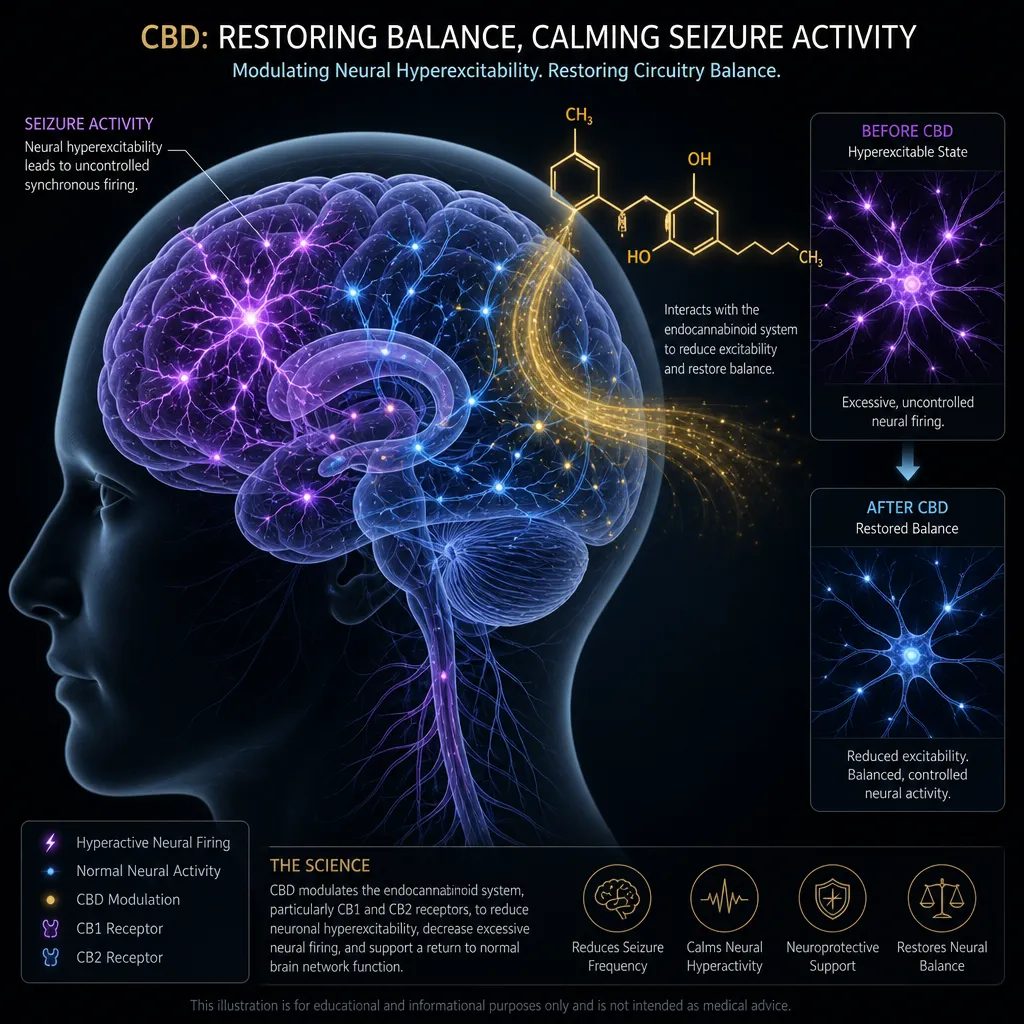
Unlike many anti-seizure medications that target a single mechanism, CBD works through multiple pathways — what pharmacologists call "polypharmacology." This may explain why it works for some patients who don't respond to single-mechanism drugs.
The Key Mechanisms
1. TRPV1 Channel Modulation — CBD activates and then desensitizes TRPV1 (the same receptor capsaicin targets), reducing neuronal excitability.
2. GABA System Enhancement — CBD indirectly enhances GABA transmission (the brain's main inhibitory neurotransmitter), reducing excessive neuronal firing without the tolerance and dependence risks of benzodiazepines.
3. Adenosine Signaling — CBD inhibits adenosine reuptake, increasing extracellular adenosine levels. Adenosine has natural anticonvulsant effects through A1 receptor activation.
4. Calcium and Sodium Channel Modulation — CBD modulates voltage-gated calcium channels and may inhibit sodium channels, similar to traditional anti-seizure drugs like phenytoin — but through a broader mechanism.
5. Anti-inflammatory Effects — CBD reduces neuroinflammation through PPAR-γ activation and decreases pro-inflammatory cytokines, which may protect against seizure-induced neuronal damage.
6. Mitochondrial Function — CBD may improve mitochondrial function in neurons, relevant for epilepsy syndromes involving mitochondrial dysfunction.
The honest caveat: the exact mechanism remains incompletely understood. CBD likely works through synergistic effects across multiple pathways rather than a single target.
What Conditions Respond Best to CBD
Strongest Evidence (FDA-Approved)
Dravet Syndrome: 43% reduction in convulsive seizures. Best responders have SCN1A mutations. Onset of effect typically within 2-4 weeks.
Lennox-Gastaut Syndrome: 37-42% reduction in drop seizures. Particularly effective for patients with frequent drop attacks.
Tuberous Sclerosis Complex: 47-49% reduction in seizure frequency. May also improve behavioral symptoms associated with TSC.
Emerging Evidence (Not FDA-Approved)
CDKL5 Deficiency Disorder: Small studies show promise; larger trials needed.
Atonic-seizure epilepsies: Case series suggest benefit, particularly for drop seizures.
Treatment-resistant focal epilepsy: Mixed results. The transdermal trial failed, but oral formulations may help a subset.
Poor Responders
- Absence epilepsy (limited evidence)
- Juvenile myoclonic epilepsy (insufficient data)
- Psychogenic non-epileptic seizures (not indicated)
Predictors of Good Response
- Genetic epilepsies (SCN1A, TSC1/TSC2 mutations)
- High baseline seizure frequency
- Younger age at treatment initiation
- Concomitant clobazam use (synergistic effect)
Side Effects: What the Trials Actually Showed
CBD for epilepsy is not side-effect-free. The clinical trials revealed a clear, dose-dependent side effect profile that's important for patients and families to understand.
Common Side Effects (≥10% incidence)
Serious Adverse Events
Hepatotoxicity (elevated liver enzymes): Occurred in 13-15% of CBD patients vs. 1-3% with placebo. The risk is higher with concomitant valproate use. Typically occurs within the first 3 months and is usually reversible with dose reduction or discontinuation. Monitoring requires ALT, AST, and bilirubin at baseline and periodically.
Discontinuation: 8-12% of patients in clinical trials discontinued due to adverse events, most commonly elevated liver enzymes, severe sedation, or GI effects.
Drug Interactions: A Critical Concern
CBD inhibits several cytochrome P450 enzymes — CYP3A4, CYP2C19, CYP2C9, and CYP2D6 — meaning it can interact with many anti-seizure medications.
The Most Important Interactions
Clobazam: CBD increases N-desmethylclobazam (clobazam's active metabolite) 3-5 fold. This can cause excessive sedation. The clobazam dose should be reduced by 25-50% when starting CBD. This interaction is actually thought to contribute to CBD's efficacy — the synergy is real but requires management.
Valproate: Increased risk of elevated liver enzymes. Monitor liver function tests closely. Avoid the combination if hepatic impairment is present.
Enzyme inducers (carbamazepine, phenobarbital, phenytoin): These can decrease CBD levels, potentially requiring higher CBD doses.
Topiramate, zonisamide: Possible increased levels; monitor for side effects.
Clinical Recommendations
1. Baseline liver function tests before starting CBD
2. Monitor LFTs at 1, 3, and 6 months, then periodically
3. Reduce clobazam dose when adding CBD (25-50%)
4. Watch for sedation when combining with CNS depressants
5. Therapeutic drug monitoring for narrow therapeutic index drugs
Dosing: How Much, How Often
Epidiolex dosing follows a specific protocol based on the clinical trials:
Starting dose: 5 mg/kg/day divided twice daily (2.5 mg/kg BID)
Titration: Increase by 5 mg/kg/day weekly based on tolerability and response
Target doses by condition:
- Dravet syndrome: 20 mg/kg/day
- Lennox-Gastaut syndrome: 20 mg/kg/day
- Tuberous sclerosis complex: 25 mg/kg/day (US max), up to 50 mg/kg/day (EU)
Important notes:
- Oral solution concentration: 100 mg/mL
- Consistency with food matters — high-fat meals increase absorption 4-5x, so take consistently with or without food
- Divided twice-daily dosing for stable blood levels
- Use the provided oral syringe for accurate dosing
For a 30 kg child at 20 mg/kg/day, that's 600 mg/day — a much higher dose than what's found in over-the-counter CBD products.
CBD vs. Over-the-Counter CBD Products
This is a crucial distinction. Epidiolex is pharmaceutical-grade, precisely dosed, and FDA-regulated. Over-the-counter CBD products are none of those things.
A 2017 study published in JAMA found that only 31% of commercially available CBD products were accurately labeled — 26% contained less CBD than listed, and 43% contained more. Some contained THC that wasn't listed.
If you or your child has epilepsy, using an unregulated CBD product instead of Epidiolex means you don't truly know what dose you're taking. For a condition where precise dosing matters — and where too little CBD may mean uncontrolled seizures while too much may mean toxicity — this is a real safety concern.
What About Non-Approved Epilepsy Types?
The FDA approval covers three specific syndromes. What about the millions of people with other forms of epilepsy?
The honest answer: the evidence is much weaker. The clinical trials that proved CBD's efficacy were specifically for Dravet, LGS, and TSC. There's some evidence for CDKL5 deficiency and other rare genetic epilepsies, but no large-scale trials.
Neurologists do sometimes prescribe Epidiolex off-label for other epilepsy types, and some patients report benefit — but this is clinical judgment, not evidence-based practice.
The Bottom Line
CBD for epilepsy is the gold standard of cannabinoid medicine. It's the one condition where the evidence is so strong that the FDA — historically cautious about cannabis-derived products — approved it.
But the reality is more nuanced than the headline:
- It works for specific severe epilepsy syndromes, not all epilepsy
- The doses used are much higher than what's in commercial CBD products
- Drug interactions are real and require medical supervision
- Side effects, particularly liver enzyme elevations, require monitoring
- It reduces seizures — it doesn't cure epilepsy
If you or someone you love has epilepsy and is considering CBD, talk to your neurologist. If you have Dravet syndrome, Lennox-Gastaut syndrome, or tuberous sclerosis complex, there's strong evidence that CBD can help. If you have another type of epilepsy, the conversation is more nuanced — but still worth having.
CBD isn't a miracle for epilepsy. It's a medication — one that went through the same rigorous testing as any other FDA-approved drug and emerged with clear evidence of efficacy and a defined safety profile. That's actually more impressive than a miracle. It's science.
If you're exploring CBD for epilepsy, our [CBD Product Finder Quiz](/quiz) can help you understand what types of products exist — but always work with a neurologist for seizure management.
Find Your Perfect CBD Product
Take our 2-minute quiz to get personalized recommendations based on your needs.
Take the Quiz →Disclaimer: This article is for informational purposes only and does not constitute medical advice. CBD products are not FDA-approved to treat, cure, or prevent any disease. Always consult with a qualified healthcare professional before starting any new supplement, especially if you have a medical condition or take medications.