CBD Balm vs Cream vs Salve: Which Topical Is Right for You? (2026 Buyer's Guide)
You're on a product page at 10pm. Your lower back has been tight all week, and you've finally decided to try a CBD topical. But now you're stuck on a question that sounds simple and isn't: should you get the balm, the cream, or the salve? They all promise relief. They all look similar in a product photo. And the price tags are close enough that you can't just pick the cheapest one and move on.
Here's the honest truth: the differences between balms, creams, and salves are real, and they matter — but not in the way most marketing suggests. The base ingredients change how each one feels, how fast it absorbs, how long it stays put, and where it works best. Pick the wrong format and you might end up with a greasy residue on a tube you never finish. Pick the right one and it becomes the product you repurchase for years.
In this guide, we'll break down exactly what separates a CBD balm from a cream and a salve, how absorption actually works (including what topicals can and can't do), which format fits which situation, how to read a label like a pro, and how to compare prices per milligram so you never overpay. If you want a broader overview first, our complete CBD topicals guide covers the full landscape, and our hands-on review of the best CBD topicals for pain tests specific products against this framework.
Quick Answer: Match the Format to the Job
If you only read one section, make it this one:
- Choose a balm if you want concentrated, targeted relief on a specific spot — a knee, a wrist, a knuckle — and don't mind a thicker texture that sits on the skin longer
- Choose a cream if you want fast absorption over a larger area — a full lower back, both shoulders, post-workout legs — with a lighter, lotion-like feel
- Choose a salve if you want the middle ground: oil-based and nourishing like a balm, but softer and easier to spread, with many formulas doubling as everyday skin care
There's no universally "best" format. There's only the best format for where you'll apply it, how often, and how much mess you're willing to tolerate.
What Each Format Actually Is
The differences come down to the base — the carrier ingredients that hold the CBD and determine how the product behaves on your skin.
Balm: Wax-Based and Concentrated
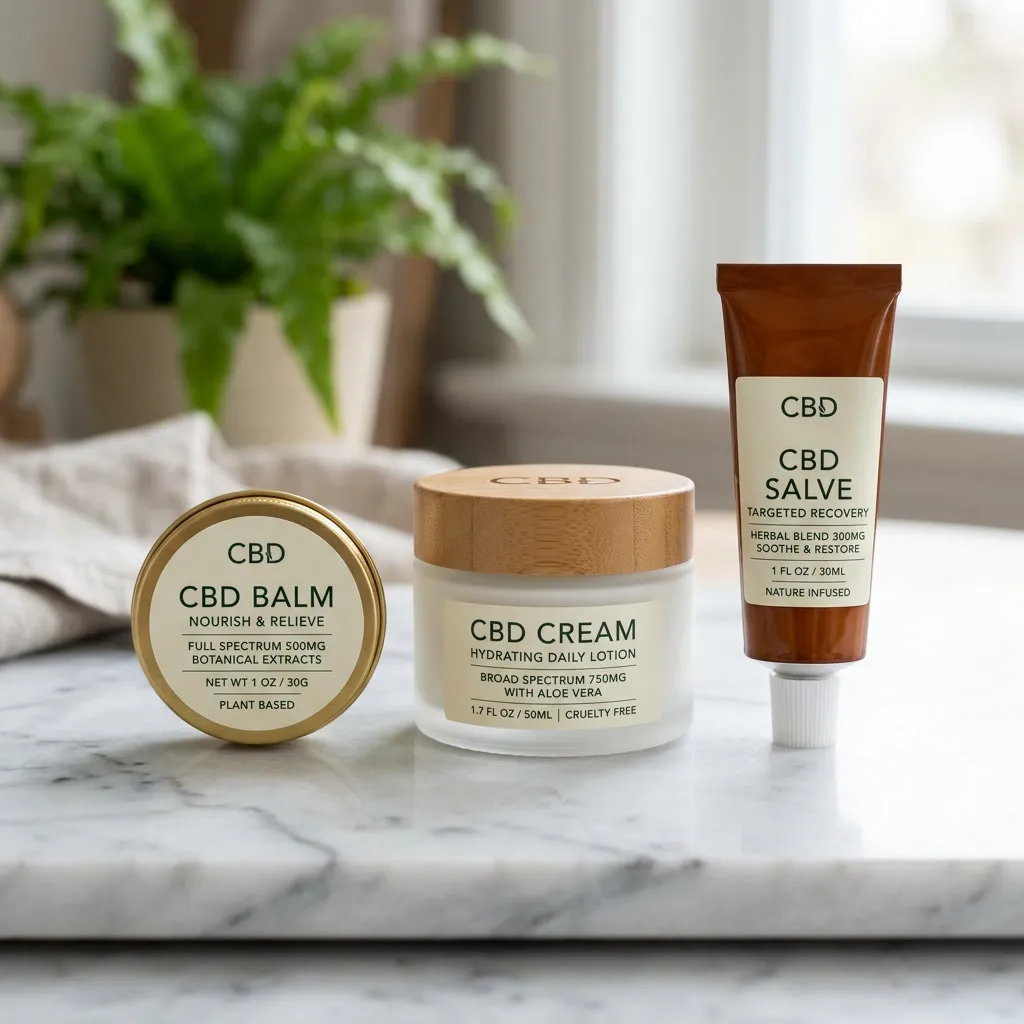
A CBD balm is built on a wax-and-oil base — typically beeswax or candelilla wax blended with coconut oil, shea butter, or hemp seed oil. The wax gives balms their firm, dense texture. That density means less product spreads per swipe, which concentrates both the CBD and the staying power in a small area. Balms tend to sit on the skin longer, forming a light occlusive layer that slows evaporation and extends contact time.
Real examples make this concrete: the Amberwing Organics CBD Pain Balm 750mg (available in Natural and Cooling Menthol versions) is a classic wax-based full-spectrum balm, while the GoGreen Hemp CBD Balm Salve 500mg–4000mg offers broad-spectrum options across a wide potency range.
Cream: Water-Based and Fast-Absorbing
A CBD cream is an emulsion — oil and water blended with the help of emulsifiers, much like a face lotion. That water content is the key difference: water evaporates, pulls other ingredients into the skin, and leaves almost no residue. Creams spread easily over large areas, absorb within minutes, and won't stain clothes the way oil-heavy formats can.
The Cannetics CBD topicals and creams collection is dominated by creams for exactly this reason. The FAB CBD Cream 1500mg (full-spectrum, $15.99) and the Diamond CBD 1,500mg Pain Relief Cream 4oz (isolate, $45.49) are both water-based muscle-and-joint formulas designed for larger application zones.
Salve: Oil-Based and Versatile
A salve is essentially a balm's softer cousin — an oil-and-herb base with little or no wax, or just enough to give it structure. Salves are softer at room temperature, melt on contact with skin, and spread more easily than balms while still leaving more of a nourishing, emollient finish than a water-based cream. Many salves are formulated with herbal ingredients (arnica, calendula, comfrey) and marketed for both relief and skin conditioning.
The FAB CBD Salve 1000mg (full-spectrum, $14.99) and the A Gift From Nature CBD Skincare Salve 1000mg (isolate, $39.99) show the range: one aimed at sore muscles, the other at daily skin health. Same format family, different intended jobs.
How Absorption Really Works (The Honest Version)
Before we talk about which format "works better," we need to be honest about what a topical can do — because this is where marketing routinely outruns the science.
When you rub CBD into your skin, it absorbs into the local tissue and interacts with cannabinoid receptors and other targets concentrated in your skin. But very little CBD crosses into your bloodstream. This is a feature, not a flaw: it means a topical acts locally, right where you apply it, without dosing your whole system — and without any psychoactive effect. It also means a topical won't help much with system-wide issues like anxiety or sleep. If those are your goals, you want an internal format; our breakdown of CBD bioavailability and delivery methods explains why.
The 2023 systematic review on transdermal and topical cannabidiol trials in Cannabis and Cannabinoid Research concluded that the evidence base is promising but still early-stage, calling for larger and more standardized human trials (PMID: 35605018). A 2024 animal-model study in the same journal found that a 1% topical CBD gel produced significant analgesic and anti-inflammatory effects, supporting the local-action mechanism (PMID: 37669453). And a 2025 study in Pharmaceuticals found topical CBD improved pain and sleep quality in people with temporomandibular (jaw) disorders — a condition where targeted, local application is the whole point (PMID: 40732351).
What this means for format choice: the balm-vs-cream-vs-salve decision isn't about which one pushes more CBD into your blood. None of them do, much. It's about which one delivers CBD to the right local area, stays there long enough, and fits your routine well enough that you'll actually use it consistently.
Best Use Cases: Joints, Large Muscles, and Daily Skin Care
Balms Excel on Small, Specific Targets
The thick, occlusive texture that makes balms messy for large areas makes them ideal for pinpoint work:
- Arthritic finger and thumb joints, where you massage a pea-sized amount directly into the joint
- Wrists, elbows, ankles, and knees
- Temples and neck tension spots
- Anywhere you want the product to stay put — under a knee brace, before a workout, overnight
A 2025 randomized double-blind trial in Pain Management Nursing tested topical hemp seed oil on knee osteoarthritis and reported reduced pain in the treatment group, illustrating how well waxy, oil-based formats suit joint application (PMID: 39256070). Products like the CBDPure Muscle & Joint 500 are formulated specifically for this kind of targeted joint and post-workout use.
Creams Win for Large Areas and Active Days
Because creams spread thin and absorb fast, they're the format for:
- Full lower-back application (a balm would take a whole finger scoop and stay greasy)
- Both shoulders or an entire leg after training
- Daytime use under clothing — no stains, no shine
- Combining with massage, since the skin doesn't drag
If you're applying to more than a palm-sized area, a cream like the FAB CBD Cream 1500mg or the Biotech CBD Pain Relief Cream in the 4oz jar is simply more practical per application.
Salves Bridge Relief and Skincare
Salves earn their slot with versatility. The oil base doubles as skin nourishment, so a salve works on dry elbows, cracked cuticles, and rough patches while still serving sore spots. If you want one tin on the nightstand that handles a tight trapezius and winter-dry hands, a full-spectrum salve like FAB's 1000mg is the multi-tool of the three formats. For skin-focused goals specifically, research on cannabidiol in cosmetic dermatology has been building a case for CBD's role in skin health more broadly (PMID: 39369127).
Texture, Scent, and Mess: The Factors Nobody Warns You About
These practical factors decide whether a product lives on your shelf or in your gym bag.
Texture and residue. Balms leave the most residue — a slight waxy film that's fine under clothing but noticeable on your hands after application. Creams vanish completely, which is why they dominate daytime use. Salves sit in between: they melt in more than a balm but leave a soft, emollient finish rather than disappearing entirely.
Scent. Wax-based balms often carry natural hemp or added aromatics; the Amberwing Organics Cooling Menthol balm is deliberately scented for a cooling sensory effect. Creams are frequently fragrance-free or lightly scented. Salves with herbal ingredients (arnica, lavender) have a noticeable botanical profile. If you're applying at work or before a meeting, an unscented cream is the safest bet.
Mess and portability. Creams come in tubes and pumps — clean, TSA-friendly, no fingerprints in the jar. Balms and salves come in tins and jars, which means fingers-in-the-product (wash before touching your eyes) and a texture that softens in a hot car. Small trade-offs, but they add up over months of daily use.
💡 Pro tip: keep a cream at your desk or gym bag for big-area daytime use, and a balm or salve by the bed for targeted evening massage. Different jobs, different drawers.
How to Read a Topical Label Like a Pro
Topical labels are where marketing goes to hide. Here's what actually matters:
Total milligrams (mg). This is the total CBD in the container, not per pump. A 1500mg cream in a 4oz jar is stronger per gram than a 750mg balm in a 2oz tin — always compare mg relative to size. For targeted relief, most people do well in the 500–1000mg range in a small container; large-area daily use justifies 1500mg and up.
Spectrum: full vs broad vs isolate.
- Full-spectrum contains the full hemp extract including trace THC (under 0.3%) and other cannabinoids — the entourage-friendly option. The FAB CBD Cream and Salve, Amberwing Organics balms, and CBDPure Muscle & Joint are all full-spectrum.
- Broad-spectrum keeps other cannabinoids but removes THC — the GoGreen Hemp balms fall here, a good pick if you're cautious about THC for any reason.
- Isolate is pure CBD only — the Binoid Healing Cream, CBDfx Muscle & Joint cream, and Diamond CBD Biotech creams. Maximum predictability, zero THC.
Third-party testing. The certificate of analysis (COA) is non-negotiable. Confirm the tested potency is within about 10% of the label, THC content matches the spectrum claim, the report screens for heavy metals and pesticides, and the batch number on the COA matches your jar. If a brand won't show a COA for the exact batch you're buying, walk away — there's no acceptable excuse in 2026. Our full guide to choosing CBD topicals walks through COA reading step by step.
Supporting ingredients. Menthol and camphor add immediate cooling/warming sensations (nice, but they're not doing the CBD's job). Arnica, glucosamine, and emu oil appear in many formulas. And if you have sensitive skin, scan for fragrance and essential oils before buying.
Price Per Milligram: The Only Price Comparison That Matters
Jar sizes and prices are all over the map, so the only honest comparison is cost per mg of CBD. Here's how some real, currently listed products stack up:
Two lessons jump out. First, format doesn't determine value — brand and potency do. FAB's full-spectrum salve costs about the same per mg as their cream, while some premium tins cost four times more per mg than a budget cream. Second, higher-potency products are usually cheaper per mg, so buying the 1500mg jar instead of the 500mg one often saves money over time — as long as you'll actually use it before it expires (most topicals stay good for 12–24 months).
> Quick Take: A $30 jar of 1500mg cream at $0.02/mg beats a $25 tin of 500mg balm at $0.05/mg — if you don't specifically need the balm's texture. Calculate before you checkout, not after.
Balm vs Cream vs Salve: The Side-by-Side
Here's the whole guide compressed into one view:
If you're torn between two formats, choose by where you'll apply it more often than by anything on this table. A great cream you use daily beats a perfect balm that's too greasy for your routine.
Common Mistakes Topical Buyers Make
A few avoidable errors account for most disappointed reviews:
- Under-dosing the area. A rice-grain smear over an entire back delivers almost nothing per square inch. Apply enough to cover the area thinly, then repeat. Most "topicals don't work for me" stories are application problems, not product problems.
- Expecting systemic effects. A topical won't touch anxiety, sleep, or whole-body aches. That's what internal formats are for — see our bioavailability guide for the distinction.
- Judging in 10 minutes. Balms especially need 15–30 minutes and sometimes a second application. Give any product a full week of consistent use before verdicts.
- Skipping the COA. If the potency is fake, nothing else on this list matters.
- Ignoring spectrum on drug-test concerns. Even trace-THC full-spectrum topicals absorb minimally into the bloodstream, but if you're drug-tested and cautious, pick broad-spectrum or isolate for peace of mind.
Frequently Asked Questions
Is a CBD balm stronger than a cream?
Strength depends on milligrams, not format. A 500mg balm is weaker than a 1500mg cream and vice versa. Balms feel more concentrated because you use less product per application, but check the label mg per container — that's the only real strength measure.
Which absorbs fastest: balm, cream, or salve?
Creams absorb fastest — usually within a few minutes — because of their water content. Salves take longer, and balms linger longest on the skin. Faster isn't automatically better: the slower absorption of a balm extends contact time on a targeted joint, which some people prefer.
Can a CBD topical get into my bloodstream?
Only minimally. Topical (not transdermal-patch) products act locally on the skin and underlying tissue with minimal bloodstream absorption. That's why they don't cause a "high" and why they work best on specific, reachable areas rather than system-wide issues.
Can I use a CBD salve on my face?
Some skincare-focused salves are formulated for facial use, and CBD has genuine research momentum in cosmetic dermatology (PMID: 39369127). But check the ingredient list first — balms with essential oils or menthol can irritate facial skin. For daily facial use, a dedicated CBD skincare product is a safer choice than a muscle-relief balm.
How much CBD topical should I apply?
There's no standard dose for topicals because absorption is local. Practical guidance: cover the area with a thin layer — roughly a pea-sized amount for a joint, a fingertip's worth for a larger muscle group — and reapply 1–3 times daily as needed. Consistency over a week tells you more than any single application.
Do balms, creams, and salves expire?
Yes. Most CBD topicals last 12–24 months unopened, less once opened, especially for water-based creams (water shortens shelf life). Store them cool and dark, and discard anything that has changed color, separated, or smells off.
Bottom Line
Balm, cream, and salve aren't competing products — they're three tools for three jobs. Pick a balm when you want concentrated, staying-power relief on a specific joint or tight spot. Pick a cream when you're treating bigger areas, dressing afterward, or applying post-workout. Pick a salve when you want one versatile product that handles mild soreness and everyday skin care. Whatever you choose, the same rules decide quality: verified third-party lab results, honest milligram labeling, and a price per milligram that survives a quick calculation. Browse the full Cannetics CBD topicals and creams collection to compare formats side by side, or start with our tested picks for the best CBD topicals for pain. Your sore spots have been patient — pick the right tool and give them a week.
Citations
- Systematic Review on Transdermal/Topical Cannabidiol Trials: A Reconsidered Way Forward. Cannabis and Cannabinoid Research, 2023. PMID: 35605018
- Analgesic and Anti-Inflammatory Effects of 1% Topical Cannabidiol Gel in Animal Models. Cannabis and Cannabinoid Research, 2024. PMID: 37669453
- Expanding the Therapeutic Profile of Topical Cannabidiol in Temporomandibular Disorders. Pharmaceuticals, 2025. PMID: 40732351
- The Potential Role of Cannabidiol in Cosmetic Dermatology: A Literature Review. American Journal of Clinical Dermatology, 2024. PMID: 39369127
- Effect of Topical Hemp (Cannabis sativa L.) Seed Oil on Knee Osteoarthritis: A Randomized Double-Blind Controlled Trial. Pain Management Nursing, 2025. PMID: 39256070
Find Your Perfect CBD Product
Take our 2-minute quiz to get personalized recommendations based on your needs.
Take the Quiz →Disclaimer: This article is for informational purposes only and does not constitute medical advice. CBD products are not FDA-approved to treat, cure, or prevent any disease. Always consult with a qualified healthcare professional before starting any new supplement, especially if you have a medical condition or take medications.