CBD Gummies vs CBD Oil: Which One Should You Buy?
The Checkout Dilemma Every CBD Buyer Knows
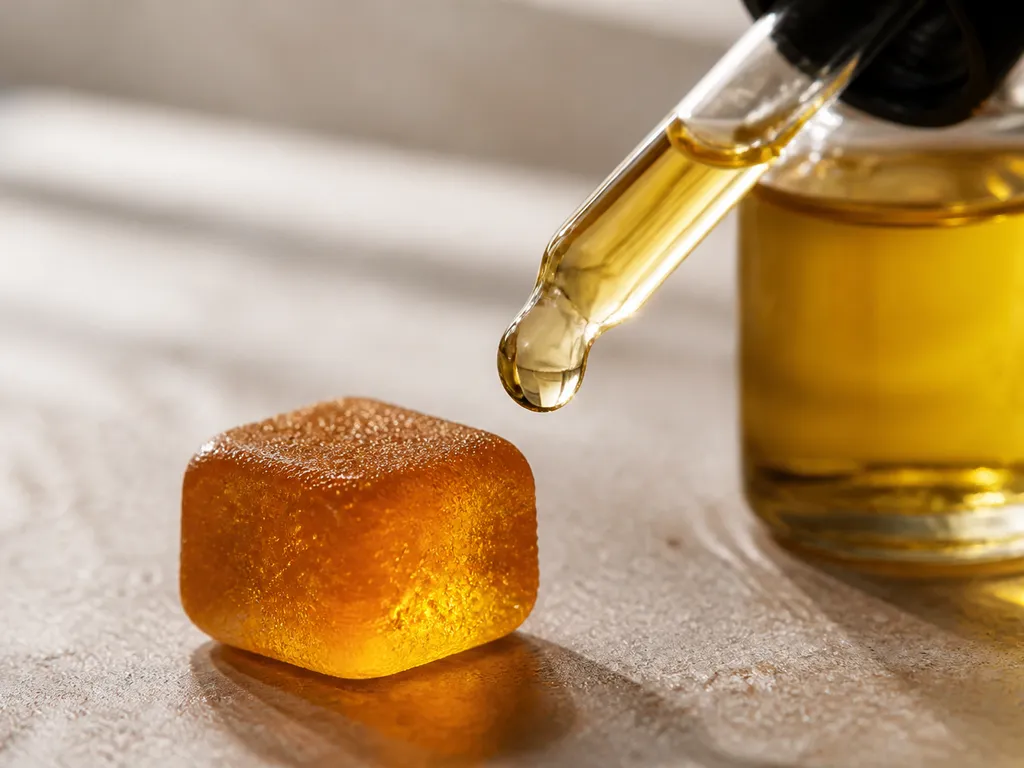
It's Thursday night, your cart is open, and you're stuck. In one tab: a jar of mixed-berry gummies that looks like something you'd actually enjoy. In the other: a dark amber bottle of CBD oil with a dropper and a dose chart that looks faintly like chemistry homework. They're both "CBD." They're both supposed to help with the same thing. And they cost about the same. So which one do you actually buy?
This is the single most common question first-time CBD buyers face, and honestly, it's a better question than most people realize. Gummies and oil aren't just two flavors of the same product — they differ in how fast they work, how precisely you can dose, how long the effects last, how much CBD your body actually absorbs, and even how well each one fits into a morning routine versus a bedtime one. The right answer genuinely depends on you: your goals, your schedule, and your tolerance for counting drops.
In this guide, we'll compare CBD gummies and CBD oil across every dimension that matters — onset speed, dose precision, taste, discretion, duration, bioavailability, and price per milligram — so you can walk away knowing exactly which format matches your situation. (And if you're still deciding between spectrums, our guide to full-spectrum vs broad-spectrum vs isolate covers that side of the label.)
Quick Answer: Match the Format to the Goal
If you want the short version before we dig in:
- Choose gummies if you want a pre-measured dose, great taste, and long-lasting effects — especially for consistent daily use or evening routines
- Choose oil if you want faster onset, flexible dosing, and more control over how much you take — especially if your needs vary day to day
- Many experienced users own both: oil for faster situational needs, gummies for steady all-day or overnight support
Now let's break down why.
Onset Speed: Oil Wins, Gummies Play the Long Game
This is the biggest practical difference between the two formats, and it comes down to anatomy. When you take oil sublingually (under the tongue) and hold it there for 60–90 seconds, some CBD absorbs through the blood vessels in your mouth and can begin working within roughly 15–30 minutes. Gummies, by contrast, are — well, food. They travel through your digestive system, get metabolized by the liver, and typically start working in about 45–90 minutes.
The food effect cuts both ways, though. A 2025 randomized crossover study in Scientific Reports found that taking a CBD extract with a high-fat meal significantly increased CBD's bioavailability and shifted its absorption into a distinct biphasic (two-wave) pattern. Translation: a gummy taken with or shortly after a meal doesn't just work more slowly — it can actually deliver notably more CBD into your system than the same dose taken on an empty stomach. That's a genuine advantage of the edible route that most people don't know about.
So the rule of thumb: if you need CBD to be "on" relatively quickly (before a meeting, after a workout, winding down at night), oil is the faster tool. If "within the next hour or so" is fine and you want steady background support, gummies are simpler and can absorb more efficiently when paired with food. If your priority is sleep specifically, timing matters even more — our CBD for sleep guide walks through working backward from your bedtime by a full hour.
Dose Precision and Consistency: Gummies Are Calculated for You
Here's a quiet problem with oil that nobody mentions at checkout: most people can't measure it accurately. Even with a good dropper, saying "I took half a dropper" doesn't tell you much — droppers vary by brand, oil viscosity varies by formulation, and a half-full dropper is rarely half the stated volume. Studies of real-world CBD products keep finding that labels don't always match contents. A 2024 analysis in Frontiers in Pharmacology that tested commercially available CBD products for labeling accuracy and contamination found meaningful discrepancies between what labels claimed and what products contained. A 2026 study in the Journal of Cannabis Research used HPTLC analytical validation on commercial CBD oils and similarly identified label-accuracy issues in some products.
A gummy sidesteps all of that. Each gummy is a fixed, known dose — 10mg, 25mg, 50mg — carved at the factory. If you take one gummy tonight and one tomorrow night, you know you got the same amount both times. That consistency matters when you're first figuring out how CBD affects you, and it's why our CBD dosage by weight guide recommends starting low and tracking your response: that's dramatically easier when every dose is identical.
Oil's flexibility cuts the other way. One advantage of a dropper is that you can take 8mg today and 20mg tomorrow if your needs change — something a fixed-dose gummy simply can't do. Precision versus flexibility is the real trade here.
Bioavailability: The Science Behind How Much CBD You Actually Get
Bioavailability — the fraction of a dose that reaches your bloodstream — is where CBD formats get genuinely interesting, and where the marketing claims get messy.
CBD is notoriously difficult to deliver. A 2023 review in Phytotherapy Research examined nanoformulation strategies specifically designed to overcome the delivery limitations of cannabinoids, noting CBD's low and variable oral bioavailability as a core problem the industry is still trying to solve. When you swallow CBD (a gummy, or oil with juice), most of the dose gets destroyed by first-pass liver metabolism before it ever circulates. Sublingual oil partially bypasses that, and the 2024 Cannabis and Cannabinoid Research study comparing oil held under the tongue against oil swallowed in gelatin capsules found similar overall pharmacokinetic profiles in healthy males — a finding that suggests your holding technique under the tongue may matter somewhat less than old advice implies, and that swallowing oil isn't the disaster some product pages claim.
Two honest takeaways:
- Gummies taken with food may absorb better than gummies taken on an empty stomach — and possibly better than oil swallowed without food, based on the high-fat-meal findings above
- No format dramatically outperforms the others in everyday use; consistency of routine matters more than squeezing out the theoretical last few percent of bioavailability
If you see "10x bioavailability" on a label, a 2025 review in the European Journal of Pharmaceutical Sciences on CBD's overall risk-benefit profile is a good reminder that the field's delivery science is still maturing — treat superlatives with skepticism.
Taste: One of These Is a Treat
Not everything needs a study. Gummies taste like candy because they are candy. Oil, even in flavored versions, is still oil — grassy, earthy, and occasionally bitter, because CBD itself is bitter. If your partner or roommate won't take CBD because of the taste, gummies solve that problem completely.
The flip side: oil's taste is also its honesty. Flavored oils exist, and holding drops under the tongue for a minute or so is the fastest learned skill in this space. But if "I forgot to take it because it was unpleasant" describes you, the gummy wins on adherence — and a supplement you actually take every day beats a theoretically better one you skip.
Discretion and Convenience
- Gummies look like a vitamin or a candy. They're silent, spill-proof, need no water, and travel well — a bottle in a gym bag or desk drawer draws zero attention
- Oil requires a dropper, a mirror or steady hand, and a minute of holding still. It's not awkward at home; it's slightly more so at the office
On the other hand, oil wins portability of lightness — a 30ml bottle weighs a fraction of a gummy jar and generates no scent. Both are fine for discreet use in most real-world settings; gummies just edge ahead for total effortlessness.
Duration of Effects: Why Edibles Last Longer
Because gummies go through digestion and gradual absorption, their effects tend to come on slower but last longer — commonly in the range of 4–8 hours, versus roughly 2–4 hours for sublingual oil holding. The biphasic absorption pattern seen with high-fat meals extends this even further, which is part of why many people prefer an evening gummy over afternoon redosing with oil.
Practical mapping:
- Morning / daytime steady support → gummy with breakfast
- Fast situational needs (onset within ~30 min) → oil
- Overnight coverage → gummy 60–90 minutes before bed
For a deeper dive on dosing by body weight and goal, see our CBD dosage by weight guide, and for storing either format so it stays potent, our CBD storage and shelf-life post covers light, heat, and humidity rules.
Head-to-Head Comparison Table
Price Per Milligram: The Math Most Buyers Skip
Per-milligram pricing is where gummies sometimes lose, but not always as badly as people assume. Run this check on any product:
1. Divide total CBD by price (e.g., 1,500mg jar at $60 = $0.04/mg)
2. Do the same for the oil (e.g., 2,400mg bottle at $70 = $0.029/mg)
3. Compare like for like — same spectrum, same third-party testing
Oils frequently win on raw price per milligram because they have fewer manufacturing steps and no flavor/color matrix. But two factors narrow the gap. First, gummies taken with food effectively deliver more absorbed CBD per label-milligram, which partially offsets the price difference. Second, waste matters: if you overpour oil, miscount drops, or abandon a bottle you dislike the taste of, your effective price per milligram rises fast. Real quality signals count too — since testing repeatedly shows label inaccuracies in the market (per the 2024 and 2026 studies above), a certificate of analysis from an independent lab is worth more than a few cents off per milligram. Never buy format on price alone; buy verified content plus format.
Who Each Format Suits Best
Gummies are the better pick if you:
- Want zero effort and pre-measured doses
- Dislike the taste of hemp
- Take CBD as part of a daily routine (mornings or bedtime)
- Are giving CBD a first try and want consistency while you learn your response
Oil is the better pick if you:
- Need faster onset for situational use
- Want to fine-tune doses day by day
- Prefer minimal ingredients and no sugar
- Already know your dose and want maximum control
Many people ultimately keep both categories in rotation. Browse our CBD gummies and edibles and CBD oils and tinctures to compare milligram options side by side, or see CBD capsules and softgels if the flavor-free middle path appeals to you.
One myth worth retiring while you're here: stronger-format marketing often blurs into broader CBD claims — our CBD myths debunked post covers which claims actually have evidence behind them.
Action Steps
1. Define your "why" first — fast relief, all-day steadiness, or sleep support all point to different formats
2. Check the price per milligram, not per bottle — divide total CBD content by the price on every option you're considering
3. Verify the certificate of analysis — confirm the CBD amount per serving matches the label, since testing shows some products don't
4. If you pick oil: measure a few practice doses, hold under the tongue 60–90 seconds, and take at consistent times
5. If you pick gummies: take with a meal (especially one with some fat) to boost absorption, and count gummies when you dose
6. Start low — 10–25mg daily is a sensible starting range for most adults — and track effects for 1–2 weeks before changing anything
7. Give one format a full 1–2 week trial before switching; format-hopping every few days makes it impossible to know what's working
Bottom Line
There's no universal winner in the gummies-vs-oil debate — there's only the right format for your specific goal. Gummies deliver consistency, taste, and longer-lasting steady effects with zero learning curve, which makes them ideal for daily routines and bedtime. Oil delivers faster onset and dosing flexibility for people whose needs vary or who want to fine-tune. Use the comparison table above, crunch the price per milligram, verify the lab report, and match the format to your goal rather than to someone else's review. When you're ready to compare real options, our CBD gummies and edibles and CBD oils and tinctures pages make the milligram math easy.
Last updated: August 29, 2026
Find Your Perfect CBD Product
Take our 2-minute quiz to get personalized recommendations based on your needs.
Take the Quiz →Disclaimer: This article is for informational purposes only and does not constitute medical advice. CBD products are not FDA-approved to treat, cure, or prevent any disease. Always consult with a qualified healthcare professional before starting any new supplement, especially if you have a medical condition or take medications.