
Your Dog's Aching Joints: What CBD Evidence Actually Supports
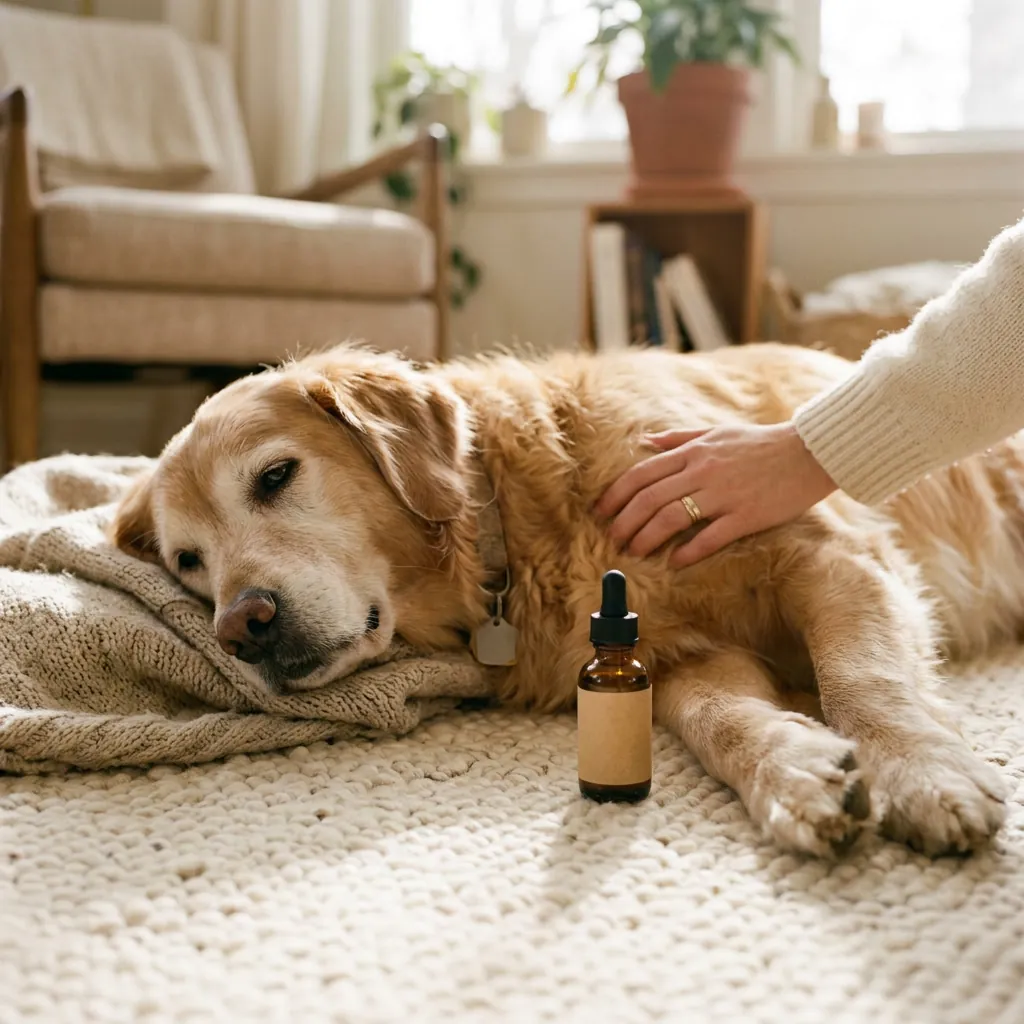
Your dog used to meet you at the door. Now he takes a beat longer to stand up, and the walk to the mailbox has become a negotiation. You have probably already done what most of us do, which is open a browser at eleven at night and type "CBD for dog arthritis" into the search bar. What comes back is a wall of cheerful product pages promising relief in a dropper. Very little of it tells you what the research actually shows, or where the research stops.
That gap matters, because arthritis is not a cosmetic problem. It is a progressive disease with real structural changes in the joint, and it hurts. Dogs are famously good at hiding pain, so by the time the limp is obvious, the disease has usually been developing for a while.
This piece is the honest version. We will look at what canine osteoarthritis actually is, what the two systematic reviews concluded, why one widely shared combination trial cannot tell us what CBD did on its own, and why the most important safety question involves the painkiller your dog may already be taking.
Canine Osteoarthritis Is Not Just Old Dog Stiffness
Osteoarthritis is a disease of the whole joint, not a thin layer of wear on the cartilage. The cartilage thins and breaks down, the bone underneath remodels and forms bony outgrowths, the joint capsule thickens, and the synovial fluid that lubricates the joint becomes inflamed. Pain comes from several of those sources at once, which is one reason a single drug rarely solves the whole problem.
It also is not simply a function of age. Age is a risk factor, and so are breed, body weight, previous injury, developmental conditions like hip dysplasia, and something as ordinary as a torn cruciate ligament years earlier. A lean Labrador and an overweight Labrador of the same age do not carry the same risk.
The clinical picture is easy to miss at home:
- Slower to rise after rest, especially in the morning
- Reluctance to jump into the car or onto the sofa
- Shorter strides or a subtle head bob
- Irritability when touched on the hips or shoulders
- Less interest in walks that used to be exciting
- Muscle loss over the hindquarters, which owners read as "just aging"
That last one is worth sitting with. Muscle wasting around an arthritic joint is a measurable sign of disuse and pain, not an inevitable part of getting older. It is one of the things a vet can track, and one of the things that can improve with proper pain control and controlled exercise.
The takeaway: osteoarthritis is a diagnosable, manageable disease. "He is just getting old" withholds treatment from a dog that could feel better.
What the 2023 Systematic Review Actually Found
The anchor paper here is a systematic review by Patikorn and colleagues, published in Frontiers in Veterinary Science in 2023, on the efficacy and safety of cannabidiol for canine osteoarthritis. A systematic review is a higher tier of evidence than a single trial, because the authors search the literature systematically, apply predefined inclusion criteria, and assess the quality of what they find.
Here is the honest summary. The included trials were few. The sample sizes were small, often a few dozen dogs at most. The products were not standardized across studies, so the dose of CBD and the presence of other cannabinoids varied from one trial to the next. Outcome measures differed too, some relying on owner questionnaires, some on veterinarian assessment, some on objective measures like force plate gait analysis.
The direction of the findings was generally encouraging. Several trials reported reductions in pain scores and improvements in owner-rated mobility compared with placebo. The review did not find a safety signal that would rule out short-term use in healthy dogs.
But confidence was limited, and the review said so. A handful of small trials with heterogeneous products and subjective endpoints cannot support a strong claim about the size of the effect, or which dogs will respond, or what happens over twelve months rather than six weeks.
There is a useful framing paper worth naming here. Corsato Alvarenga and colleagues, writing in the Annual Review of Animal Biosciences in 2023, asked what scientific validation of CBD for dog and cat diseases should actually require. Their answer works as a checklist: a defined product with known cannabinoid content, a randomized and controlled design, objective outcome measures, adequate sample size, and replication by an independent group. Very few canine arthritis trials clear all five.
The pattern across this literature is consistent in direction and modest in strength. That is a real finding, and it is not the same thing as proof of a reliable clinical effect.
If a product page tells you CBD is "clinically proven" for canine arthritis, that is not an accurate description of where the evidence sits. "Promising but preliminary" is closer.
Where the Evidence Is Genuinely Thin
It helps to be specific about the gaps.
Duration. Most trials run for a few weeks. Arthritis is managed for years. We have little controlled data on months of daily use, including whether the effect holds and whether liver values drift.
Population. Trial dogs tend to be client-owned pets with moderate disease. Dogs with severe disease, kidney or liver disease, and multiple medications are frequently excluded. Those are exactly the dogs owners most often want to treat.
Formulation. CBD is not one substance in practice. Full spectrum extract, broad spectrum extract, and isolated CBD are different products with different cannabinoid profiles. A trial that used one cannot be assumed to describe another. This is a recurring problem the broader 2025 systematic review by Moreno-Lopez and colleagues in the Journal of Small Animal Practice highlighted when it looked across cannabis-based products for both dogs and cats.
Measurement. Owner-reported outcomes are meaningful, because the owner sees the dog every day. They are also susceptible to expectation effects when the owner knows the group assignment. Studies using both owner and veterinarian scoring, plus an objective measure, carry more weight.
Reporting. Small trials are more likely to be published if they show a positive result, and that publication bias inflates the apparent effect across a whole field.
None of this means the existing trials are worthless. It means the field is young, and the honest reading is that CBD is a reasonable thing to discuss with a vet while remaining clear that the evidence base is still being built.
The Krill Oil Trial and the Attribution Problem
In 2024, Soontornvipart and colleagues published a trial in The Veterinary Journal on a combination of cannabidiol plus krill oil in dogs with chronic stifle osteoarthritis. The result was positive, with improvements in the measured outcomes in the treated group.
This is where a lot of summaries go wrong. The product tested was a combination. When a combination product outperforms a control, you cannot attribute the effect to one ingredient. Krill oil is rich in omega-3 fatty acids, which have their own literature in joint support and inflammation. It is possible that the combination works better than either ingredient alone, which would be a genuinely useful finding. It is also possible that most of the measured benefit came from the krill oil.
To isolate CBD's contribution you would need a trial with at least three arms, CBD alone, krill oil alone, and the combination, plus a placebo. That is expensive and not what this study did.
So the fair statement is this. A CBD plus krill oil product improved outcomes in dogs with chronic stifle osteoarthritis in one 2024 trial. That is encouraging for that product. It is not evidence that CBD by itself produced the improvement.
This is not a criticism of the researchers. Combination products are what people actually buy, and testing them has practical value. It is a caution about how the result gets retold.
The Safety Question That Matters Most: CBD and NSAIDs
If your dog has arthritis, there is a good chance your dog is already on a nonsteroidal anti-inflammatory drug. Carprofen, meloxicam, grapiprant, and similar medications are the backbone of canine arthritis pain management, and for many dogs they work well.
So the real-world question is not "CBD or an NSAID." It is "CBD alongside an NSAID." That is a pharmacology question, not a marketing one.
In 2024, Talsma and colleagues published work in Frontiers in Veterinary Science evaluating CBD administration with and without NSAIDs. The study is important because it addresses the interaction directly rather than studying CBD in isolation in healthy dogs. The concern is twofold.
First, drug metabolism. CBD is processed in the liver by cytochrome P450 enzymes and can inhibit some of them. Many drugs, including several NSAIDs, are handled by the same enzyme family. Inhibiting those enzymes can raise the blood level of the other drug, which for an NSAID means more exposure and potentially more risk of the gastrointestinal and kidney effects that make NSAIDs worth respecting in the first place.
Second, liver values. CBD has been associated with elevated liver enzymes in some dogs, particularly at higher doses. An NSAID can also affect the liver. Two things that each stress the liver deserve careful monitoring when used together.
The implication is not "never combine them." It is "do not combine them by guesswork." A vet who knows both drugs are in play can choose a dose, schedule bloodwork, and watch for the early signs that matter, including vomiting, diarrhea, lethargy, and reduced appetite.
Important: Never start CBD on a dog who is taking a prescription painkiller without telling the prescribing vet. Never adjust or stop that prescription on your own either.
There is also a labeling problem worth naming. Independent analyses of hemp-derived products have repeatedly found that the CBD content on the label does not always match the bottle. If you do not know how much CBD your dog is actually getting, you cannot have a sensible conversation about interactions.
Dogs Are Not Small Humans With Fur
The most common dosing mistake is arithmetic. Someone reads that a 70 kg human takes 25 mg, divides by ten, and gives a 7 kg dog 2.5 mg. That reasoning has no pharmacological basis.
Dogs metabolize cannabinoids differently from humans, and differently from cats. Oral bioavailability in dogs is low and variable, so a large fraction of what goes in the mouth never reaches the bloodstream in a useful form. The half-life differs. The enzyme profile differs. Body composition and gastric transit time differ. A milligram per kilogram figure borrowed from human data tells you almost nothing about what a dog will absorb.
What the veterinary literature does suggest is that doses in trials have varied widely and the relationship between dose and response is not well characterized. There is no established, evidence-based dosing table for canine osteoarthritis that a pet owner can safely apply at home.
That is an unsatisfying answer, and it is the true one. It is also why the CBD dosage guide is framed as general orientation rather than a prescription, and why the number for your dog should come from your vet.
A few practical points that do hold up:
- Start low and go slow, and change one thing at a time
- Record the dose, the time, and the response every day
- Give a new product at least two to three weeks before judging it
- Do not stack multiple hemp products, because the doses add up
- Buy from a maker that publishes third-party cannabinoid testing
Keep a Mobility Log, Not a Feeling
Memory is unreliable, especially when you are emotionally invested in a treatment working. Owners who have just spent money on a product tend to notice the good days. A log protects you from that.
What to record, once a day, in under a minute:
- Time to rise from rest, in seconds or in plain words
- Distance walked without stopping
- Whether the dog climbed stairs, and how
- A pain score from 0 to 10, judged at the same time each day
- Appetite, stool quality, water intake, any vomiting
- The exact product, dose, and time given
Two weeks of that gives your vet something far more useful than "he seems a bit better." It also gives you a clean baseline if you later change medication.
Video helps too. A fifteen-second clip of your dog rising from the floor, filmed the same way each week, is objective in a way that memory is not.
The Emotional Part Deserves Acknowledgment
There is a reason this topic attracts so much hope and so much marketing. Watching a dog you love struggle to stand is genuinely painful. It is one of those small daily griefs, and it makes people willing to try almost anything.
That instinct is not foolish. It is love with a search bar, and it needs a partner. The most useful thing you can do is bring it to your vet as a question rather than a purchase. Ask whether the diagnosis is confirmed, whether the current pain plan is optimized, whether weight management and physical therapy have been discussed, and whether a hemp product is reasonable given the medications and bloodwork in front of you.
Arthritis management is rarely one thing. It is a stack, including weight control, controlled exercise, joint support, rugs on slippery floors, a ramp into the car, and prescription analgesia when needed. CBD may be one small part of that stack for some dogs, and may be irrelevant for others. Both outcomes are acceptable. The dog is the point, not the product.
If your dog is also anxious at the vet or during thunderstorms, that is a separate problem with its own evidence base, covered in our guide to CBD for dog anxiety. And if you are new to the category entirely, the broader CBD pets guide covers product types, quality signals, and what to ask a manufacturer.
Action Steps
- Book a vet visit to confirm the diagnosis rather than assuming arthritis. Ask about pain scoring, muscle mass, and whether imaging is warranted.
- Bring a list of every medication and supplement your dog takes, including dose and frequency.
- Ask whether bloodwork is advisable before adding anything new, particularly liver and kidney values.
- Start a daily mobility log two weeks before you change anything, so you have a clean baseline.
- If you and your vet decide to try a hemp product, choose one with published third-party testing, start low, and change one variable at a time.
- Recheck with your vet in four to six weeks and bring the log.
- Never reduce or stop a prescribed pain plan on your own, even if the dog seems better. Improvement may be the treatment working.
If you want to see what quality-tested options look like, our CBD for pets collection lists products with batch documentation. If your dog is facing surgery, the post-operative guide covers a related set of questions about timing and medication.
Bottom Line
Canine osteoarthritis is a real, progressive, treatable disease, and the fact that it is common in older dogs does not make it normal. CBD has a plausible mechanism, a handful of small trials pointing in a consistent direction, and two systematic reviews that describe the evidence as promising but preliminary. The strongest single trial in this space tested a CBD and krill oil combination, which means it cannot tell us what CBD did alone. The most important open question for most households is the interaction with NSAIDs, and that question has a real answer only with a vet who knows your dog's labs and prescriptions.
If you take one thing from this piece, take the sequence. Diagnosis first, baseline log second, veterinary review third, and product last. Your dog cannot tell you whether the limping is better this week. A log, a vet, and a little patience can.
Educational and information only, not medical advice. The app sells nothing and contains no affiliate links. Check with your doctor before changing anything about your health routine.